Choosing the right countertop is crucial in kitchen design or remodeling projects. A good countertop defines functionality and serves as an alluring focal point that guides the overall design of a Quartzite for kitchen.
Quartzite for kitchen countertops stands as a compelling option for those seeking functionality and aesthetics embodied in a natural stone. In this post, we are going to explore quartzite countertops and how they take kitchens to the next level. You can also find some practical maintenance tips, a few designer picks of quartzite slabs, and design tips.
What Is Quartzite?
Quartzite is a natural stone mainly used for countertops. It is formed by sandstones undergoing heat and pressure under the Earth. Quartzite stones are quarried in different parts of the world and cut to the desired dimensions. The surface is treated with special materials to add smoothness and shine, and the edges and corners are shaped.
Some people confuse Quartzite for kitchen with quartz. However, there is a big difference; quartzite is a natural stone while quartz is an engineered stone. So, quartzite offers you a unique natural look while quartz can come in a wide range of colors and patterns.
What Makes Quartzite Countertops Special?
Quartzite stones are reputable for their enduring style, unique color scheme, and inherent strength. However, there are other natural and engineered slabs offering similar perks as quartzite. Let’s look at why so many people are attracted to quartzite anyway.
Visual Appeal
Natural countertop materials like granite and marble are quite common as kitchen countertop materials. They are usually used for their classic elegance. Quartzite, on the other hand, is different as it adds a touch of modernism without compromising the elegant look. The translucent look, which adds glow and depth, is usually the most remarkable draw of quartzite countertops.
Veining on a quartzite slab is similar to that of a marble, but quartzite stones offer a calmer and softer style. Unlike the bold and speckled patterns on granite or quartz slabs, quartzite countertops have lighter hues, which makes the kitchen look more spacious.
Finally, for some homeowners, background consistency is an important factor when choosing a kitchen countertop. Granite stones offer unique patterns and colors, but they don’t offer background consistency as much as quartzite stones. Thus, quartzite stones look clean and uniform in comparison.
Excellent Functionality
Quartzite stones offer several benefits in terms of performance and functionality. One of the most remarkable performance perks of quartzite stones is, of course, incredible hardness and strength. Pressed under the Earth for many years, quartzite stones are super hard, and they make a very durable and resilient countertop material.
Quartzite stones are also heat and stain-resistant. Homeowners feel more secure putting hot pans or pots on their quartzite countertops compared to other materials. Stain resistance is another reason why quartzite is superior. Although the surface is slightly porous, it is still more resistant to staining than marble or granite countertops. If you consider sealing a quartzite countertop, you can have a completely non-porous kitchen countertop, which repels the liquids and stains away.
Low Maintenance
As for the maintenance, quartzite countertops are great. They require minimal upkeep. If you clean it regularly, your quartzite countertop can serve for many years to come. You can also consider sealing the surface periodically to keep the shine and stain resistance for a lifetime. Moreover, the enduring and timeless beauty through sealing costs a very small amount of money.
Top Picks And Some Décor Tips
Quartzite stones are gaining worldwide popularity these days. Their visual appeal is one of the greatest factors that homeowners consider when it comes to choosing a kitchen countertop for their home.
As you might already know, visual appeal greatly depends on the overall composition of the décor in a room or house. Here are some décor ideas with three of the most beautiful quartzite slabs.
Sea Pearl Quartzite
Sea Pearl is a luminous and smooth quartzite stone that can easily evoke a sense of serenity and elegance. It goes well with white or light gray cabinets. If you are into coastal interior, Sea Pearl Quartzite is for you.
Smoky Quartzite
Smoky Quartzite is a perfect décor element for those who love dramatic designs. The gray and black tones make it a perfect countertop option if you like a sophisticated look with great versatility. Countertops like Smoky Quartzite look amazing with charcoal gray cabinetry, warm wood accents, and stainless steel appliances.
Taj Mahal Quartzite
Taj Mahal Quartzite is reputable for its soft creamy surface. It can complement a wide range of kitchen design styles. The grounded feel and sense of sophistication make Taj Mahal Quartzite an excellent choice for kitchens. You can create a fantastic contrast using dark wood cabinets and brass hardware. Your Taj Mahal countertop will accentuate itself and the rest of the décor.
Quartzite for kitchenCountertops In Maryland
If you are looking for quartzite countertops in Maryland, US, you should definitely visit Landmark Surfaces. Landmark offers the best quality, a wide range of options, and highly competitive prices to its customers. You can find a lot of natural and engineered stones for your kitchen, bathroom, walls, floor, poolside…etc. Get in touch with Landmark Surfaces before starting any home remodeling project.
MSI, headquartered in California, US, is the largest distributor in the industry with a wide range of products, including quartz, porcelain, granite, mosaic tiles, and so on. However, the company is especially known for its quartz products. They produce durable and easy-maintenance quartz stones and send them to a lot of countries across the world. Homeowners prefer MSI products for many reasons, including a wide range of color options, affordability, and easy care and maintenance requirements. In this blog post, you will learn everything about MSI quartzstones.
MSI Products
MSI offers numerous solutions for home and commercial settings. A lot of dealers across the US provide their customers with MSI products. Although MSI is reputable for quartz MSI quartz slabs, there are other materials offered by MSI. Here are some outstanding products listed for you:
Quartz Products
Quartz Slabs: Quartz slabs are one of the most common products offered by MSI. Buyers use these large slabs for various purposes, such as kitchen countertops, bathroom vanity tops, accent walls, or backsplashes.
Prefabricated Quartz Countertops: Prefabricated slabs come in standard sizes, and they have standard edges. As they are ready-to-install Quartz slabs, they are perfect for quick installations.
Quartz Tiles: MSI Quartz tiles are ideal for bathroom walls, kitchen backsplashes, and bathroom floors. They are sleek and durable with little ton o maintenance.
Q Premium MSI Quartz Stones Collection
Q Premium is a special collection offered by MSI. The products are of the highest technology without compromising the beauty, durability, and affordability. Here are some captivating Q Premium Quartz products made for different purposes:
LumaLuxe:It is an exciting technology for those in love with ultra-bright surfaces. Kitchen lights create beautiful reflections on countertops.
Q Studio Collection: This collection is perfect for those looking for innovative colors and patterns on their slabs.
Warm Q Looks: Warm Q collection offers some of the best quartz countertops in warm tones. Warm tones go well with both traditional and modern kitchen and bathroom designs.
Marble Look Quartz: Being engineered stones, quartz slabs come with obvious advantages. However, some homeowners still want to have the look and feel of natural stones like marble. MSI offers high-quality quartz countertops that look like marble.
Concrete & Matte Looks: This is a special collection for those who love matte look rather than bright slabs. You can find stunning Quartz slabs with striking black and gray tones in this collection.
Q White Quartz Collection:Q White Quartz is another style-specific collection offered by MSI. Timeless and classic white quartz options.
Other Products
MSI listens to you and increases its product diversity to provide anything you might need during a home building or renovation. Here is a list of some products that MSI offers in addition to engineered and natural stones:
Sinks
Faucets
Pavers
Evergrass Turf
Lush&Low Maintenance Lawns
Swimming Pool Tile
Outdoor Tile
Cobbles
Stepping Stones
Flagstones
Advantages Of MSI Quartz
Quartz countertops are made of natural quartz pieces and resin additives. Depending on the technology and raw material used in the fabrication process, the quality of the quartz slabs can vary. MSI produces the highest quality quartz slabs for you. Here are the most distinctive advantages of MSI quartz:
MSI Quartz countertops are extremely durable. They can resist scratches, heat, or staining.
MSI Quartz countertops require no maintenance. Just install it and use it for a lifetime.
MSI Quartz countertops are non-porous. It means they never absorb spills or bacteria. You can easily wipe the surface without staining.
MSI Quartz countertops come in a large variety, with a lot of color and pattern options. You will surely find your dream countertop.
MSI Quartz countertops are eco-friendly. MSI uses recycled materials to save the environment for future generations.
Maintenance And Care
MSI quartz countertops are incredibly hard, non-porous, and durable. They don’t require vigorous maintenance or cleaning routines such as polishing, sealing, refacing, oiling..etc.
Nevertheless, avoid putting hot pans on your countertop. Use trivets and hot pads to save the surface from extreme heat. Also, make sure you wipe the spills away immediately. Although MSI quartz slabs are non-porous, certain chemicals can lead to dulling of the surface in time, and thus, staining.
Innovations
MSI is always seeking to enhance the product and service quality. To this end, innovation is highly important for the company. Thanks to cutting-edge technology and dedicated engineering, MSI Quartz Stones offer some of the coolest and strongest surface technologies in the market.
One distinctive example is the LumaLux. LumaLuxe is an exclusive technology that allows buyers to enjoy incredible depth in colors and light on the slab surface. LumaLuxe technology is an excellent way to add luxury to home and commercial settings.
If you have ever been interested in countertops, you must have already heard about Cambria® stone. It is one of the most popular quartz stone brands on the market. Even if you are not planning to get a quartz countertop at all, this beautiful countertop stone could sway you to quartz stones.
But what makes Cambria in quartz stones so special? Why are they so popular? In this blog post, you will find decent answers to these and many other fundamental questions about Cambria stones.
What is Cambria Stone?
Cambria is a luxurious quartz stone brand. Though quartz stones are already luxurious and generally expensive, Cambria is even a higher-end brand with regard to its beautiful look and incredibly durable composition. The use of Cambria quartz is not limited to countertops. You can see it on many other surfaces like floor tiles, backsplashes, vanity tops…etc.
What is Cambria Stone Made Of?
Cambria stones consist of natural, pure quartz with the addition of binders and pigments. Quartz is a very hard natural material, and it is a very common mineral on the Earth. Therefore, some patterns and colors on the quartz surfaces can look naturally like granite or marble stone. Such visual effects are possible with quartz during the manufacturing process. So, you can see various natural or abstract patterns and color schemes on Cambria quartz surfaces.
Is Cambria a Natural Stone?
Actually, it is an engineered stone. About 90% of Cambria quartz stone is composed of natural quartz. In order to bind quartz minerals together, they use special binders. Also, in order to give the stone different colors and patterns, they make use of various pigments during the manufacturing steps.
High-quality additives and natural quartz minerals are combined in the Cambria processing facility, and the product at the end of the procedure is a very hard, durable, nonporous, non-absorbent, and strong stone.
Where is Cambria Stone Used?
A wide range of use areas is another factor leading Cambria to be one of the most demanded products on the market. Although it is highly popular as a countertop option, you can see Cambria quartz as bathroom surrounds, vanity tops, fireplace surrounds, wet bar areas, or even windowsills. To make a long story short, wherever you need a durable, aesthetic, and nonporous surface, you can see Cambria.
Why Should You Choose Cambria Stone?
When it comes to stone surfaces, apparently there are numerous alternatives. Many people choose quartz among various alternatives, and among different quartz brands, they choose Cambria quartz. But why? The thing is there are certain advantages of Cambria quartz over other surface stone alternatives.
Beauty
Cambria quartz is available in 200+ design alternatives. You can find unique Cambria stone colors and patterns among a wide range of models as well as the classical designs looking like natural granite or marble stones. Since it is an engineered stone, you can be sure you will find the “beauty” among Cambria models.
Strong
Another advantage of being an engineered stone is that quartz stones are harder than even granite or marble. Cambria quartz is one of the best examples of it. The hardness of these stones will remind you of that of a diamond.
Non-Absorbent
Cambria surfaces are NSF 51 certified, which means they don’t do harm to the food it contacts. In addition, its nonabsorbent surface doesn’t allow bacteria to settle on your countertops or backsplashes. The nonporous and nonabsorbent structure of Cambria quartz will keep you and your loved ones safe.
Maintenance Free
Unlike granite or marble stones, you don’t have to seal or polish the quartz stones due to their nonporous surfaces. It also brings along the advantage of easy cleaning. You can simply clean the Cambria surface with a little bit of warm water.
Stain Resistant
As mentioned above, a Cambria countertop is nonporous and nonabsorbent, which means no stain can leak beneath the stone surface. Thus, if you spill coffee, tea, or any other liquid, the stain will stay on the surface rather than penetrate into the stone.
Guaranteed
Cambria offers you a lifetime warranty against any defect or damage. You can easily submit a claim by calling them. Though it is rare to see any defect or damage, it feels much better to enjoy your quartz stone with confidence anyway.
How Much Does Cambria Stone Cost?
Many homeowners prefer Cambria because of its high quality and lifetime warranty. Therefore, Cambria stone price usually becomes of secondary importance for the home owners. However, you can take $60 -$130 per square foot to have an idea of the price. Of course, the price range is big since the color, pattern, and thickness can have a factor in pricing.
Cambria Stone Showrooms in Virginia
Whether Cambria stone is a good choice for you would be clearer if you went to see and touch it. If you are located in Virginia and interested in visiting a Cambria stone showroom in Virginia, we have a bunch of alternatives for you.
When you visit one of the showrooms, you can also see granite countertops and marble countertops in addition to Cambria quartz stones. Therefore, it would be a good opportunity for you to compare different stone options at once.
Bottom Line
As one of the most demanded products on the market, Cambria stone countertops are really beautiful and functional. In addition, they come in hundreds of different colors and patterns, which can make your stone unique easily. So, you can make sure you will not see the same stone in your friends’ homes.Due to their engineered properties, they offer homeowners outstanding hardness, aesthetic beauty, and incredible durability. Buying a Cambria stone could be one of the best investments you can make in your house. You can find Cambria stones in many showrooms in your town.
Learn where quartz comes from, how quartz countertops are made, and why engineered quartz has become one of the most popular countertop materials in Virginia, Maryland, and DC homes.
You can see granite countertops everywhere. But have you ever thought, “where does granite come from?”
Nature is full of wonders, and granite is one of the most amazing things that nature offers us. In this post, you will learn where granite comes from and how it comes to your home. Also, the formation and various uses of granite might surprise you. Read on!
Key Takeaways
Versatile Use: Beyond its immense popularity for kitchen countertops, granite is a staple for monuments, luxury flooring, and outdoor landscaping.
Deep Earth Origins: Granite forms from slowly cooled magma rich in quartz and feldspar deep beneath the Earth’s surface.
Global Sourcing: Major granite-producing countries include Brazil, India, China, and Italy, each offering unique colors and patterns.
Domestic Quarries: The United States has rich granite reserves, with major quarries in Texas, Georgia, Massachusetts, and other states.
The Journey: Granite slabs undergo careful extraction, diamond-wire cutting, resin treatment, polishing, and precise fabrication before arriving at your kitchen.
How is Granite Formed?
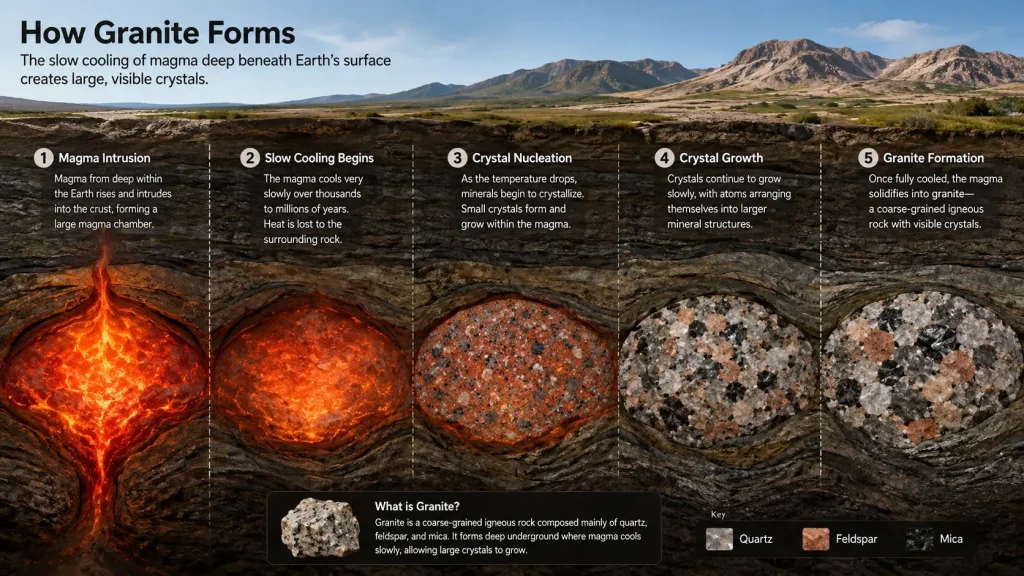
Granite is composed of organic minerals such as quartz, feldspar…etc. Of course, they were not solid stones touching each other many years ago but were lava under the Earth’s surface. So the minerals have crystallized slowly and become hard –but very hard- stones in various colors.
Color is another astounding detail about granite. The minerals give the granite stones mesmerizing colors. While red, pink, grey, and white are more usual, there are some rare colors like blue, green, gold, or black.
Why Is Granite So Durable?
The secret behind granite’s legendary durability lies in its geological formation. Because it cools extremely slowly deep within the Earth, the mineral crystals lock together tightly, creating an incredibly dense structure.
On the Mohs hardness scale, granite ranks between 6 and 7, making it harder than steel. This high density gives the stone natural scratch resistance against everyday kitchen activities and superb heat resistance. Unlike synthetic materials, granite can withstand hot pots and pans without scorching. It is a stone forged in the fires of the Earth, built to endure for generations.
Does Granite Come In White?
Not necessarily. Although there are many tones of white granite, granite comes in various natural colors including, black, brown, white, blue…etc. Actually, finding pure white granite is almost impossible, but there are white granites with black, gray, or brown shades on a white surface. You can find white ice granite, moon white granite, or white ice granite of this kind.
What Minerals Give Granite Its Color?
Have you ever wondered why one slab looks like a starry night while another is warm and pink? Granite’s color palette is determined entirely by its mineral composition. Here is a quick guide to what gives granite its distinct shades:
Mineral
Color Effect on Granite
Quartz
Milky White, Gray, or Clear
Feldspar
Pink, Red, or Creamy White
Biotite / Mica
Dark Brown or Jet Black
Amphibole
Dark Green or Black
If you want to explore the best shades for your kitchen remodeling, check out our comprehensive guide on Granite Colorsto find your perfect match.
Where Does Granite Come From?
As explained above, granite was melted rock or magma once upon a time. Today, people can mine granite in different parts of the world after millions of years, along with upheavals like tectonic movements and earthquakes.
Brazil, China, Italy, and India are some of the countries where granite quarries are located. Therefore, the granite countertop you buy for your home must be coming from one of these countries. Since each country has different geographical features, the color and some other characteristics of granites vary across the quarries in those countries.
For example, blue-colored granites that are mined in Brazil are the most expensive ones. There are also white and black granites in nature. While the white ones are more expensive, black granites are relatively affordable. In fact, their availability in the quarries and demand at certain times of the year can factor in the prices of different granites.
Which Countries Produce The Most Granite?
Granite is quarried globally, but certain nations dominate the international market due to the abundance and richness of their natural stone reserves:
Brazil: Famous for exotic, high-end granites, especially breathtaking blues and complex, multi-colored slabs.
India: Renowned for exceptionally durable dark granites, mesmerizing greys, and iconic fine-grained patterns.
China: A powerhouse in global production, offering highly consistent grey and white granites popular for both residential and large-scale commercial projects.
Italy: While famous for marble, Italy also boasts premium granite quarries and is home to the world’s finest stone processing technology.
Norway & Angola: Key players known for unique, iridescent larvikites and deep, mysterious dark granites.
Famous Granite Varieties Around The World
Because granite is a product of its specific local environment, specific regions yield world-famous varieties that homeowners seek by name:
Blue Bahia (Brazil): A rare, luxury stone with stunning, vibrant blue tones mixed with white and gold clusters.
Absolute Black (India): A flawless, deep black stone with virtually no pattern—perfect for sleek, modern designs.
Kashmir White (India): A classic variety featuring a crisp white background peppered with cranberry-colored garnets.
Viscount White: A dramatic, swirling wave of white, grey, and black that mimics the movement of marble but retains granite’s toughness.
Black Galaxy (India): A deep black background filled with golden-copper flecks that look like stars in the night sky.
Where Does Granite Come From In The United States?
The granite doesn’t always come from other countries. In the U.S, there are big quarries in some states like Texas, Massachusetts, Indiana, Georgia, and Wisconsin. If you ask, “where does black granite come from?” then the answer will be mostly other countries like India, Angola, or Scandinavia.
States Known For Granite Quarrying
The USA has a rich history of stone quarrying. Different states are famous for specific types of stone used across the construction industry:
State
Known For / Famous Variety
Georgia
Elberton Granite (The “Granite Capital of the World,” famous for uniform gray stone)
Texas
Pink Granite (Used to build the majestic Texas State Capitol building)
Massachusetts
Quincy Granite (Historically famous for dark, durable building stone)
Wisconsin
Red Granite (The official state rock, known for its deep red hue)
How Does Granite Come To Your Home?
Now that we have answered the question “where do granite countertops come from” we can talk about the journey of the granite slabs until they come to your house.
Mining the granite is just the beginning. They have a long journey before being one of the most beautiful pieces of art in your house.
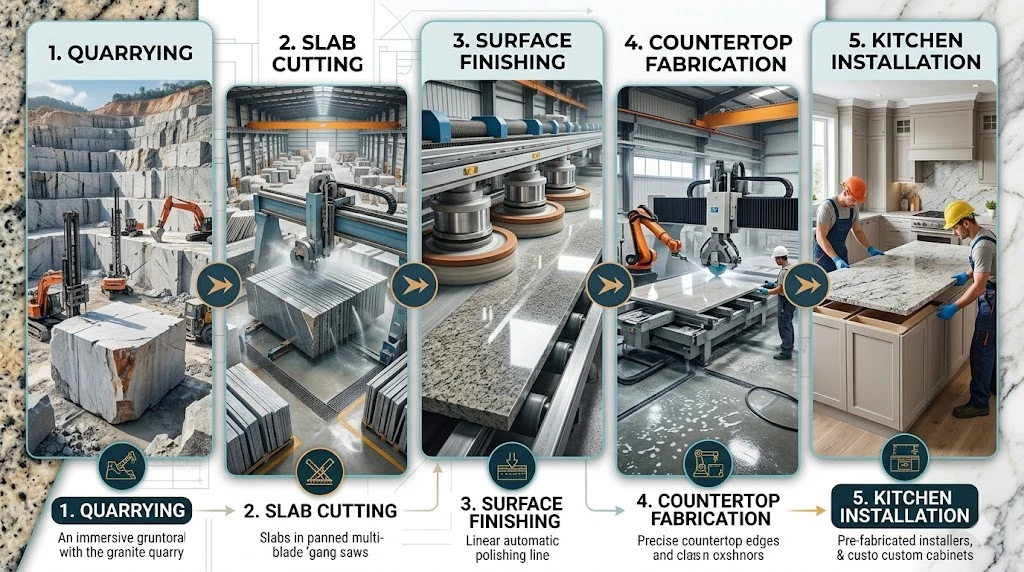
First, a large block of granite is cut out of the quarry, and it is controlled to make sure there are no major fissures, cracks, or similar imperfections. If the stone is thoroughly solid and flawless, it is cut into slabs on gang saws. The period of cutting is generally slow since granite is a very hard material.
Once the bulk of stone is completely slabbed, the slabs are coated with resin fills and then put into big industrial ovens. Hence, the minor fissures or imperfections on the surface can be filled properly. Then, the slabs are polished.
After polishing, the slabs are shipped to distributors in different places. Most granite stores buy their stones from one of those distributors. They usually prefer the one closer to their location so that they pay less for shipping.
The distributors or stores check the quality and perfection of the slabs and do some polishing to make them look shinier. They cut samples and/or take photos of the slabs in different colors and patterns to show to the customers.
When you go to the store, they show you the granite countertop colors and patterns that you can use in your kitchen or bathroom. The team goes to your place, and they measure the room and the area where you need the granite.
According to your needs and expectations, they work on the project to get your confirmation. Then, using the CNC router, they cut down the big slabs into smaller sizes, and desired finishing is applied according to the project. Now your granite is ready to install.
Granite Countertop Journey: From Quarry To Kitchen
To put this massive operation into perspective, here is the chronological step-by-step path every slab takes:
Quarrying: Drilling and shifting giant raw stone walls.
Slab Cutting: Slicing the blocks with diamond-wire saws into raw slabs.
Resin Treatment: Applying high-quality epoxy resin to fill micro-fissures.
Polishing: Buffing the surface to bring out the stone’s natural luster and deep colors.
Fabrication: Custom-cutting the slab to your kitchen’s unique dimensions and applying chosen Edge Profiles Guide.
Installation: Securing the finalized countertops perfectly in your home.
How Long Does It Take Granite To Form?
If you think the journey from the quarry to your home is long, it is nothing compared to how long it takes granite to form in nature. Granite is an ancient material. It takes millions of years of intense heat and immense geological pressure deep beneath the continental crust for magma to cool down and crystallize into the hard stone we see today.
In fact, some granite formations found on Earth today are estimated to be over 300 million to 1 billion years old! When you place your hands on a granite kitchen island, you are literally touching a piece of Earth’s ancient history.
What Is Granite Used For?
Granite is a natural construction, decoration, and architectural material. Though granite is widely used as kitchen countertops and bathroom vanity tops, there are some other uses of it. For example, some monuments are made of granite. Also, you can see granite at luxurious places as paving stones or building veneers.
Why Granite Remains Popular For Countertops
Even with dozens of new engineered materials hitting the market every year, granite remains an undisputed favorite for homeowners. It brings an unparalleled natural beauty that cannot be perfectly cloned in a factory. Granite isn’t the only premium natural stone homeowners consider. Marble is another timeless option, offering elegant veining and a luxurious appearance. If you’re deciding between these two natural materials, read our Marble vs. Granite Countertops comparison guide to compare their durability, maintenance, cost, and overall performance.
Because every block is formed by erratic geological events, every single granite slab is unique—no two kitchens will ever look exactly alike. Combine this distinct charm with a long lifespan that can easily outlast the house itself, and it’s clear why granite is still the gold standard for premium Kitchen Countertops.
Interesting Facts About Granite
Abundant Rock: Granite is one of the most abundant igneous rocks making up the Earth’s continental crust.
Ancient Masterpieces: The ancient Egyptians famously used granite to construct portions of the Great Pyramid of Giza, including the King’s Chamber.
The Curling Stone Secret: Professional Olympic curling stones are made almost exclusively from a unique, water-resistant granite found on a tiny island off Scotland.
Completely Unique: Because of the random crystallization process, your neighbor can never buy the exact same countertop pattern as yours.
Home Value Booster: Unlike synthetic alternatives, natural stone surfaces consistently retain their value and boost a home’s resale potential.
Frequently Asked Questions (FAQs)
Where does granite naturally come from?
Granite comes from deep within the Earth’s crust, where it forms from the slow cooling of molten magma. Over millions of years, tectonic movements and erosion push these granite formations closer to the surface, where they can be safely quarried.
How is granite formed?
Granite is formed when magma (melted underground rock) gets trapped beneath the Earth’s surface. Instead of erupting from a volcano, it cools down very slowly over millions of years, allowing large, visible mineral crystals to bind together.
What is granite made of?
Granite is an intrusive igneous rock primarily made of two essential minerals: Quartz and Feldspar. It also contains smaller amounts of other minerals like mica, biotite, and amphibole, which give the stone its distinct speckles and veins.
Which country produces the most granite?
Brazil, India, China, and Italy are the top global producers of granite. Brazil is highly valued for its exotic color variations, while India provides some of the world’s finest dark and dense granites.
Does granite come from volcanoes?
Not directly. Volcanic rocks (like basalt or obsidian) are extrusive, meaning they form from lava that cools quickly on the Earth’s surface. Granite is intrusive, meaning it forms entirely underground from magma and never erupts out of a volcano.
Is granite natural or man-made?
Granite is a 100% natural stone. It is harvested directly from nature and cut into shapes. This is different from quartz countertops, which are engineered in factories using crushed natural quartz crystals bound together with resins. Read our detailed comparison on Quartz Countertops vs. Granite to see which fits your lifestyle.
How long does granite take to form?
It takes millions of years for the underground magma pools to cool down completely and crystalize into solid granite stone blocks.
Where is granite quarried in the United States?
The United States has massive granite reserves, with major quarry operations actively located in Georgia (specifically Elberton), Texas, Massachusetts, Indiana, and Wisconsin.
Why is granite used for countertops?
Granite is highly sought after because of its incredible hardness (ranking 6-7 on the Mohs scale), scratch resistance, exceptional heat tolerance, and timeless natural beauty that engineered stones cannot perfectly replicate.
What colors does granite come in?
Granite comes in almost every color imaginable! While shades of gray, white, pink, and beige are the most common, you can also find gorgeous slabs of black, brown, gold, deep green, and rare, luxurious blues.
Bottom Line
Granite is one of the most stunning gifts of nature. It takes a long way for a granite countertop to reach your home. The journey is long, but it is absolutely worth it. If you are ready to choose the perfect stone for your next home upgrade, diving into a comprehensive Countertop Buying Guide is an excellent next step to plan your budget and style!
Marble serves to the human as one of the most common decorations and structural materials for ages. But have you ever thought, “where does marble come from?”
Homeowners all around the world prefer marble countertops for their elegance and easy access. Marble brightens up the dim bathrooms, adds a sophisticated look to the ordinary kitchens, and upgrades many other places with its strong nature and aesthetic beauty.
Some Practical Questions About Marble
You might be wondering about the marble when it is still under the Earth’s surface or its journey to our houses. In this post, you will learn about marble, including how it comes to our homes. As you read through the article, you will understand how marble can survive the test of time. Enjoy!
What is Marble?
Being a metamorphic rock, marble is a very common natural stone that has been in use for ages. Though many people are familiar with this stone from the marble countertops in their houses, marble has been the essential material for constructions, graves, decoration, sculpture, and various decorative works. Additionally, marbles can vary in colors and patterns like white, gray, cream, black…etc.
How is Marble Formed?
Marble is a natural stone that comes into being through a metamorphosis under the Earth’s surface. The extreme heat and pressure cause the carbon minerals in the rock to recrystallize. This crystallization also affects the minerals in the rock and fossilized minerals in the limestone, and they turn into calcite. As the heat increases towards the hot igneous rock, the amount of interlocking crystal mosaics of carbonate increases and makes bigger marble stones.
In different parts of the Earth, there are convergent plate margins that supply the marble to the world. The marble reserves are usually hundreds of meters thick, and they range under huge geographical regions.
Where Does Marble Come From?
Marble can be found in different parts of the world. However, some countries have ample amounts of quarries, and they have bigger fame in the marble industry. For example, Turkey, Italy, Spain, China, and India supply half of the world’s marble. Some other countries export marble to the world, such as the United States, Greece, Belgium…etc.
Where Does Marble Come From In The United States?
There are marble quarries in different parts of the U.S., like Vermont, Texas, and Georgia. Especially, the one in Vermont is the biggest quarry in the U.S.
According to stonenews.eu, the U.S. imports a great deal of marble from Turkey, China, Mexico and Italy to supply the demand in the country.
Why are Marble Surfaces Popular?
Marble surfaces are highly popular all around the world. You can see marble in various places ranging from ancient Greece to the Washington Monument in the U.S. It is also one of the most popular countertop materials indoors. The same material has been used for ages, and they are still standing soundly, so we can understand that durability is the key here.
When it comes to countertop and other indoor uses of marble, easy maintenance, elegant look, and easy access are some of the factors that make marble surfaces so popular.
What Colors Does Marble Come In
Composed of limestone, the marble should be a light-colored stone-like white or cream. However, some minerals that the majority of the marble rocks involve add second or third colors or patterns to the marble. Therefore, we can see black, yellow, gray, or pink colors in marbles due to the clay minerals or iron oxides.
How Durable is Marble?
Marble is a highly durable material. You can use it for a lifetime. Once it is installed properly, you can be sure that your countertop is heat resistant, easy to clean, and incredibly beautiful. If you are concerned about the scratches, you should seal them frequently since the marble surface is less resistant to scratches or cracks compared to other natural stones like granite or quartzite.
Where Does Calacatta Marble Come From?
Although marble is classy and beautiful in all sorts, some marble types are quite more valuable than others. Calacatta marble is one of a kind marble with exceptionally intricate veins. The background is so white, and the veins are much more clear than other marble stones.
Calacatta marble is quarried in the Carrara region in Italy. Since the supply is very limited due to the more challenging quarrying conditions, it is rare, and the price of a Calacatta marble is higher than others.
Bottom Line
Marble is one of the most functional materials that human beings hold. It is part of our history, our present, and most probably our future. We know many things about it, yet there are still things to know about this amazing natural stone.
Laminate countertops are generally preferred by some homeowners due to their affordable costs compared to other countertop alternatives. Also, DIYers prefer laminate kitchen countertops since the installation requires less craftsmanship.
Nevertheless, laminate countertops are away from being a smart countertop choice, not even close. Although you can find good bargains such as lowes laminate countertops or shiny-looking ads like home depot laminate countertops, the following post will tell you about why you should consider other alternatives instead of laminate.
What Is A Laminate Countertop?
Laminate countertops are a mixture of plastic and resin. The mixture is laminated on paper or particleboard. Generally, the lamination copies some natural stones like granite or marble.
The kitchen sinks or bathroom sinks can be under-mounted by some manufacturers during the production; however, you need to buy a drop-in sink in many cases. Formica® and Wilsonart® are famous brand names, and many people even think that they are material names similar to laminate.
As the brand names might suggest, laminate countertops were very popular between the 40s and 60s. They are still available today since they look like granite countertops, not the quality. Being cheap and easy to install, laminate countertops appeal to DIYers with tight budgets.
How Thick Are Laminate Countertops?
Laminate countertops are usually composed of three layers. The first layer is the base made of heat-fused kraft paper sheets compressed on each other. The second layer is foil or printed paper giving the laminate the color and pattern that you see on the surface. Finally, on the top of them, a protective top layer is applied. This layer is transparent, and you can see the second layer through the third layer.
All of these layers are fused onto each other in the production process. The total laminate countertop thickness is generally 1,5 inches, but the manufacturers can also produce custom-made thickness in laminate countertops. Some people prefer to mimic the natural stone countertops or butcher’s block wood countertops with their laminate countertops so that they can use slightly different thicknesses like 1,16 inches.
How Much Are Laminate Countertops?
The cost of a square foot laminate countertop ranges from $20 to $60. Therefore, it makes laminate countertops one of the cheapest alternatives. Although the price can vary depending on the color and pattern selection, these countertops are mainly preferred due to their relatively affordable prices.
Why Should You Avoid Laminate Countertops? (INFOGRAFİK)
Any countertop is supposed to serve as a storage area, a cutting surface, or a decorative element in the kitchen design. There are many countertop options on the market, and laminate countertops are one of the least expensive ones. However, laminate kitchen countertops fail to serve as an ideal countertop option due to the following reasons. In order to help you understand the issue better, we will refer to the laminate vs. granite comparison when needed.
1- Appearance
Some companies manufacture laminate countertops, and they tend to mimic the patterns and colors of granite stones. However, granite stones are completely natural, and since the mineral compositions vary in nature, it is hardly possible to find two exactly the same granite countertop color or pattern.
It means laminate countertops cannot offer you a unique appearance. Instead, you have to buy one of those uniform appearances dictated by the producer company.
2- Heat Resistance
You can never put hot items on a laminate countertop. If you buy a laminate countertop, you will be advised to use a heating pad between the hot items and the laminate countertop. This might sound practical at first, but you may be tired of this in the long term. However, granite or any other stones are resistant to heat, so you can directly put your hot items on them.
3- Hardness
Laminate countertops are one of the least hard countertop alternatives you can get. They are made of softer materials such as paper and plastic, and thus they are not as hard as other countertop alternatives such as granite or quartz. However, laminate countertops are highly prone to cracks or water damages due to their softer structure. Granite, quartz, or marble is hard, and they are more resilient to damages.
4- Sinks
Many people prefer under-mounted sinks over drop-in sinks as under-mounted sinks give a more integrated look. Although some special laminate countertops can provide you with an under-mounted sink, most of the laminate countertops require a drop-in sink.
Even if you buy a laminate countertop with an under-mounted sink, the installation needs more professionalism and delicacy, so the DIY option is crossed out, which is normally one of the most significant advantages of laminate countertops. On the other hand, under-mounted sinks are widespread in other stone-originated countertops.
5- Durability
The durability of the laminate countertops is closely related to the vulnerable surface due to the poorer hardness they offer. Unfortunately, durability is a big problem for many laminate countertops on the market.
Since the surface is laminated industrially, it can be delaminated in time due to applying excess water combined with some chemicals for maintenance. Also, cracks on the surface make it easier to be peeled. Granite and other stones, on the other hand, offer you greater hardness and thus durability.
6- Maintenance
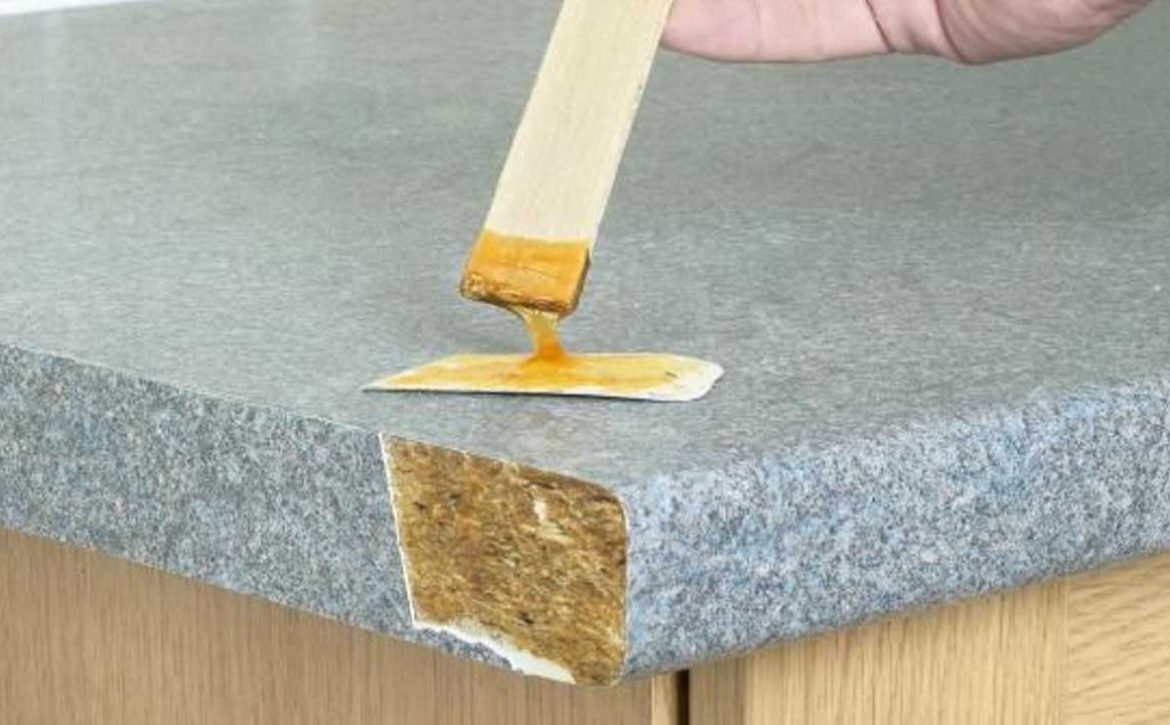
Although laminate countertops are supposed to be low-maintenance countertop alternatives since they don’t require sealing, they are still more problematic when it comes to maintenance. Since they are scratched easily, you will need to repair them with some special repairing kits.
Considering the good bargain it offered at first, you can tolerate this countertop restoration job for a while. However, it will not take a long time for you to get tired of this.
7- ROI (Return on Investment)
Whatever improvement you make in your house, you should always think if your investment will add value to your home. Although laminate countertops are relatively inexpensive, they don’t look attractive after a few years of use. Thus, when you want to sell your house, laminate countertops may affect your selling negatively, as most homeowners would like to have a granite countertop rather than a laminate.
Bottom Line
Many people buy a new house or get a new kitchen only a few times or less in their lives, and the cheaper doesn’t mean the better. But, by avoiding laminate countertops, you can make the most of your countertops and kitchen.
Choosing a countertop for your newly remodeled kitchen or bathroom is a lot of fun. However, it’s a serious business. After all, there is a considerable investment involved and it is a commitment that will stay for a long time with you. If you wish to choose quartz as your countertop option, you must know about several quartz countertops pros and cons before making the final decision.
Quartz is relatively new when compared to other countertop options like granite. Still, it has managed to become a popular household name due to its characteristics. Unlike other natural stones like granite or marble, quartz is an engineered stone. Further, this opens up new possibilities for flexibility and purpose. Now let us look into its benefits and limitations as a countertop option.
Quartz at a Glance
Photo by Sidekix Media on Unsplash
Quartz is an engineered stone as they contain a ratio of 93% crushed quartz and 7% resin and polymers. This is the reason why some call it natural while others call it made-made. But in reality, it is a mixture of both. Interestingly, quartz is a natural mineral that is composed of oxygen and silicon. The manufacturing process involves crushing the natural quartz into fine pieces and then bonding them together with resins. Since it is an engineered stone, quartz does not have the usual weakness of natural stone.
Quartz Countertops: Pros
Photo by Jason Briscoe on Unsplash
Consistent in Appearance
Quartz countertops are manufactured surfaces made of quartz crystals combined with other minerals then bonded with resins.
Therefore, each piece of quartz looks similar. This means, when you buy a quartz countertop, you know that the installed countertop in your kitchen will look the same you see in the showroom.
Contrarily, this isn’t the case with natural stone countertops like granite or marble as their patterns and veins can vary considerably between each slab. And if you want to get a consistent design, you may need to visit the slab yard to select the slabs yourself.
In this way, quartz countertops possess a consistent design, which further looks attractive after installation.
Durability
When you opt to install a quartz countertop, you are getting a solid and tough surface material that can withstand decades of use. Further, it is resistant to scratches and chipping. Along with that, you don’t need to take care of water seeping inside as quartz countertops are entirely water-resistant.
This is one of the biggest reasons to choose quartz countertops over others.
We can say, quartz countertops are indestructible to a large extent; however, this does not mean you don’t need to use a chopping board. Being this durable doesn’t mean you should not care for it. Interestingly, quartz manufacturers provide warranties against defects and damages.
Low Maintenance
While selecting a countertop, the first thing that should strike your mind will be how much will this take to maintain. Natural stone countertops require high maintenance to keep them looking best. You also have to seal them every year to improve their longevity. As natural stone countertops are porous, they are prone to water damage and can quickly get stained.
Quartz, on the other side, doesn’t have this problem. You will never need to seal a quartz countertop as it is always waterproof. Further, natural stone countertops also require special cleansers.
In case natural stone countertops are exposed to acidic cleaners, they can get damaged. But with quartz, you don’t have to worry about anything; just a non-abrasive cleaner is all you need.
Does not Attract Mold
Places around your kitchen sink can attract a lot of mold and fungi, which can be harmful to your family as well as your countertop. Natural stones like marble have seams. If you don’t seal them properly, marble can attract a lot of mold and damage. However, quartz countertops being waterproof and non-porous, are resistant to these things.
Variety of Designs and Finishes
With quartz countertops, you will find lots of designs. Moreover, several elegant designs give a contemporary look to your kitchen, our bathroom. Along with that, you will find some quartz countertops with exquisite designs that have glass and metal chips. Apart from this, quartz countertops give you the freedom of customization; though this comes at a premium, it’s worth it if you are looking for an extraordinary design.
Quartz Countertops: Cons
Photo by Sidekix Media on Unsplash
Cannot Withstand Extreme Heat
If you love cooking most of the time and too for an extended period, quartz is not the perfect countertop option. This is because quartz countertops cannot withstand extreme heat, thus increasing the chances of being cracked.
If we look deep, quartz is entirely heat resistant; however, the resins and polymers used to bond them together can melt. On the other side, natural stones like granite and marble are completely natural and can withstand greater temperatures and that too for long.
Not Suitable for Outdoor Use
Nowadays, an outdoor kitchen has become a popular trend. This makes it essential to select the right countertop that is suitable for this purpose. Unfortunately, you cannot use quartz countertops outdoors as the resins that bind the countertop can fade in direct sunlight. This can also happen if you place your countertop beside a sunny window. For outdoor kitchens and living spaces, granite and marbles are much better options.
High Price
Quartz countertops are considered luxury options as they typically cost more when compared to natural stone countertops. Nevertheless, the cost of alternatives like granite and marble varies widely depending on several factors.
But when considering granite or quartz, keep in mind that high-end natural stones can cost much more than quartz.
As you can see, there are a lot of reasons to love quartz countertops. But they aren’t an ideal countertop option for everyone. The price is on the higher side, but maintenance and durability can make up for it.
When considering drawbacks like heat resistance, you should know that there are cons associated with natural stones. After considering all the quartz countertops’ pros and cons, and only you can decide if it’s right for you.