




Where Does Granite Come From For Your Countertops?

You can see granite countertops everywhere. But have you ever thought, “where does granite come from?”
Nature is full of wonders, and granite is one of the most amazing things that nature offers us. In this post, you will learn where granite comes from and how it comes to your home. Also, the formation and various uses of granite might surprise you. Read on!
Key Takeaways
Versatile Use: Beyond its immense popularity for kitchen countertops, granite is a staple for monuments, luxury flooring, and outdoor landscaping.
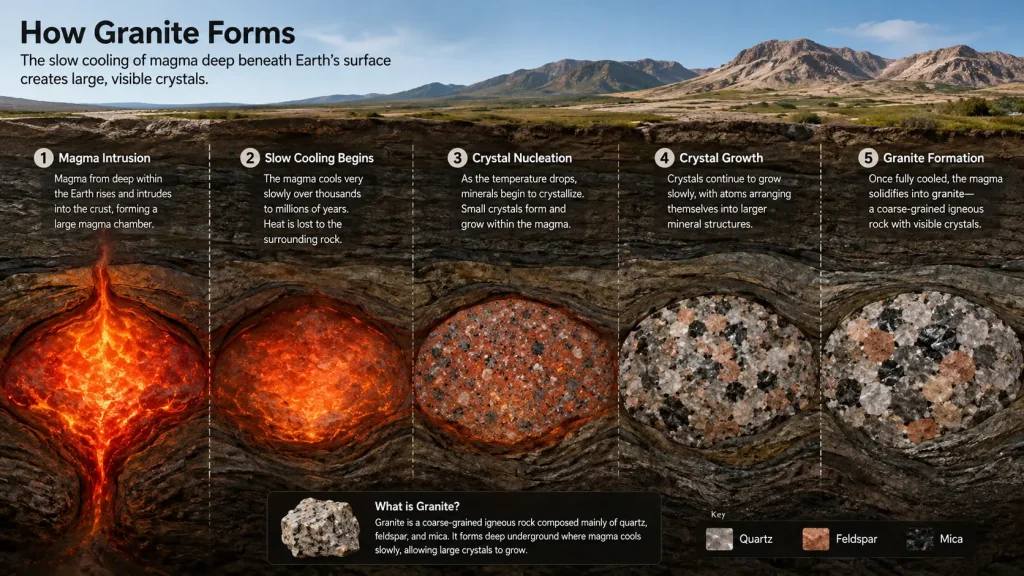
Deep Earth Origins: Granite forms from slowly cooled magma rich in quartz and feldspar deep beneath the Earth’s surface.
Global Sourcing: Major granite-producing countries include Brazil, India, China, and Italy, each offering unique colors and patterns.
Domestic Quarries: The United States has rich granite reserves, with major quarries in Texas, Georgia, Massachusetts, and other states.
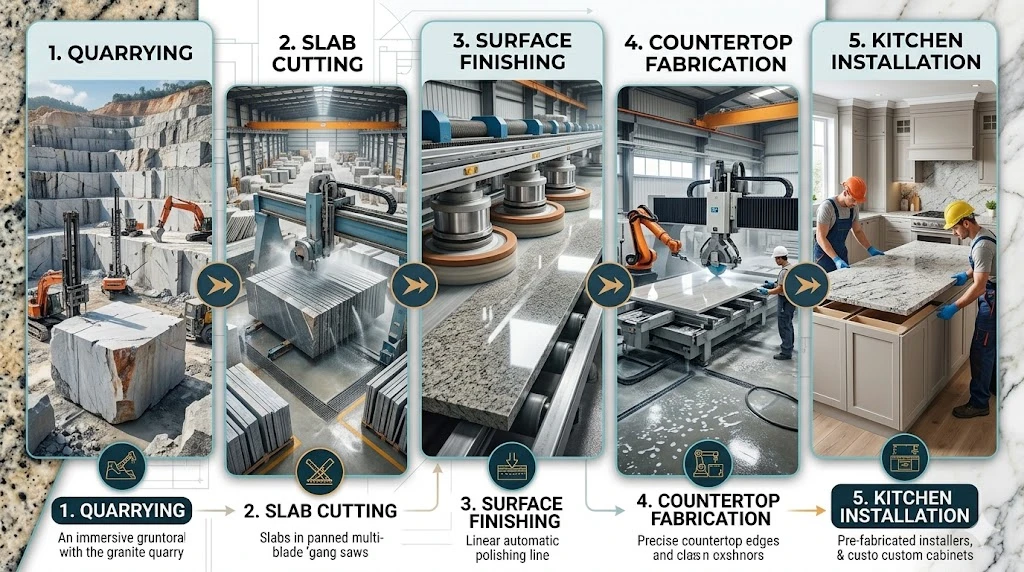
The Journey: Granite slabs undergo careful extraction, diamond-wire cutting, resin treatment, polishing, and precise fabrication before arriving at your kitchen.
How is Granite Formed?
Granite is composed of organic minerals such as quartz, feldspar…etc. Of course, they were not solid stones touching each other many years ago but were lava under the Earth’s surface. So the minerals have crystallized slowly and become hard –but very hard- stones in various colors.

Color is another astounding detail about granite. The minerals give the granite stones mesmerizing colors. While red, pink, grey, and white are more usual, there are some rare colors like blue, green, gold, or black.
Why Is Granite So Durable?
The secret behind granite’s legendary durability lies in its geological formation. Because it cools extremely slowly deep within the Earth, the mineral crystals lock together tightly, creating an incredibly dense structure.
On the Mohs hardness scale, granite ranks between 6 and 7, making it harder than steel. This high density gives the stone natural scratch resistance against everyday kitchen activities and superb heat resistance. Unlike synthetic materials, granite can withstand hot pots and pans without scorching. It is a stone forged in the fires of the Earth, built to endure for generations.
Does Granite Come In White?
Not necessarily. Although there are many tones of white granite, granite comes in various natural colors including, black, brown, white, blue…etc. Actually, finding pure white granite is almost impossible, but there are white granites with black, gray, or brown shades on a white surface. You can find white ice granite, moon white granite, or white ice granite of this kind.

What Minerals Give Granite Its Color?
Have you ever wondered why one slab looks like a starry night while another is warm and pink? Granite’s color palette is determined entirely by its mineral composition. Here is a quick guide to what gives granite its distinct shades:
| Mineral | Color Effect on Granite |
| Quartz | Milky White, Gray, or Clear |
| Feldspar | Pink, Red, or Creamy White |
| Biotite / Mica | Dark Brown or Jet Black |
| Amphibole | Dark Green or Black |
If you want to explore the best shades for your kitchen remodeling, check out our comprehensive guide on Granite Colors to find your perfect match.
Where Does Granite Come From?
As explained above, granite was melted rock or magma once upon a time. Today, people can mine granite in different parts of the world after millions of years, along with upheavals like tectonic movements and earthquakes.
Brazil, China, Italy, and India are some of the countries where granite quarries are located. Therefore, the granite countertop you buy for your home must be coming from one of these countries. Since each country has different geographical features, the color and some other characteristics of granites vary across the quarries in those countries.

For example, blue-colored granites that are mined in Brazil are the most expensive ones. There are also white and black granites in nature. While the white ones are more expensive, black granites are relatively affordable. In fact, their availability in the quarries and demand at certain times of the year can factor in the prices of different granites.
Which Countries Produce The Most Granite?
Granite is quarried globally, but certain nations dominate the international market due to the abundance and richness of their natural stone reserves:
- Brazil: Famous for exotic, high-end granites, especially breathtaking blues and complex, multi-colored slabs.
- India: Renowned for exceptionally durable dark granites, mesmerizing greys, and iconic fine-grained patterns.
- China: A powerhouse in global production, offering highly consistent grey and white granites popular for both residential and large-scale commercial projects.
- Italy: While famous for marble, Italy also boasts premium granite quarries and is home to the world’s finest stone processing technology.
- Norway & Angola: Key players known for unique, iridescent larvikites and deep, mysterious dark granites.

Famous Granite Varieties Around The World
Because granite is a product of its specific local environment, specific regions yield world-famous varieties that homeowners seek by name:
- Blue Bahia (Brazil): A rare, luxury stone with stunning, vibrant blue tones mixed with white and gold clusters.
- Absolute Black (India): A flawless, deep black stone with virtually no pattern—perfect for sleek, modern designs.
- Kashmir White (India): A classic variety featuring a crisp white background peppered with cranberry-colored garnets.
- Viscount White: A dramatic, swirling wave of white, grey, and black that mimics the movement of marble but retains granite’s toughness.
- Black Galaxy (India): A deep black background filled with golden-copper flecks that look like stars in the night sky.
Where Does Granite Come From In The United States?
The granite doesn’t always come from other countries. In the U.S, there are big quarries in some states like Texas, Massachusetts, Indiana, Georgia, and Wisconsin. If you ask, “where does black granite come from?” then the answer will be mostly other countries like India, Angola, or Scandinavia.

States Known For Granite Quarrying
The USA has a rich history of stone quarrying. Different states are famous for specific types of stone used across the construction industry:
| State | Known For / Famous Variety |
| Georgia | Elberton Granite (The “Granite Capital of the World,” famous for uniform gray stone) |
| Texas | Pink Granite (Used to build the majestic Texas State Capitol building) |
| Massachusetts | Quincy Granite (Historically famous for dark, durable building stone) |
| Wisconsin | Red Granite (The official state rock, known for its deep red hue) |
How Does Granite Come To Your Home?
Now that we have answered the question “where do granite countertops come from” we can talk about the journey of the granite slabs until they come to your house.
Mining the granite is just the beginning. They have a long journey before being one of the most beautiful pieces of art in your house.
First, a large block of granite is cut out of the quarry, and it is controlled to make sure there are no major fissures, cracks, or similar imperfections. If the stone is thoroughly solid and flawless, it is cut into slabs on gang saws. The period of cutting is generally slow since granite is a very hard material.

Once the bulk of stone is completely slabbed, the slabs are coated with resin fills and then put into big industrial ovens. Hence, the minor fissures or imperfections on the surface can be filled properly. Then, the slabs are polished.
After polishing, the slabs are shipped to distributors in different places. Most granite stores buy their stones from one of those distributors. They usually prefer the one closer to their location so that they pay less for shipping.
The distributors or stores check the quality and perfection of the slabs and do some polishing to make them look shinier. They cut samples and/or take photos of the slabs in different colors and patterns to show to the customers.
When you go to the store, they show you the granite countertop colors and patterns that you can use in your kitchen or bathroom. The team goes to your place, and they measure the room and the area where you need the granite.
According to your needs and expectations, they work on the project to get your confirmation. Then, using the CNC router, they cut down the big slabs into smaller sizes, and desired finishing is applied according to the project. Now your granite is ready to install.
Granite Countertop Journey: From Quarry To Kitchen
To put this massive operation into perspective, here is the chronological step-by-step path every slab takes:
- Quarrying: Drilling and shifting giant raw stone walls.
- Block Extraction: Detaching large, rectangular blocks weighing tons.
- Slab Cutting: Slicing the blocks with diamond-wire saws into raw slabs.
- Resin Treatment: Applying high-quality epoxy resin to fill micro-fissures.
- Polishing: Buffing the surface to bring out the stone’s natural luster and deep colors.
- Fabrication: Custom-cutting the slab to your kitchen’s unique dimensions and applying chosen Edge Profiles Guide.
- Installation: Securing the finalized countertops perfectly in your home.
How Long Does It Take Granite To Form?
If you think the journey from the quarry to your home is long, it is nothing compared to how long it takes granite to form in nature. Granite is an ancient material. It takes millions of years of intense heat and immense geological pressure deep beneath the continental crust for magma to cool down and crystallize into the hard stone we see today.
In fact, some granite formations found on Earth today are estimated to be over 300 million to 1 billion years old! When you place your hands on a granite kitchen island, you are literally touching a piece of Earth’s ancient history.
What Is Granite Used For?
Granite is a natural construction, decoration, and architectural material. Though granite is widely used as kitchen countertops and bathroom vanity tops, there are some other uses of it. For example, some monuments are made of granite. Also, you can see granite at luxurious places as paving stones or building veneers.

Why Granite Remains Popular For Countertops
Even with dozens of new engineered materials hitting the market every year, granite remains an undisputed favorite for homeowners. It brings an unparalleled natural beauty that cannot be perfectly cloned in a factory. Granite isn’t the only premium natural stone homeowners consider. Marble is another timeless option, offering elegant veining and a luxurious appearance. If you’re deciding between these two natural materials, read our Marble vs. Granite Countertops comparison guide to compare their durability, maintenance, cost, and overall performance.
Because every block is formed by erratic geological events, every single granite slab is unique—no two kitchens will ever look exactly alike. Combine this distinct charm with a long lifespan that can easily outlast the house itself, and it’s clear why granite is still the gold standard for premium Kitchen Countertops.
Interesting Facts About Granite
- Abundant Rock: Granite is one of the most abundant igneous rocks making up the Earth’s continental crust.
- Ancient Masterpieces: The ancient Egyptians famously used granite to construct portions of the Great Pyramid of Giza, including the King’s Chamber.
- The Curling Stone Secret: Professional Olympic curling stones are made almost exclusively from a unique, water-resistant granite found on a tiny island off Scotland.
- Completely Unique: Because of the random crystallization process, your neighbor can never buy the exact same countertop pattern as yours.
- Home Value Booster: Unlike synthetic alternatives, natural stone surfaces consistently retain their value and boost a home’s resale potential.
Frequently Asked Questions (FAQs)
Where does granite naturally come from?
Granite comes from deep within the Earth’s crust, where it forms from the slow cooling of molten magma. Over millions of years, tectonic movements and erosion push these granite formations closer to the surface, where they can be safely quarried.
How is granite formed?
Granite is formed when magma (melted underground rock) gets trapped beneath the Earth’s surface. Instead of erupting from a volcano, it cools down very slowly over millions of years, allowing large, visible mineral crystals to bind together.
What is granite made of?
Granite is an intrusive igneous rock primarily made of two essential minerals: Quartz and Feldspar. It also contains smaller amounts of other minerals like mica, biotite, and amphibole, which give the stone its distinct speckles and veins.
Which country produces the most granite?
Brazil, India, China, and Italy are the top global producers of granite. Brazil is highly valued for its exotic color variations, while India provides some of the world’s finest dark and dense granites.
Does granite come from volcanoes?
Not directly. Volcanic rocks (like basalt or obsidian) are extrusive, meaning they form from lava that cools quickly on the Earth’s surface. Granite is intrusive, meaning it forms entirely underground from magma and never erupts out of a volcano.
Is granite natural or man-made?
Granite is a 100% natural stone. It is harvested directly from nature and cut into shapes. This is different from quartz countertops, which are engineered in factories using crushed natural quartz crystals bound together with resins. Read our detailed comparison on Quartz Countertops vs. Granite to see which fits your lifestyle.
How long does granite take to form?
It takes millions of years for the underground magma pools to cool down completely and crystalize into solid granite stone blocks.
Where is granite quarried in the United States?
The United States has massive granite reserves, with major quarry operations actively located in Georgia (specifically Elberton), Texas, Massachusetts, Indiana, and Wisconsin.
Why is granite used for countertops?
Granite is highly sought after because of its incredible hardness (ranking 6-7 on the Mohs scale), scratch resistance, exceptional heat tolerance, and timeless natural beauty that engineered stones cannot perfectly replicate.
What colors does granite come in?
Granite comes in almost every color imaginable! While shades of gray, white, pink, and beige are the most common, you can also find gorgeous slabs of black, brown, gold, deep green, and rare, luxurious blues.
Bottom Line
Granite is one of the most stunning gifts of nature. It takes a long way for a granite countertop to reach your home. The journey is long, but it is absolutely worth it. If you are ready to choose the perfect stone for your next home upgrade, diving into a comprehensive Countertop Buying Guide is an excellent next step to plan your budget and style!
