



Soapstone Kitchen Countertops: A Complete Buyer’s Guide (2026)
Introduction
Soapstone kitchen countertops are a naturally non-porous, talc-based metamorphic stone that resists heat and stains without sealing, darkens over time, and scratches more easily than granite or quartz — making it best for homeowners who want a living, low-maintenance surface with a patina.
Soapstone behaves differently from the engineered slabs most Northern Virginia kitchens are built around. It takes marks, and then it absorbs them into a surface that looks better at year ten than year one. Homeowners in Chantilly, Alexandria, the rest of Northern Virginia, Maryland, and Washington, D.C. who cook hard and don’t want a maintenance schedule tend to fall for it fast. Homeowners who want their counters to look brand new in 2036 usually don’t.
This guide covers what soapstone actually is at the mineral level, how it handles heat, how the patina develops, what slab sizes mean for your seam layout, which edges and drainboard details suit the stone, how to sand out a scratch, and how it stacks up against granite, quartz, and quartzite. Read it end to end before you visit a slab yard — soapstone is one of the few materials where seeing and touching the stone changes the decision.
- Soapstone is a metamorphic rock made primarily of talc; countertop-grade (architectural) slabs typically contain around 30% talc, while softer carving grades run as high as 80%.
- It is naturally non-porous, so it never needs sealing — unlike granite, which is typically resealed every 1–3 years.
- Heat resistance is exceptional: a pot can be set directly from a 500-degree burner onto soapstone without scorch marks.
- Soapstone darkens with age and oiling, moving from light gray toward deep charcoal or near-black, and can be left natural, aged, or oiled.
- Scratches are the main trade-off, but they sand out with 120-, 220-, and 400-grit paper plus mineral oil in about five minutes.
What Is Soapstone? The Basics Behind the Stone
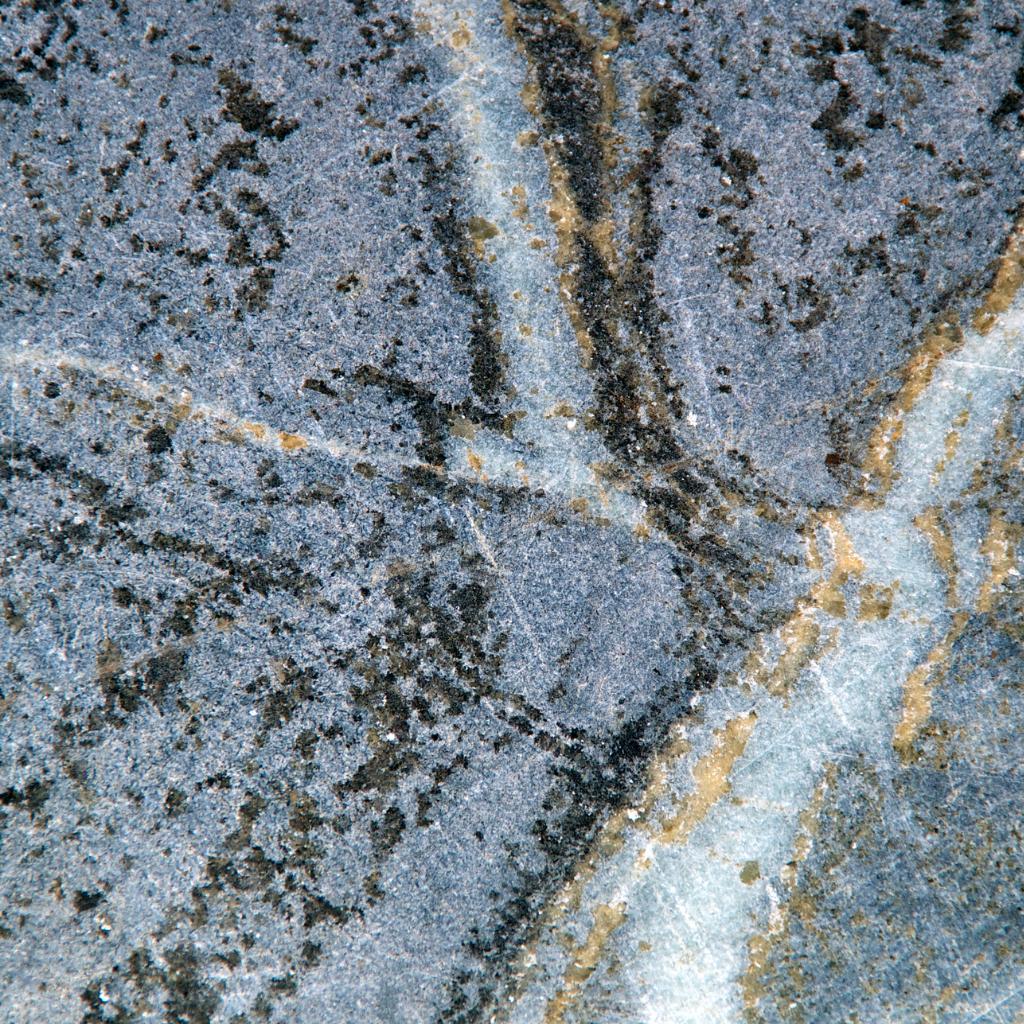
Geologically, this is a metamorphic rock formed when magnesium-rich rock is squeezed and heated under pressure, with talc as the dominant mineral. Talc sits at 1 on the Mohs hardness scale — the softest mineral there is — which is why the surface feels slightly waxy under your palm and why a fingernail can leave a mark on a low-grade piece. But the talc percentage varies enormously between slabs, and that percentage is the single most useful spec to ask about.
Carving grade, used for sculptures, sinks in art studios, and decorative objects, can run as high as 80% talc. Architectural or countertop grade typically sits around 30% talc, with the remainder made up of harder minerals like chlorite, magnesite, dolomite, and amphibole. Those harder minerals are what make a countertop slab hold up under a knife-happy household. If a supplier can’t tell you whether a slab is architectural grade, treat that as a red flag.
The other defining property is that soapstone is inert. It doesn’t react with acids, which is why chemistry lab benches have been made from it for generations. Spill lemon juice, red wine, vinegar, or turmeric on it and nothing happens to the stone itself — no etching like marble, no staining like unsealed granite. The proof is durability over centuries: original soapstone sinks and counters installed in the 1800s across New England are still in daily service.
Why Homeowners Choose Soapstone for the Kitchen
The non-porous structure is the headline. There is no sealer to apply at installation and no resealing cycle for the life of the counter — a meaningful difference from granite, which is typically resealed every one to three years depending on the slab and how hard the kitchen gets used. Bacteria and liquids have nowhere to go because the stone has effectively no absorption.
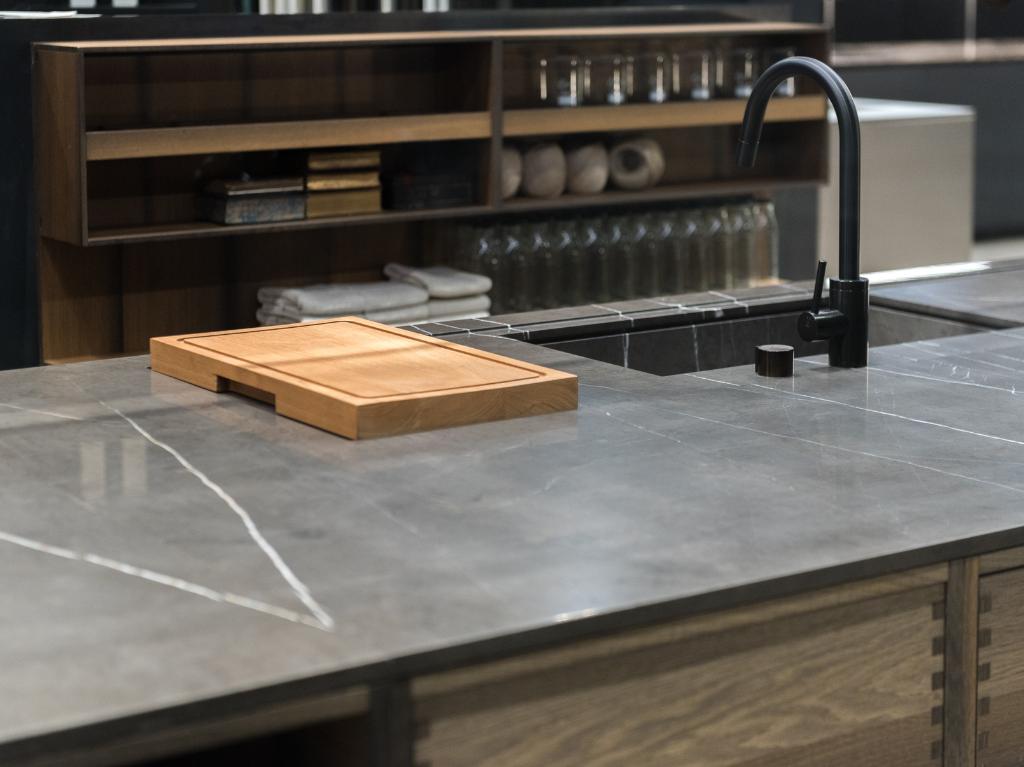
The second draw is visual honesty. Soapstone reads as stone rather than as a printed pattern. Veining tends to be quartz-white or pale gray threading through a gray or blue-gray field, and the movement is subtler than a dramatic quartzite slab. It pairs naturally with unlacquered brass, soapstone or fireclay farmhouse sinks, painted Shaker cabinets, and unpainted wood.
Third, it is repairable in place. A chipped corner on quartz usually means a color-matched epoxy fill by a technician. A scratch or a shallow chip on soapstone can be worked out with sandpaper and mineral oil at your own kitchen counter, without a service call. Very few countertop materials give a homeowner that kind of control.
Best For- Serious home cooks who put hot cookware down without thinking
- Households that want zero sealing and zero specialty cleaners
- Traditional, farmhouse, and Craftsman kitchens
- Homeowners who like a surface that changes and shows use
- Baking stations, where the cool surface is a genuine advantage
- Naturally non-porous — never needs sealing
- Acid-proof; lemon, wine, and vinegar do not etch it
- Handles direct heat from cookware
- Scratches and shallow chips are sandable by the homeowner
- Color palette works with both painted and natural wood cabinetry
- Softer than granite, quartz, and quartzite; it will show knife and pan marks
- Color range is limited to grays, greens, and near-blacks
- Slab sizes are smaller than most granite and quartz, which means more seams on long runs
Heat Resistance: Why Soapstone Handles Hot Pans So Well
Talc and the associated magnesium silicates have high specific heat capacity and low thermal expansion, so the stone absorbs energy and spreads it laterally instead of building the localized stress that cracks or discolors other surfaces. You can take a pan straight off a gas burner running at 500 or 600 degrees Fahrenheit and set it on the counter without scorch marks. Experienced fabricators who have worked the material for three decades report never seeing heat damage soapstone.
Quartz is roughly 90–93% ground natural quartz bound with polymer resin, and that resin is the weak link — sustained contact above about 300°F can yellow it or cause a thermal-shock crack, which is why every quartz manufacturer specifies trivets. Solid surface is even more heat-sensitive. Granite tolerates heat well but can be discolored where a sealer has been applied, and repeated thermal cycling on one spot is not ideal.
This is also why soapstone shows up in wood stoves, bake ovens, and fireplace surrounds. The same mass that resists a hot pan will hold warmth for hours. In a kitchen, that translates to a counter that feels cool for pastry work but shrugs off the roasting pan you just pulled out of a 425-degree oven.
Color and Patina: Natural, Aged, and Oiled Looks
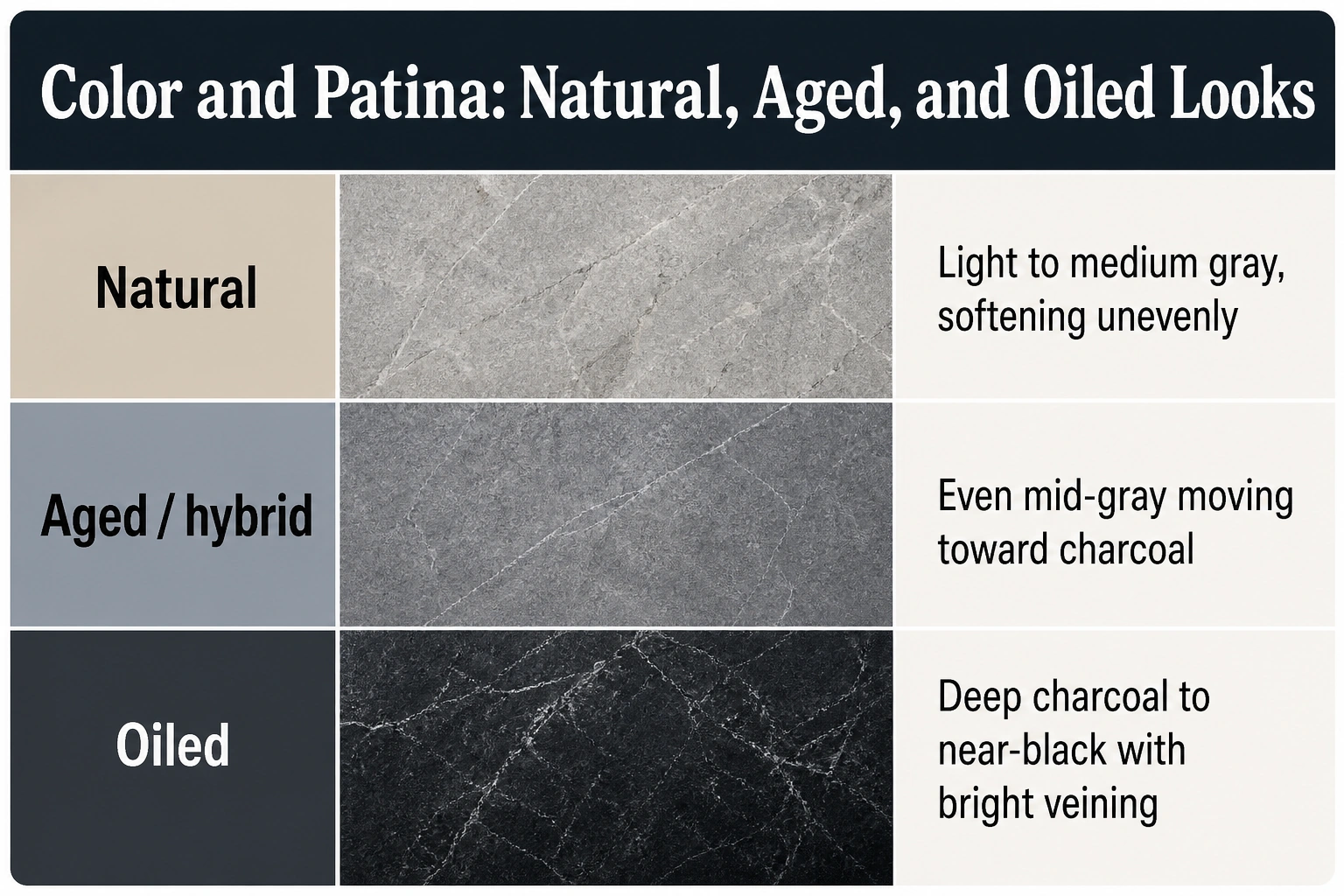
Untreated soapstone is a light to medium gray, and the exact depth varies by slab variety and quarry. Left completely alone, it will darken unevenly over months as oils from cooking and hands transfer to the surface — a patina that is genuinely beautiful in some kitchens and blotchy-looking in others, depending on how consistently the counter gets used. This is the “natural” route, and it requires the most patience.
The “oiled” route accelerates and evens out the same process. A wipe of food-grade mineral oil saturates the surface, immediately pulling the stone to deep charcoal or near-black and making the white veining pop. Early on you’ll want to oil roughly once a month; after the first year, three or four times a year is usually enough, and eventually the stone holds its darkness on its own. Oiling is not a sealer — it changes nothing about the stone’s porosity, only its appearance.
The “aged” or hybrid approach is a middle ground: oil once at installation to establish an even base tone, then stop and let the kitchen finish the job. This avoids the patchiness of pure natural aging without committing to a monthly routine. Whichever you pick, the decision is fully reversible — stop oiling and the stone gradually lightens; start again and it darkens back down.
| Finish approach | Appearance | Effort | How it develops |
|---|---|---|---|
| Natural | Light to medium gray, softening unevenly | None | Darkens where the kitchen gets used most |
| Aged / hybrid | Even mid-gray moving toward charcoal | One oiling at install | Kitchen use finishes the patina over 1–2 years |
| Oiled | Deep charcoal to near-black with bright veining | Monthly year one, 3–4x/year after | Full color immediately, holds with upkeep |
Thickness, Slab Sizes, and Where Seams Land
Standard countertop soapstone is fabricated at 3 cm, roughly 1.25 inches. At that thickness the slab is self-supporting across normal cabinet spans and does not need a plywood sub-base the way thinner stone does. Heavier 2.5-inch stock exists and produces a striking monolithic edge, but soapstone is dense — around 175–180 pounds per cubic foot — so a full kitchen in 2.5-inch material becomes a genuine structural and handling question before it becomes an aesthetic one.
Slab dimensions are the real planning constraint. Soapstone commonly comes in slabs around 30 inches by 84 inches, dramatically smaller than the 65-by-130-inch jumbo slabs typical in quartz. Seven feet is therefore your practical maximum single-piece run, and a 10-foot island or a long sink wall will have at least one seam. Oversize soapstone stock is available in some varieties and can push past that limit, but availability is variety-dependent.
Because seams are more or less inevitable, seam placement deserves real attention during templating. Good practice is to land a seam at a sink cutout or a cooktop cutout, where the opening already breaks the visual line, rather than mid-run on an uninterrupted counter. Soapstone seams do have one advantage: the stone is uniform enough in color that a well-cut, tightly-fit seam with matched veining reads far less obviously than a seam in a heavily-figured granite. Our digital templating step exists precisely to settle these decisions on paper before anything gets cut.
Best For- Kitchens with runs under seven feet between corners or cutouts
- Islands where a deliberate center seam is acceptable
- Perimeter counters interrupted by a range or a sink
- 3 cm stock needs no plywood sub-base
- Uniform coloring makes seams visually quiet
- Smaller slabs are easier to maneuver through tight D.C. rowhouse stairwells
- More seams than quartz or granite on long runs
- Very large single-piece islands are usually not possible
Edge Profiles and Drainboard Details for Soapstone Kitchen Countertops
Soft stone shapes easily, which opens up profiles that would be expensive in granite — but it also chips more readily at a sharp arris, so the profile choice matters more here than it does on harder material. A simple eased edge with a slightly generous radius is the workhorse: clean, modern, and it takes a bump from a cast-iron pan without spalling. A quarter-bevel or half-bullnose adds a little shadow line while keeping the corner protected. Ogee and double-ogee profiles are technically possible and read beautifully in a traditional kitchen, though the fine ridges are the first thing to show wear.
Because soapstone comes in relatively thin stock, mitered edges are a common way to fake a thicker slab. A 45-degree miter on 1.25-inch material can produce an apparent 2-, 3-, or even 4-inch edge without the weight of solid 2.5-inch stone. The miter joint on soapstone closes tightly and, once oiled, is nearly invisible — an advantage this stone has over materials with more directional pattern.
Drainboards are the detail that people fall in love with, and they’re only practical because soapstone machines so cleanly. Three formats dominate:
- Traditional grooves: eight parallel runnels, 16 to 18 inches long, cut on a slight slope back toward the sink. This is the classic New England farmhouse look.
- British style: a flat sloped field with a 1/2-inch drop and a 1/4-inch lip retaining the water at the perimeter — contemporary, easier to wipe down than runnels.
- European style: minimalist and unadorned, just a clean flat surface on a 1/2-inch slope with no lip and no grooves.
Any of the three can be paired with an undermount sink so water sheets directly into the basin. Runnels collect a little more residue than flat drainboards and want an occasional scrub with a soft brush, but they also hide the odd scratch better than an open flat field does.
Care, Cleaning, and Repairing Scratches
Daily cleaning is dish soap, warm water, and a cloth. Nothing about the stone requires a pH-neutral stone cleaner, and there is no sealer to strip, so household products that are off-limits on marble — vinegar, bleach, citrus cleaners, degreasers — cause no harm here. Abrasive powders are the one thing to avoid, not because they’ll damage the stone chemically but because they’ll dull an oiled surface unevenly.
Surface scratches on an oiled counter usually aren’t scratches at all — they’re marks in the oil layer, and a fresh wipe of mineral oil makes them vanish. Test that first before reaching for sandpaper. Actual scratches in the stone show as a lighter line, because you’ve exposed un-oiled material underneath.
For a genuine scratch, the repair sequence is straightforward and takes about five minutes:
- Sand out the scratch with 120-grit sandpaper, working in the direction of the counter’s long axis and feathering a few inches past the mark on each side.
- Follow with 220-grit over the same area to remove the coarse scratch pattern left by the 120.
- Finish with 400-grit for a smooth, consistent surface texture that matches the surrounding stone.
- Wipe away the dust, then apply mineral oil generously to the repaired zone and let it sit before buffing off the excess — this blends the repair into the surrounding patina.
Deep chips at an edge or corner are the exception and are better handled by a fabricator, who can dress the profile back rather than leave a dished spot. But the everyday reality of living with soapstone is that most damage is a five-minute problem you fix yourself, which is not something you can say about engineered quartz surfaces.
Soapstone vs. Granite, Quartz, and Quartzite
The four materials fail in different directions, and picking one is really about deciding which failure mode you can live with. Soapstone scratches. Granite needs periodic sealing and can stain if you skip it. Quartz can be damaged by heat. Quartzite is the toughest of the group but is often the most expensive and the hardest to fabricate.
| Soapstone | Granite | Quartz | Quartzite | |
|---|---|---|---|---|
| Type | Natural metamorphic | Natural igneous | Engineered (~90–93% quartz + resin) | Natural metamorphic |
| Mohs hardness (approx.) | 1–3 | 6–7 | 7 (aggregate) | 7 |
| Sealing | Never | Typically every 1–3 years | Never | Usually annually |
| Heat | Excellent — direct from a 500°F burner | Very good | Limited; resin binder is heat-sensitive | Very good |
| Acid etching | None | Rare | None | Rare |
| Scratch resistance | Low | High | High | Highest |
| DIY repair | Yes — sandpaper and oil | No | No | No |
| Typical installed range | $80–$120 per sq. ft. | Varies by slab grade | Entry-level $65–$130 per sq. ft. | Varies by slab grade |
On price, soapstone typically runs $80 to $120 per square foot installed in markets where it’s readily stocked, which puts it above the low end of quartz at $65 to $130 per square foot and squarely in premium natural stone territory. Fabricated soapstone material alone is often quoted around $90 per square foot for 1.25-inch stock and around $158 per square foot for 2.5-inch stock. Those are illustrative ranges only; the final number depends on square footage, edge profile, cutouts, drainboard work, and slab availability, and we quote every job individually after templating.
If you’re weighing the two most common alternatives against each other rather than against soapstone, our granite versus quartz comparison goes deeper on those two specifically.
Who Soapstone Is Right For — and Who Should Choose Something Else
Soapstone rewards a particular temperament. If you look at a scuffed leather bag or a worn butcher block and see character, this stone will make you happy for decades. If a mark on a new surface bothers you for a week, it will make you miserable, and no amount of oiling changes that.
The practical fit is strongest in kitchens where heat is constant and knives mostly stay on a board. It’s a poor fit where the counter doubles as a cutting surface, where children do craft projects with metal tools, or where a homeowner wants a bright white or beige kitchen — soapstone simply does not come in those colors. It’s also worth thinking about resale: gray-to-black stone is a strong look, but it is a look, and it appeals to a narrower slice of buyers than a neutral quartz.
Best For- Cooks who use the counter as a landing zone for hot cookware
- Owners planning to stay in the home ten-plus years
- Historic homes and traditional kitchens in older D.C. and Alexandria neighborhoods
- Anyone who wants to repair their own counter rather than schedule service
- Lowest ongoing maintenance burden of any natural stone
- Aging improves the appearance instead of degrading it
- Completely inert around food and acids
- Wrong choice for anyone who wants a permanently pristine surface
- Narrow color range and a strong stylistic point of view
- Long runs require seams that other materials wouldn’t
What Northern Virginia, Maryland, and D.C. Kitchens Should Know Before Choosing a Dark Stone
Regional housing stock matters more with soapstone than with almost anything else, because the stone commits you to a particular look. A lot of homes across Fairfax, Loudoun, Prince William, Montgomery, and Prince George’s counties are colonials and townhomes with north-facing kitchens, 8-foot ceilings, and one window over the sink. Drop darkened counters into that room and you can lose a real amount of perceived brightness. The fix is not complicated — under-cabinet LED strips in the 3000K to 3500K range, lighter cabinet fronts, and a reflective backsplash — but it needs to be part of the plan, not an afterthought.
Rowhouses and older properties inside the District and in Old Town Alexandria present a different issue: access. Soapstone’s smaller slab format is genuinely helpful here, because a 30-by-84-inch piece navigates a narrow staircase or a tight galley entry far more easily than a jumbo quartz slab. If your kitchen is on a second floor or behind a series of turns, mention it early so templating and delivery can be sequenced around it.
Mid-Atlantic summers push indoor humidity high and winter heating drops it low, and that cycle is hard on wood, drywall seams, and grout. It has essentially no effect on soapstone, which neither absorbs moisture nor expands meaningfully with temperature change. Homeowners who have fought efflorescence in a tile backsplash or a warped butcher block island often find that a stone counter is the one surface in the room that never moves. If you want to see slabs under real light before committing, our Chantilly showroom off Highway 50 is set up for exactly that comparison.
Plan Your Countertop Project With Landmark Surfaces
Soapstone photographs poorly. On a screen it looks flat and one-note; in person the veining has depth and the surface has that distinctive soft feel that no image conveys. Handling a sample and dragging a fingernail across it tells you in ten seconds whether you can live with a soft stone — which is why we’d rather you see slabs in person than choose from a photo.
Our process is the same regardless of material: slab selection at the showroom, digital templating in your home once cabinets are set, fabrication, and installation. Templating is where seam locations, edge profile, sink reveal, and any drainboard detail get finalized, and with soapstone those conversations carry more weight because of the slab-size constraint. We carry a broad range of natural stone alongside Silestone, Caesarstone, MSI Quartz, Cambria, Corian Quartz, and Dekton, so if soapstone turns out to be the wrong fit after you’ve touched it, there’s a full alternative wall in the same room.
To be clear about scope: we fabricate and install countertops. We don’t do cabinets, plumbing, layout changes, general contracting, or interior design, so if your project involves moving a sink or reconfiguring the kitchen, you’ll want a contractor coordinating that work alongside us. Serving Northern Virginia, Maryland, and Washington, D.C. from our two Virginia showrooms, we can walk you through slabs and pricing whenever you’re ready — book a showroom appointment or reach out with your rough square footage for an estimate.
Frequently Asked Questions
Is soapstone good for a kitchen countertop?
Yes, for cooks who value heat and stain resistance over a flawless surface. Soapstone is non-porous, never needs sealing, is unaffected by acids like vinegar and lemon juice, and handles cookware straight off a 500-degree burner. The trade-off is softness — it will show knife and pan marks over time.What are the disadvantages of soapstone countertops?
Yes, there are notable disadvantages: scratching, limited color range, and slab size. It is far softer than granite or quartz, so marks appear with normal use. Colors run gray to near-black only. Slabs around 30 by 84 inches mean runs over seven feet need a seam, unlike jumbo quartz slabs.
Is soapstone cheaper than granite?
No, generally not. Soapstone typically runs $80 to $120 per square foot installed, which places it in premium natural stone territory, while granite spans a wide range from budget to exotic slabs. Entry-level granite is usually cheaper; high-end granite can exceed soapstone. Final pricing always depends on the specific project.Which is better, soapstone or granite?
No — neither is universally better; they fail differently. Soapstone wins on heat resistance, acid resistance, and zero sealing, and it can be repaired with sandpaper. Granite wins decisively on scratch resistance and offers far more colors and patterns, but typically needs resealing every one to three years.
Ready to Choose Your Countertops?
Visit a Landmark Surfaces showroom in Chantilly or Alexandria to compare slabs, edge profiles and finishes in person, or request a free quote. You can also browse our live inventory before you visit.


