


Years of Experience
0 +
Spotless Countertop Installation in Less Than a Week By 24+ years of experience and cutting-edge technology of Stone Fabrication & Installation there is no uncertanity


25391 Pleasant Valley Rd.
Chantilly, VA 20152
Phone: (703) 259-9027
5655 General Washington Dr
Suite G
Alexandria, VA 22312
Phone: (703) 259-9028
White Carrara is the marble everyone imagines when they think of marble: a soft gray-white ground with fine, feathery gray veins, quarried above the town of Carrara in Tuscany for two thousand years. It is the least expensive Italian marble we sell and remains the most popular stone on our floor for bathroom projects. With an understanding of the maintenance that comes with marble, it remains a practical option for kitchen countertops.
We stock White Carrara marble at our Chantilly location in 2cm slabs, honed and polished, from one lot. This page covers the honed-or-polished decision, what separates Carrara from the Calacattas that cost three times as much, which rooms it suits, what living with a Carrara kitchen is really like, and what it tends to cost installed. For today’s slab count, go to live inventory.
On most stones the finish is a style choice. On Carrara it is a maintenance choice, and one that often determines whether you will be happy with a marble counter after five years. We stock both in the same lot, so you can see them side by side and decide for yourself.
Honed. A matte surface, ground smooth but not polished to a shine. The gray reads softer, the veins blend into the ground, and the stone looks like the old Italian kitchen counters it descends from. A practical point: an etch mark, the dull spot an acid leaves on marble, is only a loss of shine. On a surface that has no shine to lose, it is less noticeable. A honed Carrara kitchen collects marks with everyday use, but even after a year you may find them hard to spot without looking closely. This is the finish we recommend for any Carrara that will be around food, wine, or children.
Polished. A mirror surface that deepens the white, sharpens the veins, and makes the room brighter. It is the perfect finish for bathrooms, fireplaces, and furniture, where acids are rare and the shine is the main character. In a kitchen, every lemon slice and wine ring leaves a dull print you will see in raking light, so the top will need professional re-polishing every few years to look new again. Some people find natural wear charming. Most people who chose a polished finish for a kitchen without being told this often do not.
The things that do not change with finish. Hardness, staining, and sealing are the same either way: both of these finishes scratch if a pot is dragged across them, both absorb red wine if left overnight, both want a sealer. A honed surface is slightly more porous and does not hold a sealer as long. Neither finish is “low maintenance”; honed is simply the one that hides daily use better.
If you cannot decide, our guide to finishes covers the general points, and a water drop test on each slab in the warehouse shows you the difference in seconds.

 4.9287 reviews

 Trustindex verifies that the original source of the review is Google.
 Trustindex verifies that the original source of the review is Google.
 Trustindex verifies that the original source of the review is Google.
 Trustindex verifies that the original source of the review is Google.
 Trustindex verifies that the original source of the review is Google.
 Trustindex verifies that the original source of the review is Google.
 Trustindex verifies that the original source of the review is Google.
 Trustindex verifies that the original source of the review is Google.


 Trustindex verifies that the original source of the review is Google.
 Trustindex verifies that the original source of the review is Google.
 Trustindex verifies that the original source of the review is Google.


 Trustindex verifies that the original source of the review is Google.
 Trustindex verifies that the original source of the review is Google.
 Trustindex verifies that the original source of the review is Google.

 Trustindex verifies that the original source of the review is Google.
 Trustindex verifies that the original source of the review is Google.
 Trustindex verifies that the original source of the review is Google.
 Trustindex verifies that the original source of the review is Google.
 Trustindex verifies that the original source of the review is Google.
 Trustindex verifies that the original source of the review is Google.
 Trustindex verifies that the original source of the review is Google.
 Trustindex verifies that the original source of the review is Google.
 Trustindex verifies that the original source of the review is Google.
 Trustindex verifies that the original source of the review is Google.


 Trustindex verifies that the original source of the review is Google.


 Trustindex verifies that the original source of the review is Google.
 Trustindex verifies that the original source of the review is Google.

 Trustindex verifies that the original source of the review is Google.
 Trustindex verifies that the original source of the review is Google.
 Trustindex verifies that the original source of the review is Google.
 Trustindex verifies that the original source of the review is Google.


 Trustindex verifies that the original source of the review is Google.
 Trustindex verifies that the original source of the review is Google.
 Trustindex verifies that the original source of the review is Google.
 Trustindex verifies that the original source of the review is Google.
Carrara is the marble with the longest track record in houses, and it has earned a place in almost every room. The question is not whether it can go there but which finish and what expectations go with it. The cases where we would steer you to something else are after the cost section.
The default. Vanity tops, tub decks, shower walls and curbs, window sills. Polished or honed both work; keep acidic cleaners off of it. A 2cm slab covers a double vanity and a shower niche with stone to spare.
The classic marble kitchen, perimeter and island, should be a honed Carrara. It withstands heat, it can handle a baker’s rolling pin, and the marks it takes fade into the gray. For someone who wants real marble in a working kitchen, this is the stone and the finish.
Surrounds, hearths, full-height backsplashes, and bookmatched wall panels. The 2cm thickness is made for vertical work: lighter to hang, and the soft veining reads as calming across a large surface where a Calacatta would overpower the room.
Hotel bathrooms, restaurant bar faces, lobby cladding, and unit vanities, where the look of Italian marble is wanted at a price that suits fifty rooms. Carrara is the most consistent marble to buy in quantity because the lot is large and the pattern is quiet.
Whether you’re seeking a free estimate, a showroom visit, or an in-home evaluation, our team is ready to transform your space.
The three famous white Italian marbles come out of the same mountains above Carrara, and the names cause more confusion than any other in the trade. They are the same rock. What differs is how white the ground is and how the veins behave. That difference is set by which part of which quarry a block came from.
Carrara. A gray-white ground with fine, feathery, evenly spread gray veins. The most abundant of the three by far, which is why it is the most affordable. The Carrara quarries grade it by how clean the white is: the Italian trade reference, the CMP Solmar handbook of Apuan commercial names, lists Bianco Carrara C and CD as the standard selections, with the letter classes running from the whitest to the grayest blocks. Our current lot is a mid-gray selection with consistent veining, which is what you want for countertops: the slabs match each other.
Calacatta. A whiter, brighter ground with fewer, bolder veins in gray or gold, from a handful of quarries that produce far less. Three to four times the slab price of Carrara, and the one people usually mean when they reference “the marble in the magazine.” We carry several; the Calacatta pages on this site cover them in more detail.
Statuario. The whitest ground of all with dramatic, dark gray veining, historically reserved for sculpture. Rare, expensive, and sold in small lots.
What they share. All three are calcite marble, metamorphosed limestone, and the Geology.com marble reference gives two facts that govern every decision about them: a Mohs hardness of 3, and a reaction with acids. A Calacatta etches exactly like a Carrara. If you are choosing between them, you are choosing a look and a price, not a level of maintenance. The gray veins in all three are extremely similar: traces of clay and organic material folded into the pure white calcite during metamorphism.
If the budget says Carrara and the heart says Calacatta, a honed Carrara with a bolder-veined slab chosen in person narrows the gap more than you would expect. Ask to see the whole lot; the variation from slab to slab is where the value hides.
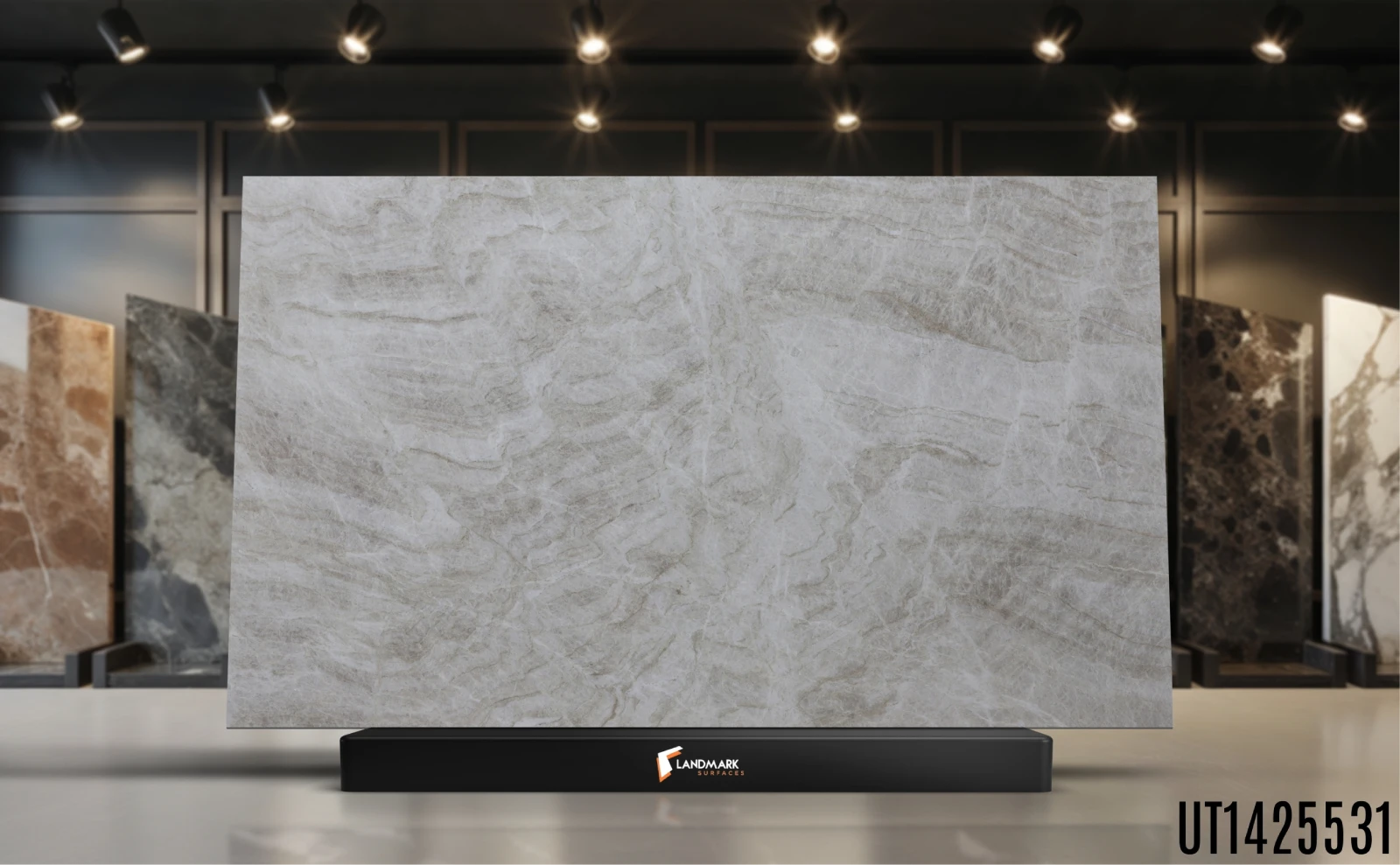
Our White Carrara marble in Chantilly is 2cm thick, about 117 by 72 inches, from one lot, with honed and polished slabs in the same stock. The ground is a soft gray-white rather than a bright white, the veining is fine and evenly spread with no dominant band, and there is a faint directional grain running the length of the slab. It is a calm, classic Carrara; nothing on it will fight a tile or a cabinet color. Several slabs are on the floor as of this writing; check live inventory for today’s count.
What 2cm means for you. Two centimeters is the standard thickness for marble in Europe and for walls everywhere. For a countertop it is built up at the edge, either laminated with a strip of the same stone or mitered, to read as 3cm, 4cm, or thicker; the edge you see is a choice rather than a standard. A 2cm slab also weighs about a third less than 3cm, which makes shower walls, backsplashes, and bookmatched panels easier and cheaper to install.
Honed and polished in one lot. Because both finishes come from the same block, a honed kitchen counter and a polished backsplash cut from consecutive slabs match in color and vein. That pairing is common on this stone and works well: the working surface hides marks, the vertical surface carries the shine.
Carrara varies less from block to block than any other Italian marble, but it still varies. A future lot may run whiter or grayer, or carry a heavier vein, than the slabs photographed here. The slab you choose is tagged to your job the day you choose it.
Carrara is the marble our shop has cut the most of, and the recommendations below come from all that experience.
Edges on 2cm. The edge is built, not found. A laminated edge glues a strip of the same slab under the front to make a 4cm face; a mitered edge folds the top down at 45 degrees for a seamless thick look. On Carrara a mitered edge is the best-looking one, because the veins carry over the corner and the glue line sits where the eye does not see it. Simple profiles suit the stone: eased, small bevel, and miter. We ease every exposed corner by default; marble chips on a sharp 90-degree corner more readily than granite.
Vein direction. The grain runs the length of the slab. We keep it running the same way across a kitchen so that the perimeter and island are in harmony with each other, and we discuss the direction at the template stage, because once the first piece is cut the rest follow it.
Seams. On a quiet, evenly veined stone seams are easy to hide, and a tight seam on honed Carrara is one of the least visible in natural stone. We place them away from the sink and in the calmest area of the pattern.
Cutouts and rodding. Marble is softer than granite and 2cm is thinner than 3cm, so every narrow strip at a sink or cooktop is rodded, and undermount sink cutouts get polished and eased rather than left sharp. Cutouts are kept out of the heaviest veins where the layout allows.
Sealing in the shop. Every piece is sealed before it leaves, with a second coat at installation. On honed slabs we apply a sealer suited to open surfaces; on polished, a standard impregnator.
Weight and lead time. A 2cm slab at 117 by 72 inches weighs roughly 650 to 700 pounds. Fabrication and installation typically run 5 to 7 business days from template.


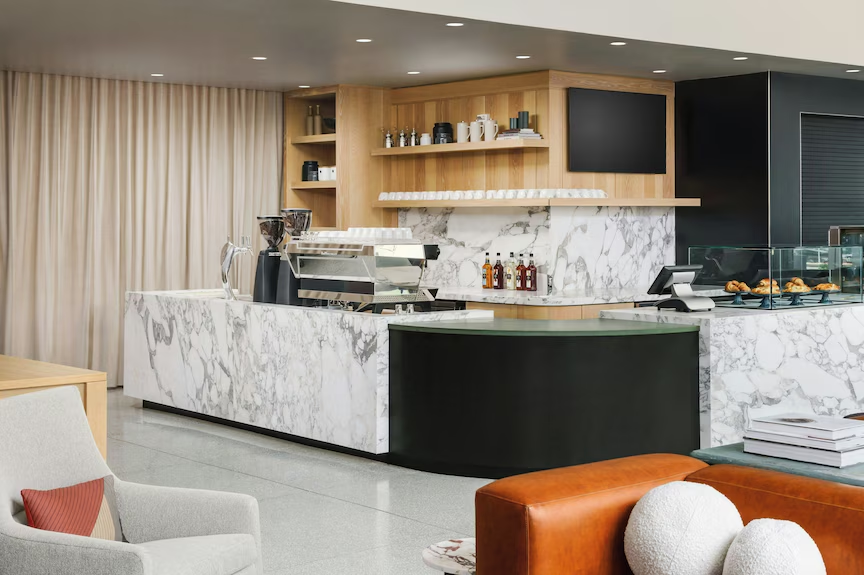
White Carrara marble countertops typically run $70 to $130 per square foot installed, which makes Carrara the least expensive way to get Italian marble and puts it in the same range as a premium granite. The slab is a smaller share of that number than on any other marble we sell; the edge build-up on 2cm and the care taken with cutouts are where the fabrication cost lies.
What moves the number:
For comparison, our Calacatta Viola runs $140 to $280 per square foot installed, the Calacatta quartzites $90 to $200, and a white engineered quartz $50 to $110. Our countertop installation cost guide explains what is included in the installed price.
All figures are general ranges. The real number depends on the slab, the square footage, the edge, the number of seams and cutouts, and the finish, and it is all set at the free in-home estimate after we have measured.
Italians have cooked on Carrara for centuries without sealers, trivets, or coasters, and their counters have a heavy patina. The American question is whether you want yours to look like that. Here is the stone next to the two surfaces most often chosen instead of it.
| Day to day | Honed White Carrara | Calacatta quartzite | White engineered quartz |
|---|---|---|---|
| Lemon, wine, vinegar, tomato | Etches; nearly invisible on honed, visible on polished | No etching | No etching |
| Knives and dragged pots | Scratches; use boards and felt | Resists | Resists |
| Hot pans | Tolerates heat; trivets anyway | Tolerates heat | Can scorch the resin |
| Stains (oil, coffee, red wine overnight) | Possible; sealer slows them, poultice lifts most | Rare when sealed | None |
| Sealing | At install, then yearly in a kitchen | At install, then every 1 to 3 years | None |
| Repair | Etches and scratches can be re-honed in place | Rarely needed | Chips are permanent |
| Look over ten years | Softens into patina | Unchanged | Unchanged; resin may yellow in sun |
| Installed cost per sq ft | $70 to $130 | $90 to $200 | $50 to $110 |
Etching, in practice. Calcite reacts with acid, and the Natural Stone Institute’s care guide names the usual suspects: lemon, vinegar, and other acids may dull or etch calcareous stone. On honed Carrara a fresh etch shows as a slightly lighter spot at a low angle and disappears into the ground within weeks of use. On polished Carrara it is a permanent dull print until the top is re-polished. That is the key difference between the two finishes, and it is the reason why the honed kitchen is the one we install most often.
Sealing and stains. Seal at installation and about once a year for a kitchen, less in a bathroom. A sealer slows stains and buys you time to wipe up any messes; it does not make marble stain-proof and it does nothing for etching. Oil is the one issue you need to look out for; wipe it before going to bed. A dark spot that does appear can come out with a poultice, which we can supply or do for you.
Cleaning. Warm water and a pH-neutral stone soap. No vinegar, no citrus cleaners, no bathroom sprays with acid, and no regular use of bleach. A cutting board for knives and a felt pad under anything heavy that gets dragged is another suggestion for taking care of your stone.
Where we would slow you down
For where marble sits among the stones people actually install, see our guide to the types of natural stone countertops.


Yes, honed, for someone who accepts patina. It takes heat and rolling pins, etches from acids, and scratches from knives; on a honed finish the marks fade into the gray. For a surface that should look untouched for years, choose a quartzite or quartz instead.
Same mountains, same calcite, same care. Carrara has a gray-white ground with fine, even gray veins and is abundant, so it costs less. Calacatta has a whiter ground with fewer, bolder veins and comes from a handful of quarries, so it costs three to four times more per slab.
Honed for kitchens, bars, and anywhere acid tends to land, because an etch mark is a loss of shine and a honed surface has none to lose. Polished for bathrooms, fireplaces, and furniture, where the shine is the focus and acids are rarely anywhere near them. We stock both in the same lot.
It can absorb oil or red wine left overnight, so it is sealed at installation and about once a year in a kitchen. Everyday spills wiped within an hour do not stain. A spot that does appear usually comes out with a poultice.
Yes. Two centimeters is the standard marble thickness in Europe. For a countertop the edge is built up by lamination or a miter to read as 4cm or thicker, narrow strips are rodded, and the lighter slab makes backsplashes and shower walls easier to install.
Usually, yes, in 2cm honed and polished slabs, but natural stone inventory changes weekly. Check the live inventory page or contact us before visiting, and we will tell you what is on the floor that day.
White Carrara is the marble to buy when you want the real thing without the Calacatta price, and the honed slab is the one to buy when you want to be able to cook on it. Both finishes are in our Chantilly warehouse; ask us for a lemon and a sample of each for a demonstration, and the decision makes itself more clear within ten minutes.
Pricing and lead times on this page are general ranges for planning purposes. Actual cost depends on the slab selected, measured square footage, edge build-up, seams, cutouts, and finish, and is confirmed at your free in-home estimate. Slab availability changes weekly. Natural stone varies from block to block, and future lots of White Carrara may differ in whiteness and vein density from those shown. Marble etches and scratches in normal use; this is a property of the stone, not a defect. Warranty terms vary by product, typically 6 to 10 years.
