


Years of Experience
0 +
Spotless Countertop Installation in Less Than a Week By 24+ years of experience and cutting-edge technology of Stone Fabrication & Installation there is no uncertanity


25391 Pleasant Valley Rd.
Chantilly, VA 20152
Phone: (703) 259-9027
5655 General Washington Dr
Suite G
Alexandria, VA 22312
Phone: (703) 259-9028
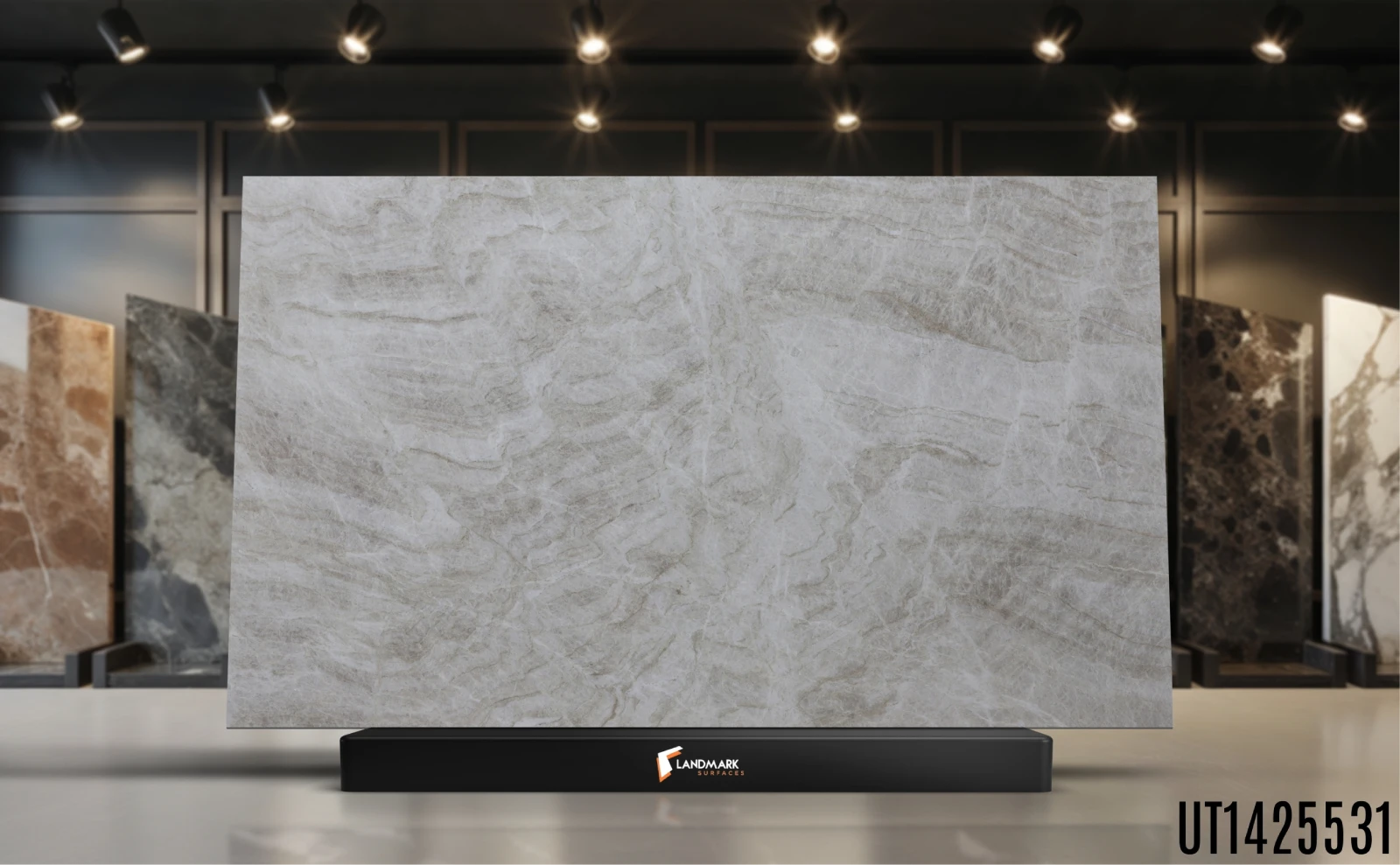
Shadow Storm marble is a white stone with gray veins that move like clouds in the sky: broad, soft bands that sweep diagonally across the slab, with a faint green-gray cast in the densest veins. It is sold as marble, quartzite, and as dolomite, sometimes by the same stone yard. The naming confusion needs to be addressed first, because it shapes expectations for how the stone will perform as a countertop.
We stock it in Chantilly in 3cm polished slabs, about 119 by 78 inches. This page starts with what the stone is and is not, then covers where it works, what our slab looks like up close, how we cut it, what it costs installed, and what living with a polished dolomitic marble is like day to day. For today’s slab count, go to live inventory.
This stone is commonly marketed under three different names, which can make shopping for it confusing. Some yards call it Shadow Storm quartzite, others call it Shadow Storm marble, and a few call it a dolomite. Only one of those names is wrong in a way that matters: it is not a quartzite. A true quartzite is a metamorphosed sandstone, almost entirely quartz, and it does not react to acid at all. Shadow Storm reacts. If you put a drop of lemon juice on an offcut, wait, and then wipe, it will leave a dull spot on a polished face. Slower than Carrara, but it dulls.
The most accurate label is dolomitic marble. The stone is a carbonate rock in which much of the calcite has been replaced by dolomite, a calcium-magnesium carbonate. That substitution changes how the stone performs compared with a typical Italian white marble. It is slightly harder, etches more slowly, and keeps its polish a little longer in a working kitchen. It is also why the quartzite label sticks. On a showroom floor, a hard, bright, polished white slab with gray movement looks like quartzite, and a quartzite price is easier to justify.
We list it as marble, because that is what it acts like on a counter. You get the look many buyers chase in the quartzite aisle at a significantly lower price, along with a surface that still asks for the same basic care as marble: a cutting board, a coaster, and an annual application of sealer. If a supplier calls it quartzite and prices it accordingly, ask for a simple lemon-juice test before you commit.

 4.9287 reviews

 Trustindex verifies that the original source of the review is Google.
 Trustindex verifies that the original source of the review is Google.
 Trustindex verifies that the original source of the review is Google.
 Trustindex verifies that the original source of the review is Google.
 Trustindex verifies that the original source of the review is Google.
 Trustindex verifies that the original source of the review is Google.
 Trustindex verifies that the original source of the review is Google.
 Trustindex verifies that the original source of the review is Google.


 Trustindex verifies that the original source of the review is Google.
 Trustindex verifies that the original source of the review is Google.
 Trustindex verifies that the original source of the review is Google.


 Trustindex verifies that the original source of the review is Google.
 Trustindex verifies that the original source of the review is Google.
 Trustindex verifies that the original source of the review is Google.

 Trustindex verifies that the original source of the review is Google.
 Trustindex verifies that the original source of the review is Google.
 Trustindex verifies that the original source of the review is Google.
 Trustindex verifies that the original source of the review is Google.
 Trustindex verifies that the original source of the review is Google.
 Trustindex verifies that the original source of the review is Google.
 Trustindex verifies that the original source of the review is Google.
 Trustindex verifies that the original source of the review is Google.
 Trustindex verifies that the original source of the review is Google.
 Trustindex verifies that the original source of the review is Google.


 Trustindex verifies that the original source of the review is Google.


 Trustindex verifies that the original source of the review is Google.
 Trustindex verifies that the original source of the review is Google.

 Trustindex verifies that the original source of the review is Google.
 Trustindex verifies that the original source of the review is Google.
 Trustindex verifies that the original source of the review is Google.
 Trustindex verifies that the original source of the review is Google.


 Trustindex verifies that the original source of the review is Google.
 Trustindex verifies that the original source of the review is Google.
 Trustindex verifies that the original source of the review is Google.
 Trustindex verifies that the original source of the review is Google.
Shadow Storm earns its place on a short list of white stones that can carry a whole kitchen without feeling as delicate as a typical white marble. The veining is substantial enough to define a long island, subtle enough to sit comfortably with the cabinets, and paired with a dolomite composition that tolerates everyday use better than Carrara. The rooms below are in the order we recommend them. The cases where we would steer you to something else come after the cost section.
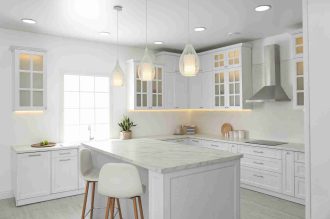
The island is where this stone was made to go. A single 119 by 78 inch slab covers most islands in one piece, with the broad diagonal bands running the length of the top and the densest movement set where eyes follow it into the room. A 3cm slab carries a clean eased or mitered edge with no build-up. On the perimeter it works just as well, and the lighter end of the slab usually goes there, so the island carries the drama while the perimeter stays calm. Keep lemons and vinegar on a tray rather than directly on the stone, and this is a kitchen stone you can cook on every day.
Vanity tops, tub decks, and shower walls. A polished white dolomitic marble fits well in a bathroom: there is no acid typically in this room, water spotting easily wipes off a polished face, and the diagonal movement looks amazing on a tall shower wall, where a bookmatched pair from one slab can meet at a corner. For a shower floor we recommend honing a piece, because a polished face is slippery when wet. The 3cm slab is a bit too thick for a wall; ask us about the lighter options if you have a large wall you want to cover.
A fireplace surround in Shadow Storm is a safe place to use the polished finish at full shine, because nothing acidic ever touches it and the stone picks up the flickering movement of the fire. Heat does not trouble a dolomitic marble. The same applies to a feature wall behind a range hood or a bar, where the veins can run floor to ceiling. One slab usually covers surround, hearth, and a mantel shelf with stone to spare.
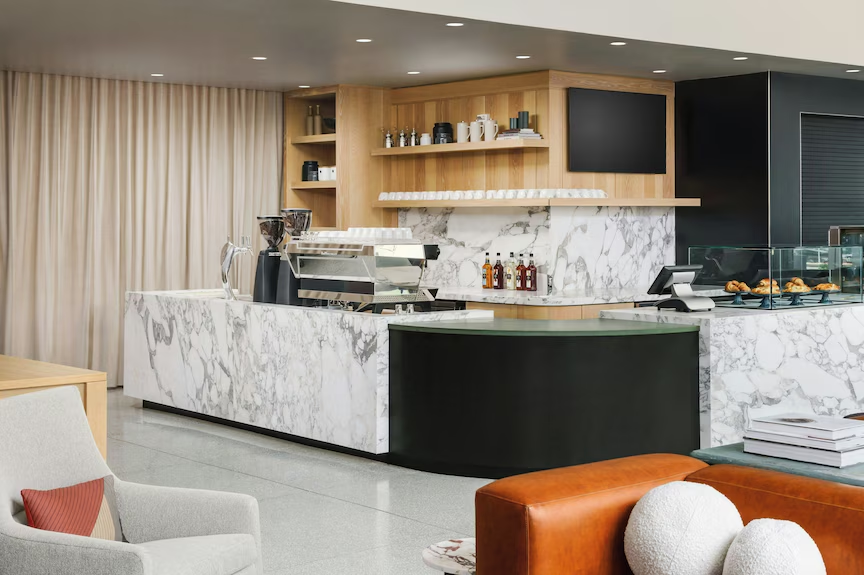
Dining tables, console tops, reception desks, and hospitality bars. The stone’s advantage is that it delivers much of the visual appeal of quartzite while remaining priced closer to marble, a meaningful difference when design goals and budgets need to align. For a dining table we hone the top; for a reception desk we keep it polished and recommend a topical sealer on the transaction ledge. In multi-slab commercial work, ask about bundle availability early, because the pattern shifts from slab to slab.
Whether you’re seeking a free estimate, a showroom visit, or an in-home evaluation, our team is ready to transform your space.
Our Shadow Storm in Chantilly is 3cm polished, about 119 by 78 inches, from one lot. The ground is a cool white with a faint warm undertone where the veins thin out. The movement is the main attraction of this slab: wide, soft gray bands sweep from lower left to upper right across the whole face, folding over each other like cloud layers rather than running as single lines. Inside the densest bands, there is a green-gray tint with a scatter of fine darker flecks, reflecting the underlying dolomite. There is no hard contrast anywhere on the face; the eye reads it as weather, not as drawing.
The pattern runs diagonal. That shapes the layout more than anything else about this stone. A piece rotated 90 degrees reads differently from one kept as it sat on the slab, so we keep every cut piece in its original orientation and set the direction at the template appointment. On an island the bands usually run toward the main line of sight into the room; on a perimeter they run with the long wall.
Polished from the factory. This lot arrived polished, and dolomitic marble is well suited to a polished finish, because it holds that polish better than Carrara. We will still show you an etched polished sample alongside an etched honed one before you decide. We can also hone the slab, or part of it, upon request. The honed face turns the gray bands softer and the white slightly warmer.
Why 3cm matters here. Most white marble on our floor is 2cm. At 3cm, the edge you see is the stone itself, with no lamination line, and a mitered waterfall can be finished with no visible seam line on a pattern this soft. It also means the slab is heavy, which the fabrication notes cover.
Shadow Storm varies more than most white stones from block to block. Some lots run whiter with thin gray threads, some run like a storm of gray-green. A future lot may look noticeably different from the slab photographed here. The slab you choose is tagged to your job the day you choose it.
Shadow Storm is a dolomitic marble quarried in Brazil. It began as a carbonate sediment, a lime mud, in which magnesium-rich water replaced much of the original calcite with the mineral dolomite before the rock was buried, heated, and recrystallized into marble. The Geology.com dolomite reference describes that replacement process and notes two practical advantages: dolomite has a Mohs hardness of 3.5 to 4 against calcite’s 3, and dolomite only bubbles weakly to diluted acid where calcite fizzes vigorously. It is harder, and is slower to react, but is still a carbonate stone.
Like many veined marbles, the gray in this stone comes from clay, carbon, and trace amounts of iron incorporated into the carbonate during recrystallization. The green-gray cast in the heaviest bands is characteristic of the Brazilian dolomitic whites and is one way to tell the family apart from an Italian marble, where the veins run pure gray or gray-blue. The flecks inside the bands are small dolomite crystals catching the light.
The quartzite problem, in one paragraph. Brazil also produces the white quartzites that dominate the high end of the market, and several of them come out of the ground within a few hundred miles of the dolomitic marbles. The trade has been selling the two side by side for years, and some yards tag a soft white stone as quartzite either out of habit or because the quartzite price is better. The Natural Stone Institute is clear on this point: calcareous stone etches from acids, and a buyer who was told their stone is quartzite will not expect a reaction on their stone. Our rare and exotic quartzite guide covers how to tell a true quartzite in the showroom. The easiest way to check is with a glass scratch test and a drop of lemon juice, both of which we are happy to perform on an offcut while you watch.
Names that overlap. Super White, Fantasy Brown, and a handful of other trade names belong to the same dolomitic family and behave the same way. Some of them are sold as Shadow Storm by other yards when the lot color is light enough. If you have seen a Shadow Storm elsewhere that looked warmer or grayer than ours, it may have been one of those closely related varieties. Compare slabs, not names.
A dolomitic marble cuts and polishes like marble, with two differences a fabricator notices: it is a little harder on the blade, and the polished face is more forgiving when being handled in the shop. The factors that most influence fabrication on Shadow Storm are the diagonal pattern, the 3cm thickness, and the choice of a polished or honed finish.
Edges on 3cm. No build-up. A clean eased edge, a small bevel, or a half bullnose cuts straight into the slab with no visible glue line. Mitered edges and waterfall ends are where this stone really gets to shine: the soft pattern hides the miter joint better than a high-contrast marble does, and the 3cm face gives the miter enough leeway to close cleanly. We ease every exposed corner by default. Heavy ogee profiles are possible but cut across the diagonal movement; we recommend the simpler profiles.
Vein direction. We lay the job out on the digital template with the slab photo underneath, keep every piece in its original orientation, and set the bands to run the same way across the room. Where a run turns a corner, the bands change direction at the seam. We place that seam where the eye does not instantly pick it up, usually at the sink or the cooktop.
Seams. The soft, cloud-like movement makes seams easier to hide than on a linear-veined marble, because there is no single vein that has to line up. We match the gray density on either side of the joint rather than chasing a line, and we place seams in the lightest part of the pattern.
Cutouts and rodding. Narrow strips at a sink or cooktop are rodded on dolomitic marble as a standard practice, 3cm included. Undermount sink cutouts are polished to match the face, which on a polished lot takes an extra shop step and is included in the fabrication price.
Sealing in the shop. Every piece gets a penetrating sealer before it leaves and a second coat at installation. A polished dolomitic face is tighter than a honed marble and holds a sealer well; in most kitchens a yearly reseal is typically enough.
Weight and lead time. A 3cm slab at 119 by 78 inches weighs roughly 1,100 to 1,200 pounds. That affects how many hands are on the install and whether a long island overhang needs steel supports. Fabrication and installation typically run 5 to 7 business days from template.


Shadow Storm typically runs $90 to $170 per square foot installed. That places it above White Carrara, below the Italian Calacattas, and a clear step below the Brazilian white quartzites it is often mistaken for. The slab is imported from Brazil and the lot is small, which keeps the material cost above a higher volume-quarried Carrara; the polished finish adds no additional cost to the slab.
What moves the number:
For comparison, White Carrara on our floor runs $70 to $130 per square foot installed, the Calacattas $120 to $280 depending on the stone and grade, a true white quartzite such as Taj Mahal $120 to $220, and a white engineered quartz is $50 to $110. Our countertop installation cost guide explains what is included in an installed price.
All figures are general ranges. The real number depends on the slab, the square footage, the edge, the number of seams and cutouts, and whether any piece is honed or goes on a wall. It is set at our free in-home estimate after we have measured.
Shadow Storm is easier to live with than an Italian white marble, but more demanding than the quartzite it is sold as. Those differences matter. Here it is compared next to the three surfaces most often chosen instead of it.
| Day to day | Polished Shadow Storm | Polished White Carrara | True white quartzite (Taj Mahal) |
|---|---|---|---|
| Lemon, wine, vinegar, tomato | Etches slowly; dull spot after minutes, not seconds | Etches quickly; visible after a short contact | No etching |
| Knives and dragged pots | Scratches; Mohs 3.5 to 4, marks are fine lines | Scratches more easily; Mohs 3 | Resists scratching; Mohs 7 |
| Hot pans | Tolerates heat; trivets anyway | Tolerates heat; trivets anyway | Tolerates heat well |
| Stains (oil, coffee, red wine overnight) | Possible if unsealed; poultice lifts | Possible and visible; poultice lifts | Rare when sealed |
| Sealing | At install, then about yearly | At install, then about yearly | At install, then every year or two |
| Repair | Re-polished in place | Re-polished in place | Rarely needed |
| Look over ten years | Soft patina on the polish where hands and acids land | Visible wear on a working counter | Essentially unchanged |
| Installed cost per sq ft | $90 to $170 | $70 to $130 | $120 to $220 |
Etching. Dolomite reacts with acid more slowly than calcite, and on a polished Shadow Storm a splash of lemon juice wiped up quickly while cooking usually leaves no traces of an etch. A lemon half left face down overnight leaves a dull ring. On a white ground with soft gray movement that ring is far less visible than on a plain white stone, and it comes out with a re-polish, which we can do for you. In a bathroom or on a wall, etching is rarely an issue at all.
Stains and sealing. Seal at installation and about once a year in a kitchen, less in a bathroom. Re-seal when water stops beading on the surface. A dark spot that gets through comes out with a poultice, which we can do or supply to you.
Cleaning. Warm water and a pH-neutral stone soap. No vinegar, no citrus cleaners, no acidic bathroom sprays, and no regular use of bleach. Use a cutting board for knives, felt under anything that gets dragged, coasters under wine. In a shower, a squeegee after use keeps mineral spotting off the polish.
Where we would slow you down
For how polished, honed, and leathered finishes change a stone’s behavior, see our countertop finishes guide.


A marble, specifically a dolomitic marble from Brazil. It is often sold as quartzite because it is harder and brighter than an Italian marble, but it is a carbonate stone and it etches from acids, which a true quartzite never does. A simple lemon juice test on an offcut can resolve the question in a matter of minutes.
Yes, more slowly than Carrara. Dolomite reacts with acid weakly where calcite reacts strongly, so a wiped-up splash usually leaves no damage, while acid left sitting leaves a dull spot. On a polished face that spot can be re-polished in place; on a honed face it blends into the surface.
Yes, for a household that uses cutting boards and coasters. It is one of the more forgiving white marbles for a working kitchen, and the 3cm polished slab carries a long island in one piece. If you want a counter that requires no habits at all, a true quartzite is the better choice.
Our lot is polished, and on a dolomitic marble the polish holds up better than it would on Carrara. We can hone the slab or part of it upon request, which softens the gray and hides etching better. We will show you an etched sample of each finish before you decide.
Yes. A penetrating sealer at installation and about once a year in a kitchen, less in a bathroom. Sealing slows stains; it does not stop it from etching. Re-seal when water no longer beads on the surface.
Usually, yes, in 3cm polished slabs, but natural stone inventory changes weekly and the lot is not large. Check the live inventory page or contact us before visiting, and we will tell you what is on the floor that day.
Shadow Storm fills the gap between marble and quartzite for buyers who want the appearance of the latter without paying its premium. The slab is in our Chantilly warehouse; bring a cabinet door, and ask us for a lemon, a piece of glass, and an offcut to test. Ten minutes with those three tells you more than any label.
Pricing and lead times on this page are general ranges for planning purposes. Actual cost depends on the slab selected, measured square footage, edge profile, seams, cutouts, and finish, and is confirmed at your free in-home estimate. Slab availability changes weekly. Natural stone varies from block to block, and future lots of Shadow Storm may differ in tone and veining from the slab shown. Dolomitic marble etches and scratches in normal use; this is a property of the stone, not a defect. Warranty terms vary by product, typically 6 to 10 years.
