




Years of Experience
0 +
Spotless Countertop Installation in Less Than a Week By 24+ years of experience and cutting-edge technology of Stone Fabrication & Installation there is no uncertanity


25391 Pleasant Valley Rd.
Chantilly, VA 20152
Phone: (703) 259-9027
5655 General Washington Dr
Suite G
Alexandria, VA 22312
Phone: (703) 259-9028
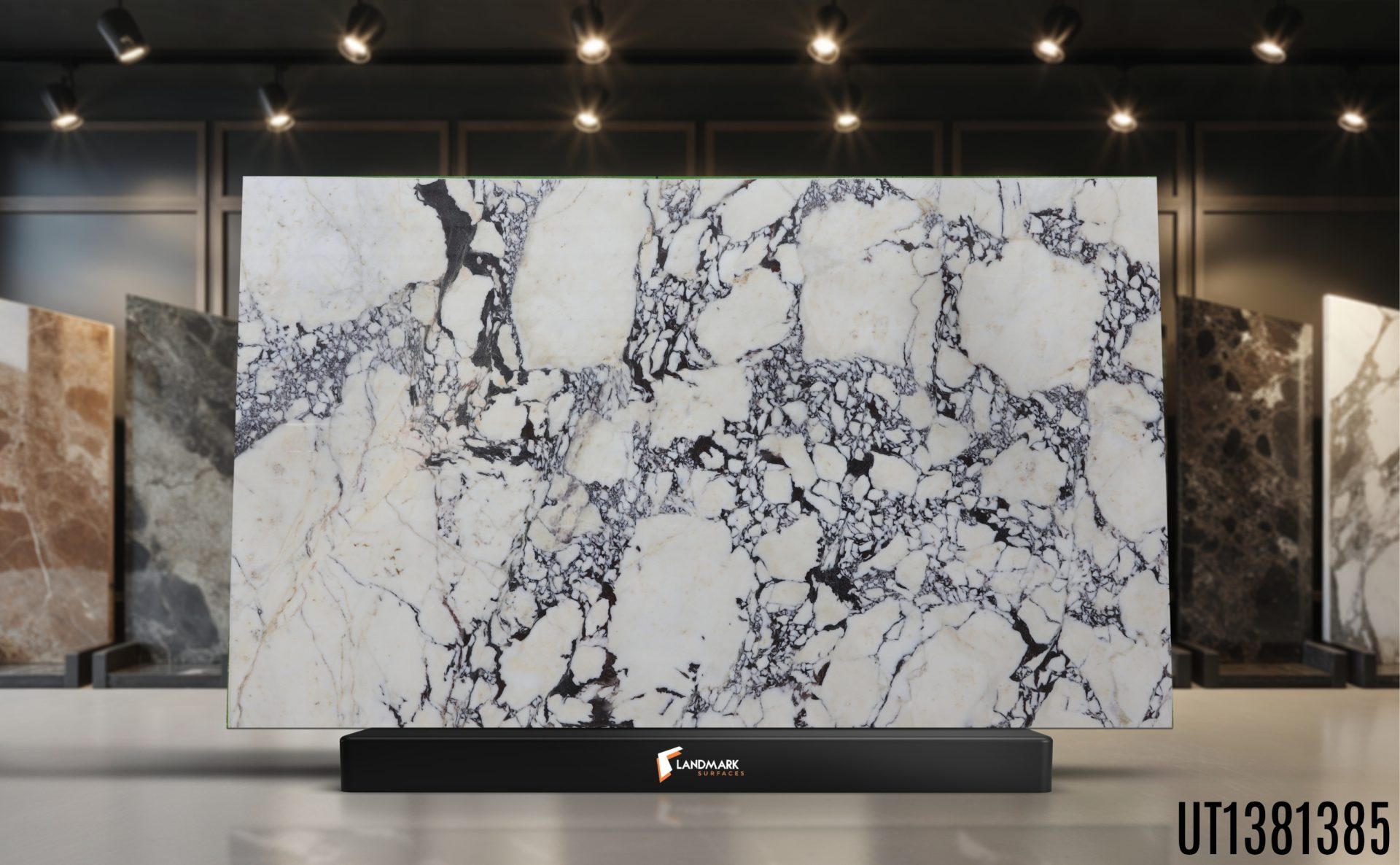
Calacatta Viola marble is the most searched stone on this site and the one we spend the most time talking people out of putting in the wrong room. It is an Italian breccia from the Versilia side of the Apuan Alps: a white to cream ground broken into angular pieces and cemented back together by veins of deep plum, burgundy, and violet. Nothing else on our floor looks like it, and nothing else on our floor is as sensitive to a splash of lemon juice as this slab is.
We stock it in Chantilly in two lots, 3cm polished and 2cm polished, from different blocks with noticeably different patterns. This page is about how to choose the best application: whether you want the real marble or one of its porcelain or quartz lookalikes, which rooms it belongs in, how etching can affect everyday life, how the two thicknesses differ, and what it tends to cost. For today’s slab count, go to live inventory.
Calacatta Viola became so popular so fast that the name now covers three different things, and roughly one in six searches for it is for a product that is not marble at all. It is worth sorting out which one you want before you drive to a warehouse.
The marble. The stone on this page. Quarried in Tuscany, each slab is unique, cut at 2cm or 3cm thicknesses, polished. Soft, acid-sensitive, and the only version with real depth: the white ground is translucent calcite, and the violet is a mineral stain that runs through the whole thickness of the slab. It is also the only version that ages, which some people appreciate and some people try to avoid.
The porcelain. Several porcelain slab makers print a Calacatta Viola pattern on a 6mm to 12mm fired ceramic body. We carry one of those in our porcelain line. It does not etch, stain, or scratch, it goes outdoors, and the pattern repeats every few slabs. Under a raking light the surface is flat; there is nothing behind the print. For a busy family kitchen or an outdoor bar, this is often the most practical and durable solution, and we will tell you so.
The quartz. Engineered quartz brands sell a Calacatta Viola colorway too. Same trade-offs as any quartz: no etching, no sealing, a printed or mixed pattern that repeats, and a resin binder that cannot withstand hot pans or direct sun. The violet in quartz reads as a cooler, flatter purple than the stone does.
The other marbles. Lookalike marbles from Turkey, Portugal, and Spain are sold under the same name. They are real marble and etch the same way, but their veins are softer and more diffuse, and the ground is warmer or grayer. Our slabs are Italian; the lot tag on the slab says where it came from, and you are welcome to check where any of our stones come from.
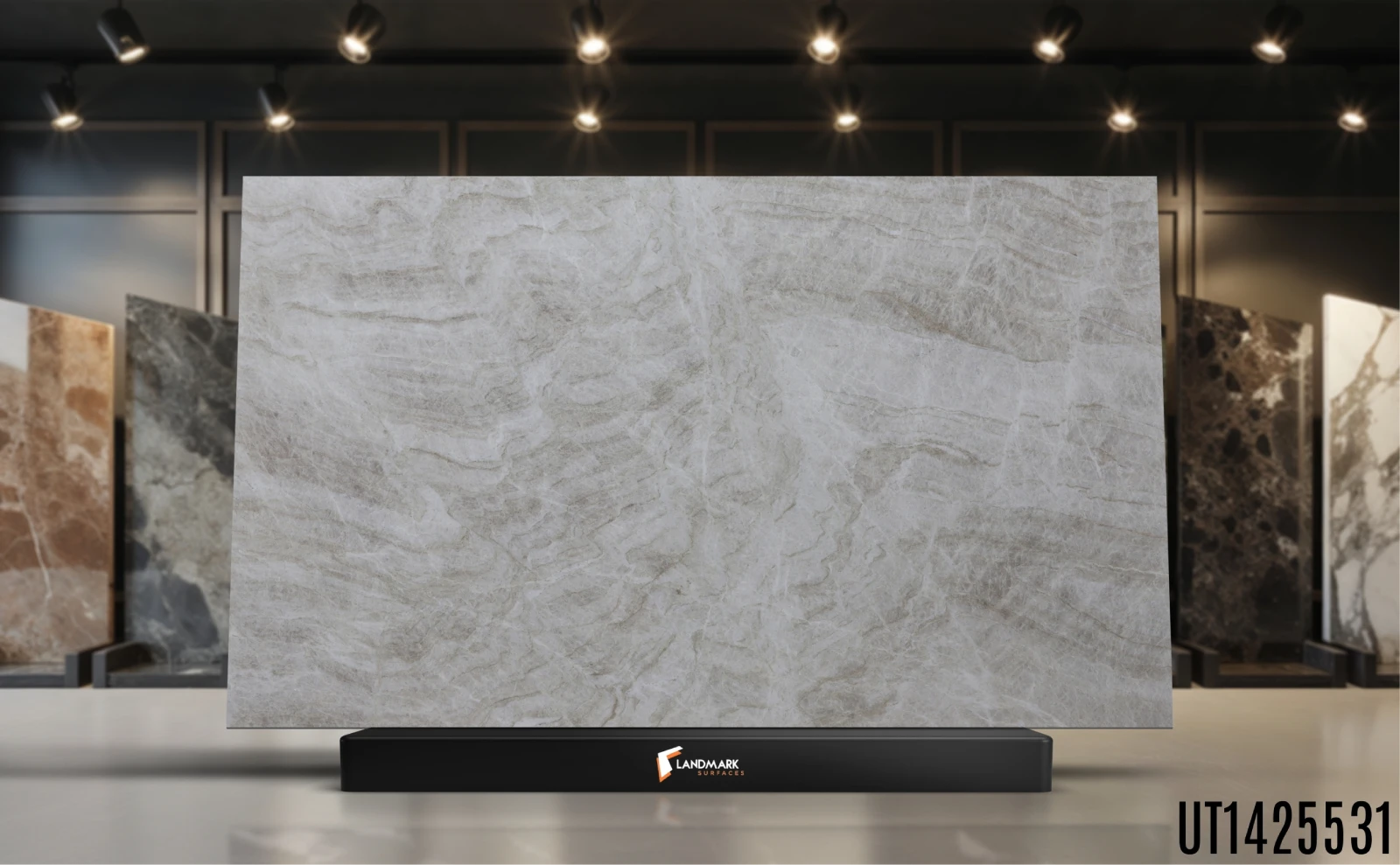
If you want marble, keep reading. For a busy family kitchen where nobody wants extra maintenance, the porcelain section is often the best place to start. Calacatta quartzites provide a natural-stone middle ground: the look of veined white stone with granite hardness, but without the violet.

 4.9287 reviews

 Trustindex verifies that the original source of the review is Google.
 Trustindex verifies that the original source of the review is Google.
 Trustindex verifies that the original source of the review is Google.
 Trustindex verifies that the original source of the review is Google.
 Trustindex verifies that the original source of the review is Google.
 Trustindex verifies that the original source of the review is Google.
 Trustindex verifies that the original source of the review is Google.
 Trustindex verifies that the original source of the review is Google.


 Trustindex verifies that the original source of the review is Google.
 Trustindex verifies that the original source of the review is Google.
 Trustindex verifies that the original source of the review is Google.


 Trustindex verifies that the original source of the review is Google.
 Trustindex verifies that the original source of the review is Google.
 Trustindex verifies that the original source of the review is Google.

 Trustindex verifies that the original source of the review is Google.
 Trustindex verifies that the original source of the review is Google.
 Trustindex verifies that the original source of the review is Google.
 Trustindex verifies that the original source of the review is Google.
 Trustindex verifies that the original source of the review is Google.
 Trustindex verifies that the original source of the review is Google.
 Trustindex verifies that the original source of the review is Google.
 Trustindex verifies that the original source of the review is Google.
 Trustindex verifies that the original source of the review is Google.
 Trustindex verifies that the original source of the review is Google.


 Trustindex verifies that the original source of the review is Google.


 Trustindex verifies that the original source of the review is Google.
 Trustindex verifies that the original source of the review is Google.

 Trustindex verifies that the original source of the review is Google.
 Trustindex verifies that the original source of the review is Google.
 Trustindex verifies that the original source of the review is Google.
 Trustindex verifies that the original source of the review is Google.


 Trustindex verifies that the original source of the review is Google.
 Trustindex verifies that the original source of the review is Google.
 Trustindex verifies that the original source of the review is Google.
 Trustindex verifies that the original source of the review is Google.
This is a feature stone. It is at its best when it is looked at more than it is worked on, and where a small amount of patina over the years will read as character rather than damage. The rooms below are in the order we recommend them. The kitchen is last for a reason, which we will explain in the section after the cost figures.
The best-suited home for Calacatta Viola. A vanity top, a tub deck, a shower wall in bookmatched slabs. Few acids, no knives, and a vanity-size piece can come from the most dramatic corner of a slab. Keep perfume and toothpaste off the polish and it will retain its finish for years to come.
Vertical, untouched, and lit from the side, a full slab of Calacatta Viola will become the most photographed feature in your house. The 2cm lot is the right one for this use: lighter, cheaper to hang, and the pattern is denser. Nothing spills on a wall.
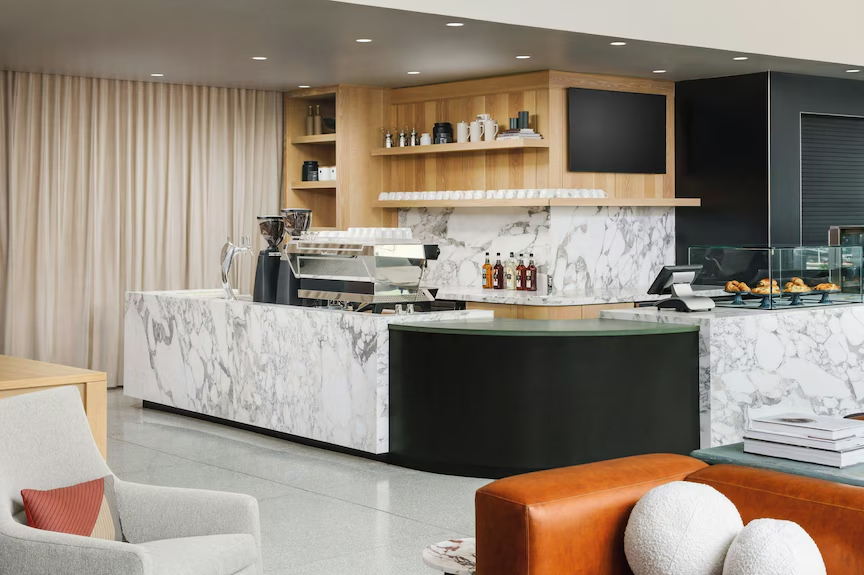
Low traffic, high visibility, usually one slab. A bar top will potentially experience splashes of wine and citrus, so expect the polish to soften around the sink over the years; most bar owners accept that so they can have this quality of marble there. A console in the entry sees little day-to-day wear and stays perfect for a lot longer.
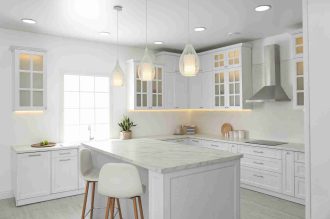
An island people gather around, with a harder stone on the perimeter where the cooking happens, is how most of our clients experience Calacatta Viola in a kitchen. A full working kitchen in this marble is possible for someone who likes patina and cleans as they go; it is not for everyone, and we explain this at the estimate.
Whether you’re seeking a free estimate, a showroom visit, or an in-home evaluation, our team is ready to transform your space.
The name is a marketing success more than a geological one. “Calacatta” properly describes the white, gold-veined marbles from a few quarries above Carrara. Calacatta Viola comes from the same mountains but a different district: the Versilia valleys around Seravezza, which have produced colored breccias since the sixteenth century. The Italian marble trade’s own reference, the CMP Solmar handbook of Apuan commercial names, files it under the Brecce di Seravezza as “Calacatta Viola, also Breccia Viola: white with purple veins,” and notes that the Calacatta label was borrowed for these older, brecciated materials because of their arabesque look. The quarries that produce it are few and the seams are thin, which is why the price sits where it does.
A breccia is a rock made of broken pieces. The white ground of Calacatta Viola was a marble that fractured under mountain-building pressure; mineral-rich water then moved through the cracks and cemented the fragments back together. The violet is that cement: calcite colored by iron and manganese oxides. It is not a surface stain and it does not fade, but it also means the slab is a mosaic of pieces held together by veins, and the veins are where the fissures live.
To the touch, it is a true marble: calcite, roughly Mohs 3 to 4, soft enough to scratch with a steel knife and reactive to any acid. The Natural Stone Institute’s care guide puts it plainly: products containing lemon, vinegar, or other acids may dull or etch calcareous stones. Everything we recommend on this page follows from that one principle.
One name worth keeping separate: Breccia Capraia, from the same Seravezza valleys, is the gray cousin: the same mosaic of white fragments, held together by a gray web with gold threads instead of violet veins. We carry both, Viola in two lots and Capraia in a polished Extra grade. If the purple is a non-negotiable, you want Calacatta Viola; if the mosaic texture is the desired feature and the color is not as important, look at Breccia Capraia.
We have Calacatta Viola marble at our Chantilly location from two blocks, and they do not look alike. Both are polished; the difference is thickness and pattern, and it determines which one your project should use.
The 3cm lot. Slabs are roughly 117 by 70 inches. Large, clean white fragments, some the size of a dinner plate, separated by bold plum-to-black veins with an occasional rust thread. This is the classic open, high-contrast Calacatta Viola that photographs beautifully from across a room. It is the proper slab for an island, a vanity top, or a bar, where the thickness carries an edge profile without lamination and where a big white field is desired.
The 2cm lot. Slabs are roughly 135 by 74 inches. Smaller fragments, denser veining, more gray in the ground, with flecks of oxblood throughout. Busier and softer from a distance, and the longer format is ideal for walls: a shower, a fireplace, a full-height backsplash. At 2cm it weighs about a third less, hangs more easily, and costs less per square foot. For a countertop it requires a laminated or mitered edge to read as a thicker top, which is standard practice and priced as such.
Choosing between them. Countertop with a visible edge and a calm field: 3cm. Wall, shower, or fireplace: 2cm. A kitchen island with a waterfall end can go either way; the 2cm lot mitered looks exactly as thick as you need it to. Several slabs of each are on the floor at the time of writing; check live inventory for today’s count, and come look at both, because the photos above flatten the difference between them.
This marble changes block to block more than almost any stone we carry. A future lot may run whiter, more purple, or finer-grained than either of these. The slab you choose is the slab you get; we tag it to your job the day you pick it.
A breccia is fabricated differently from a solid marble, and Calacatta Viola is fabricated differently again because of what it costs if a piece breaks.
Backing and resin. Slabs arrive from Italy resin-filled and mesh-backed, because the fragments are held together by veins that can sometimes open. We check every slab for soft spots and surface fills under light before it goes on the saw, in addition to telling you where they are. A fill in a vein is normal on this stone and not a defect; a fill in the middle of a white field is something we route around.
Layout. The slab is a mosaic, so we lay out the largest uninterrupted white fragments where you will get the greatest visual impact, and put the busy, vein-heavy areas near walls and appliances. Cutouts go through vein-free zones wherever the layout allows; a sink cutout that crosses three veins has potentially three places to crack.
Bookmatching. Consecutive slabs from the same block mirror each other, and on this stone the effect is especially theatrical. Shower walls and fireplace surrounds are usually bookmatched from the 2cm lot. It doubles the slab count and we lay it out on the digital template before anything is cut to get a precise alignment.
Edges. On 3cm, eased, small bevel, or half bullnose. On 2cm, a mitered edge built up to the thickness you want; a mitered waterfall on this marble is one of the best things we make since it makes full use of its movement and veining. We avoid heavy ogee profiles on breccia because the profile crosses many fragments and vein boundaries and looks muddled.
Seams. A seam through a white field is visible; a seam that follows a vein disappears. We plan seams along veins, not at the geometric middle of a run, and on a bookmatched pair the seam is the centerline by design.
Rodding and handling. Narrow strips at sinks and cooktops are rodded without exception. The slabs are moved and installed with more hands than a granite of the same size, because a fracture on a slab at this price has different financial consequences from one on a standard granite.
Weight and lead time. A 3cm slab at 117 by 70 inches weighs roughly 900 to 1,000 pounds; a 2cm slab at 135 by 74 about 800. Fabrication and installation typically run 5 to 7 business days from template.


Calacatta Viola marble typically runs $140 to $280 per square foot installed for the 3cm lot and somewhat less for 2cm, which places it at the top of our marble collection alongside the rarest Calacattas. Most of that cost is the slab itself. Italian supply is small, the blocks are selected one at a time, and the usable yield from a breccia is lower than that of a solid white marble.
What moves the number:
For comparison, a classic White Carrara installs at roughly $70 to $130 per square foot, the Calacatta quartzites at $90 to $200, and the porcelain version of this pattern at $60 to $120. Our countertop installation cost guide explains what is included in an installed price.
All figures are general ranges. The real number depends on the lot, the square footage, the number of seams and cutouts, and the edge profile. It is set at the free in-home estimate after we have measured.
Marble owners are divided into people who were told the truth before they bought and people who were not. Here is the truth, next to the two surfaces most often chosen instead of marble.
| Day to day | Calacatta Viola marble | Calacatta quartzite | Calacatta Viola porcelain |
|---|---|---|---|
| Lemon, wine, vinegar, tomato | Etches: dull spots within minutes on a polished top | No etching | No etching |
| Knives and dragged pots | Scratches; use boards and felt | Resists | Resists |
| Hot pans | Tolerates heat; trivets anyway | Tolerates heat | Tolerates heat |
| Stains (oil, coffee, wine left overnight) | Possible; sealer slows them, poultice lifts most | Rare when sealed | None |
| Sealing | At install, then yearly or more on a counter | At install, then every 1 to 3 years | None |
| Repair | Etches and scratches can be re-honed or re-polished in place | Rarely needed | Chips are permanent |
| Pattern | Unique, through the full thickness | Unique | Printed, repeats, surface only |
| Outdoors | No | Yes | Yes |
| Installed cost per sq ft | $140 to $280 | $90 to $200 | $60 to $120 |
What etching is. Calcite dissolves in acid. A drop of lemon juice left on a polished marble top takes a few minutes to eat the polish off that spot, leaving a dull mark in the shape of that drop. It is not a stain and it does not go deeper; it is a change in surface finish. Sealers do not prevent it, because the sealer sits in the pores and the acid attacks the surface. On a honed finish the same etch is nearly invisible, which is why many marble kitchens are honed; on this stone, polishing is what makes the violet sing, so most people keep it polished and accept the marks or have them buffed out every few years.
Sealing and stains. Sealing matters more on marble than on granite because the stone is more open. Seal at installation, re-seal when water stops beading, and keep oil and red wine from sitting overnight. The Natural Stone Institute is clear that a sealer is an impregnator that slows stains, not a coating that stops them.
Cleaning. Warm water and a pH-neutral stone cleaner, nothing else. No vinegar, no citrus cleaners, no bathroom sprays with acid in them, which rules out the most common household cleaners. Coasters under glasses, especially wine and citrus. A microfiber cloth should never be too far away from this kind of countertop.
Where we would slow you down
For where marble sits among the stones people actually install, see our guide to the types of natural stone countertops.


Yes. Calacatta Viola is an Italian brecciated marble from the Versilia district of the Apuan Alps, a calcite stone with violet veins colored by iron and manganese oxides. Porcelain and quartz products sold under the same name are printed or engineered copies.
In Tuscany, Italy, in the Seravezza area of the Apuan Alps, where colored breccias have been quarried since the sixteenth century. Lookalike marbles are also quarried in Turkey, Portugal, and Spain and sold under the same name; our slabs are Italian.
Yes, with care. It etches from acids and scratches from knives, so most of our clients use it on an island or bar and put a harder stone where the cooking happens. A full marble kitchen suits someone who accepts patina and wipes spills as they go.
Yes to both. Lemon, vinegar, wine, and most cleaners dull the polish where they sit, and oil or red wine left overnight can stain. A sealer slows stains but does not stop etching. Etches can be re-polished in place.
3cm for countertops with a visible edge and a calm, open pattern. 2cm for shower walls, fireplaces, and full-height backsplashes, or for a countertop with a mitered edge or waterfall. We stock both; the two lots also differ in pattern, so see them side by side.
Usually, yes, in 3cm and 2cm polished slabs, but natural stone inventory changes weekly and this marble sells quickly. Check the live inventory page or contact us before visiting, and we will tell you what is on the floor that day.
Calacatta Viola marble is a stone people fall for from a single photo, but it is best to only buy after seeing it in person. The two lots are in our Chantilly warehouse; stand in front of both, put a drop of water on the polish to see how the violet deepens, and tell us which room you have in mind for it. If this is not the room for this stone, we will tell you, and we will show you what we would put there instead.
Pricing and lead times on this page are general ranges for planning purposes. Actual cost depends on the lot and slab selected, measured square footage, seams, cutouts, and edge profile, and is confirmed at your free in-home estimate. Slab availability changes weekly. Natural stone varies from block to block, and future lots of Calacatta Viola may differ in color, vein density, and fragment size from those shown. Marble etches and scratches in normal use; this is a property of the stone, not a defect. Warranty terms vary by product, typically 6 to 10 years.
