




Years of Experience
0 +
Spotless Countertop Installation in Less Than a Week By 24+ years of experience and cutting-edge technology of Stone Fabrication & Installation there is no uncertanity


25391 Pleasant Valley Rd.
Chantilly, VA 20152
Phone: (703) 259-9027
5655 General Washington Dr
Suite G
Alexandria, VA 22312
Phone: (703) 259-9028
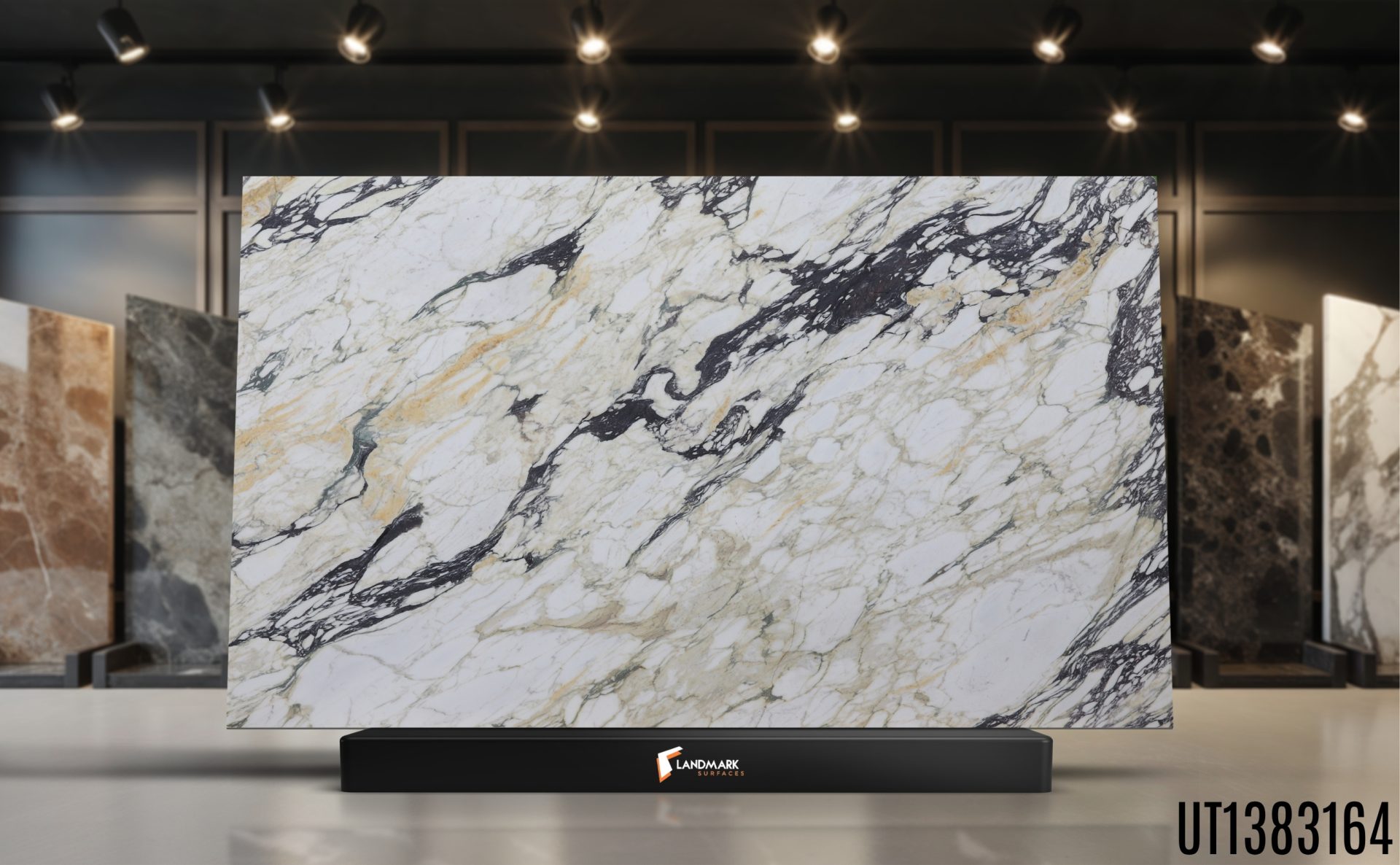
Calacatta Monet marble is a white Italian marble defined by two distinct elements: broad sweeps of charcoal that cross the slab like brushstrokes, and finer veins of gold and ochre woven beside and through them. The trade name is a nod to the famous painter since it references the brushstroke-like veining. On the slab the two colors do not compete; the charcoal gives structure and the gold gives the warmth, so a room has to be designed around both.
We stock it in Chantilly in 2cm honed slabs from one lot, large ones at about 115 by 80 inches. This page is about making the most of Calacatta Monet: how to design a kitchen around its two-color veining, where the stone works best, what it is and where it comes from, how we fabricate it, what living with a honed white marble involves, and what it typically costs installed. For today’s slab count, go to live inventory.
Most white marbles give a designer one dominant color to work with: the gray of a Carrara, or the gold of a Calacatta Oro. Monet gives two, charcoal and gold, and the most successful kitchens are those that keep both in mind. The most successful projects have a few common principles, starting from the template appointments where the decisions get made.
Pick which vein leads. Every slab in our lot carries both colors, but each one emphasizes them differently. Some have a dominant charcoal sweep with gold as an accent; others are gold-forward with the charcoal breaking through in short strokes. The slab you choose sets the mood of the room, and it should be the first decision made, before cabinets.
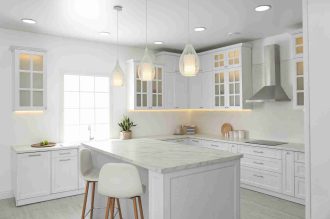
Cabinets answer the charcoal. Black, deep green, navy, or walnut cabinets pick up the dark veining and make the white ground read brighter. White cabinets work too, but then the charcoal becomes the dominant element in the room and the counter carries all that weight; this is a strong look and a deliberate one.
Hardware and lighting answer the gold. Unlacquered brass, aged bronze, or warm-toned fixtures pick up the ochre vein and keep the stone from reading too cold. Chrome and polished nickel fight it. Warm white bulbs flatter the gold; cool daylight bulbs flatten it.
Let the stone be the pattern. A busy tile backsplash paired with Monet is the most common mistake. A plain plaster wall, a slab backsplash from the same lot, or a simple glazed tile in a color pulled from the vein all work much better. The same goes for floors: nothing with another dominant pattern.
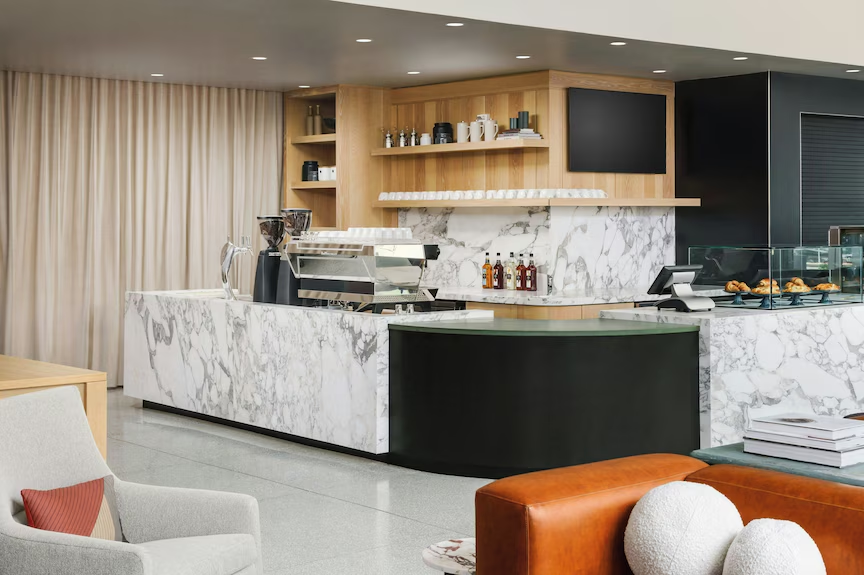
Where to spend the drama. The boldest sweep in the slab belongs where it is seen in full: an island top, a wall behind the range, a bookmatched shower. The quieter corners of the slab go into the perimeter runs beside the sink or a coffee station, where cutouts would interrupt a big vein anyway. We mark all of this on the digital template before anything is cut.

 4.9287 reviews

 Trustindex verifies that the original source of the review is Google.
 Trustindex verifies that the original source of the review is Google.
 Trustindex verifies that the original source of the review is Google.
 Trustindex verifies that the original source of the review is Google.
 Trustindex verifies that the original source of the review is Google.
 Trustindex verifies that the original source of the review is Google.
 Trustindex verifies that the original source of the review is Google.
 Trustindex verifies that the original source of the review is Google.


 Trustindex verifies that the original source of the review is Google.
 Trustindex verifies that the original source of the review is Google.
 Trustindex verifies that the original source of the review is Google.


 Trustindex verifies that the original source of the review is Google.
 Trustindex verifies that the original source of the review is Google.
 Trustindex verifies that the original source of the review is Google.

 Trustindex verifies that the original source of the review is Google.
 Trustindex verifies that the original source of the review is Google.
 Trustindex verifies that the original source of the review is Google.
 Trustindex verifies that the original source of the review is Google.
 Trustindex verifies that the original source of the review is Google.
 Trustindex verifies that the original source of the review is Google.
 Trustindex verifies that the original source of the review is Google.
 Trustindex verifies that the original source of the review is Google.
 Trustindex verifies that the original source of the review is Google.
 Trustindex verifies that the original source of the review is Google.


 Trustindex verifies that the original source of the review is Google.


 Trustindex verifies that the original source of the review is Google.
 Trustindex verifies that the original source of the review is Google.

 Trustindex verifies that the original source of the review is Google.
 Trustindex verifies that the original source of the review is Google.
 Trustindex verifies that the original source of the review is Google.
 Trustindex verifies that the original source of the review is Google.


 Trustindex verifies that the original source of the review is Google.
 Trustindex verifies that the original source of the review is Google.
 Trustindex verifies that the original source of the review is Google.
 Trustindex verifies that the original source of the review is Google.
Monet is a statement stone, and statements belong where they can be seen in their entirety. Because our lot is honed, it is also a more forgiving kitchen marble than its appearance might suggest. The cases where we would steer you elsewhere are after the cost section.
The natural home for the boldest sweep in the slab. A 115 by 80 inch slab covers a large island in one piece, and a mitered waterfall end carries the charcoal down to the floor. Pair it with a quieter perimeter, in the same stone or a harder one.
A full-height slab behind the range, with the veins running up from the counter, is the second-most photographed use of this stone. Vertical, 2cm is the right thickness, and heat from a cooktop is not a concern for marble.
Two consecutive slabs mirrored on a shower wall turn the charcoal sweep into a symmetrical design. Honed marble is also the better finish underfoot and around water. Vanity tops can come from the remnant of a kitchen installation.
A surround cut so one vein frames the opening, or a dining table top from the most painterly part of a slab. Small pieces let you buy the best square feet of the lot without buying the whole slab.
Whether you’re seeking a free estimate, a showroom visit, or an in-home evaluation, our team is ready to transform your space.
Calacatta Monet is a white marble from the quarries above Carrara, a member of the Calacatta family, and the most colorful member of it. The Italian trade’s reference, the CMP Solmar handbook of Apuan commercial names, describes it as white with gray, brown, pink, and golden veins, which is the widest color grouping of any Calacatta in the handbook. On our lot the gray reads as charcoal and the brown and gold flow together into ochre; the pink peaks through as a faint warmth at the edge of some veins.
All of that color is mineral. The white is calcite, the recrystallized limestone that every Apuan marble is made of. The charcoal is carbon and clay that were part of the original sea-floor sediment and then were squeezed into bands as the limestone was folded and heated over millions of years. The gold and ochre are iron oxides that moved through the rock by way of water after it formed. Because the two pigments got into the stone at different times and by different routes, they took different paths, which is why a Monet slab has two systems of veins crossing each other rather than one. The Geology.com marble reference covers general cases: pure marble is white, and clay, iron oxide, and bituminous material are what give it its colors.
What this means for your counter is the same as for every marble: calcite, Mohs 3, and a reaction with acids. The color does not change the chemistry. Monet etches like a Carrara and scratches like a Carrara; it is simply a Carrara-basin marble with more going on in it.
Compared with its cousins. Next to Calacatta Borghini, Monet is bolder and warmer, with far more dark veins; Borghini carries its gold inside gray veins on a cleaner field. Next to a Calacatta Oro or “Calacatta Gold,” Monet has the charcoal coloring that those do not. Next to Calacatta Viola, which is a breccia, Monet is a true veined marble: the pattern flows rather than fractures. Engineered quartz sold under the Monet name is a printed copy of this pattern; it does not etch and has no depth, and it repeats every few slabs.
Our Calacatta Monet marble in Chantilly is 2cm honed, about 115 by 80 inches, from one lot. That is a large slab for a Calacatta, and that matters for this stone: a big island comes out of one piece with the main vein uninterrupted, and a range wall can be a single panel. Several slabs are on the floor as of this writing; check live inventory for today’s count.
How the lot reads. The ground is a clean white with a faint cream warmth. The charcoal runs in wide diagonal sweeps, some a hand’s width across, that cross the slab from corner to corner; the gold and ochre run as finer veins beside them and as soft patches between. Every slab in the lot has both colors, and every slab leans one way or the other, which is why we ask you to choose the slab before choosing cabinets. Consecutive slabs mirror each other closely enough to bookmatch.
Why honed. We stock Monet in honed because it is a kitchen stone in most of the projects it goes into, and an etch mark on a honed white surface is close to invisible where the same mark on a polished one is a permanent dull print until it is fixed. Honed also calms the charcoal a little, which most people prefer on a large island. Polished Monet is brighter and the veins read sharper; we can polish a slab upon request for a bathroom or a fireplace, but first we will show you an etched sample of each finish.
What 2cm means. Walls, showers, and backsplashes: the right thickness, lighter and easier to hang. Countertops: the edge is built up by lamination or a miter to read as 3cm or thicker, and narrow strips are rodded. The edge you see is a choice, not what comes standard.
Monet varies block to block more than most Calacattas because it has more pigment to vary. A future lot may run grayer, more gold, or quieter than the slabs photographed here. The slab you choose is tagged to your job the day you choose it.
Monet is cut the way a picture is framed: the pattern decides the cuts, not the other way around.
Vein mapping. Before the template is final we photograph the slab, overlay the kitchen on it, and move the pieces until the main charcoal sweep lands where it will be fully seen and the cutouts fall in the quiet areas. A sink cutout through the middle of a dominant vein is something that cannot be undone, so it is the first thing we check.
Continuity across pieces. Where the island meets a perimeter run, or a counter meets a backsplash, we cut adjacent pieces from adjacent areas of the slab so that the veins carry across the joint at the same angle. On a two-color stone this matters twice as much, because the gold vein and the charcoal vein both have to line up.
Bookmatching. Consecutive slabs mirror each other. A bookmatched Monet shower or island is a showpiece; the charcoal sweep becomes a symmetrical figure and the gold echoes it. It doubles the slab count and we show you the mirrored layout on the template before cutting.
Edges on 2cm. A mitered edge is the best edge for this stone, because the veins fold over the corner and continue down the face. A laminated edge works where the edge is hidden. We ease every exposed corner since marble chips on a sharp 90-degree corner more readily than granite.
Seams. On a stone this bold, a seam through a vein is more noticeable and a seam through the white field is not. Seams go in the field, and occasionally shift a few inches in order to stay out of a vein. On a bookmatched pair the seam is the centerline by design.
Cutouts and rodding. Every narrow strip at a sink or cooktop is rodded. Undermount sink cutouts are eased and honed to match the top.
Sealing in the shop. Honed white marble is an open surface. Every piece gets a penetrating sealer before it leaves the shop and a second coat at installation.
Weight and lead time. A 2cm slab at 115 by 80 inches weighs roughly 730 pounds. Fabrication and installation typically run 5 to 7 business days from template.


Calacatta Monet marble typically runs $130 to $230 per square foot installed, which puts it in the same tier as Calacatta Borghini but below the rarest breccias. The slab is most of that cost; Monet comes from a small part of the Carrara district and the demand for it has risen faster than the supply in the last two years.
What moves the number:
For comparison, a White Carrara installs at roughly $70 to $130 per square foot, the Calacatta quartzites at $90 to $200, and an engineered quartz printed with a Monet pattern at $60 to $110. Our countertop installation cost guide explains what is included in an installed price.
All figures are general ranges. The real number depends on the slab, the square footage, the edge, the number of seams and cutouts, and whether the layout is bookmatched. It is set at the free in-home estimate after we have measured.
A honed white marble with a lot of pattern is, for daily use, one of the more forgiving marbles: the veins hide what the white would show. Here it is compared to the two surfaces most often chosen instead.
| Day to day | Honed Calacatta Monet | Calacatta quartzite | Monet-pattern engineered quartz |
|---|---|---|---|
| Lemon, wine, vinegar, tomato | Etches; nearly invisible on honed, hidden further by the veins | No etching | No etching |
| Knives and dragged pots | Scratches; use boards and felt | Resists | Resists |
| Hot pans | Tolerates heat; trivets anyway | Tolerates heat | Can scorch the resin |
| Stains (oil, coffee, red wine overnight) | Possible on the white areas; sealer slows, poultice lifts | Rare when sealed | None |
| Sealing | At install, then yearly in a kitchen | At install, then every 1 to 3 years | None |
| Repair | Etches and scratches re-honed in place | Rarely needed | Chips are permanent |
| Pattern | Unique, two vein systems, bookmatches | Unique | Printed, repeats, surface only |
| Installed cost per sq ft | $130 to $230 | $90 to $200 | $60 to $110 |
Etching. Calcite reacts with acid; the Natural Stone Institute’s care guide names lemon, vinegar, and other acids as the main offenders that dull or etch calcareous stone. On honed Monet an etch is a slightly lighter patch visible at a low angle, and on a surface this busy it is hard to find. Keep bathroom sprays and citrus cleaners off it for best results.
Stains and sealing. The white areas can absorb stains that the veins would hide, so the sealer matters: at installation and about once a year in a kitchen, less in a bathroom. Wipe oil and red wine instead of leaving it to soak in. A dark spot that does appear comes out with a poultice, which we can supply or do for you.
Cleaning. Warm water and a pH-neutral stone soap. No vinegar, no abrasive pads, and no regular use of bleach. A cutting board for knives, felt under anything that gets dragged, coasters under wine.
Where we would slow you down
For where marble sits among the stones people actually install, see our guide to the types of natural stone countertops.
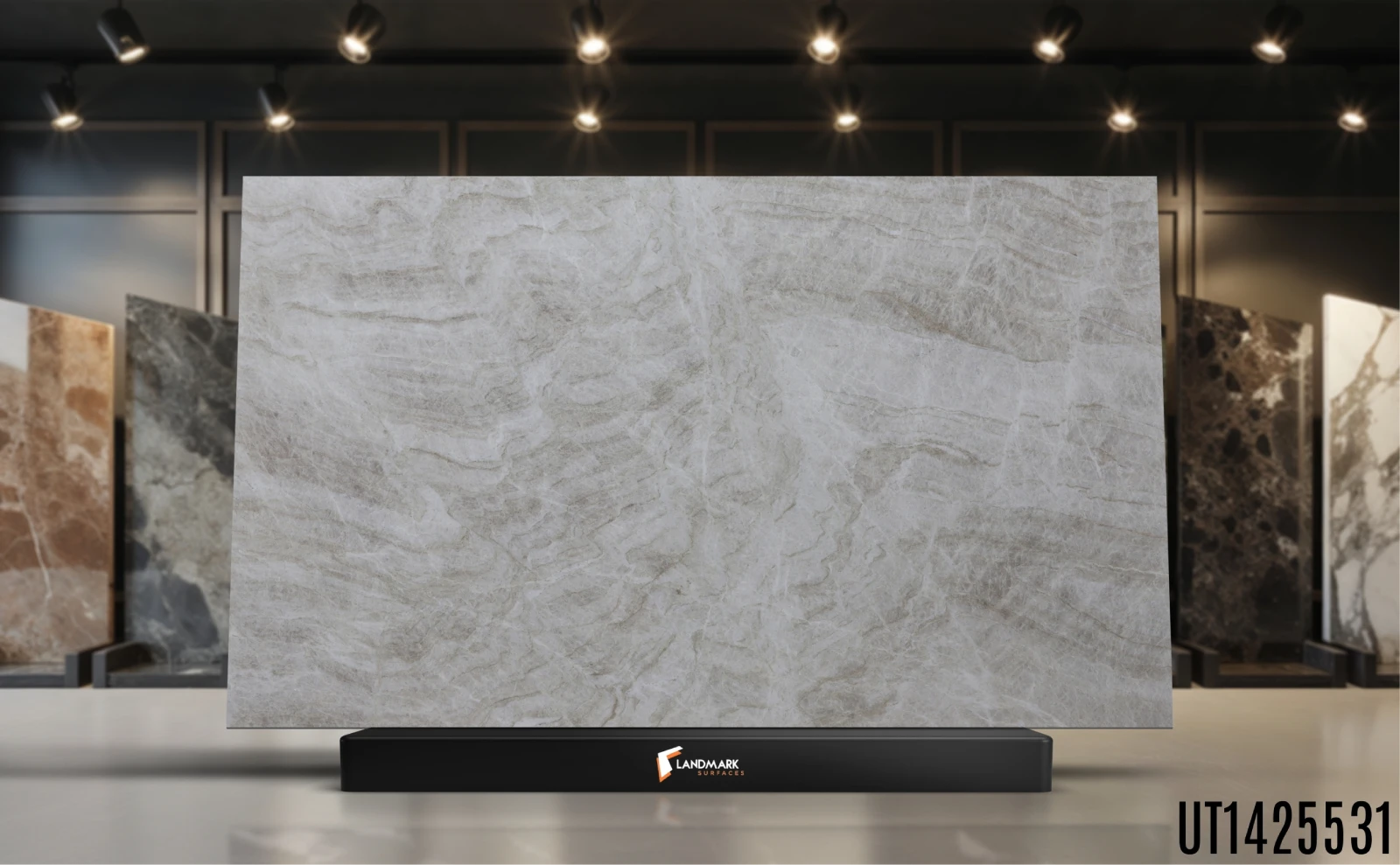


A clean white ground crossed by broad charcoal sweeps and finer gold and ochre veins, with a faint pink warmth in some vein edges. It is the most colorful of the Calacatta marbles, and every slab leans either charcoal-forward or gold-forward.
Yes, honed. It etches from acids and scratches from knives like every marble, but on a honed white surface with this much pattern, the marks are close to invisible. We stock it honed for that reason.
Both are white Carrara-district marbles with the same care needs. Monet is bolder and warmer, with wide charcoal veins and separate gold veins. Borghini is cleaner, with gray veins that carry gold inside them and leave more open white field between them.
Dark cabinets, black, deep green, navy, or walnut, pick up the charcoal vein and make the white brighter. White cabinets work in a strong, counter-led look. Warm metals such as brass or bronze pick up the gold; keep backsplashes and floor patterns quiet.
Yes. A penetrating sealer at installation and about once a year in a kitchen. It slows stains on the white areas and buys time to wipe up spills; it does not stop etching. Re-seal when water no longer beads on the surface.
Usually, yes, in 2cm honed slabs, but natural stone inventory changes weekly and this marble sells quickly. Check the live inventory page or contact us before visiting, and we will tell you what is on the floor that day.
Calacatta Monet is a stone you should choose by looking slab by slab, because no two in the lot lean the same way and the one you pick sets the mood for the room. This lot is in our Chantilly warehouse; bring a cabinet door and any hardware finishes, walk the whole lot, and tell us which vein you want to lead with. We will build the template around it.
Pricing and lead times on this page are general ranges for planning purposes. Actual cost depends on the slab selected, measured square footage, edge build-up, seams, cutouts, and whether the layout is bookmatched, and is confirmed at your free in-home estimate. Slab availability changes weekly. Natural stone varies from block to block, and future lots of Calacatta Monet may differ in the balance of charcoal and gold from those shown. Marble etches and scratches in normal use; this is a property of the stone, not a defect. Warranty terms vary by product, typically 6 to 10 years.
