


Years of Experience
0 +
Spotless Countertop Installation in Less Than a Week By 24+ years of experience and cutting-edge technology of Stone Fabrication & Installation there is no uncertanity


25391 Pleasant Valley Rd.
Chantilly, VA 20152
Phone: (703) 259-9027
5655 General Washington Dr
Suite G
Alexandria, VA 22312
Phone: (703) 259-9028
Calacatta Gold Marble is often the first stone people ask about when they visit our showroom. It is among the most searched-for Calacattas in the United States. It is the stone most people picture when they think of an Italian marble interior: a bright white ground crossed by veins that range from gray into gold. Before you shop, it helps to know that the slabs behind the name vary more than photographs suggest.
This page covers what the name means in practice and how it relates to the other gold Calacattas we stock, the rooms where the stone belongs, its geology, the slabs on our floor, the finish decision that shapes fabrication, what it costs installed, and how it performs day to day. For today’s slab count, see live inventory.
Calacatta Gold is the benchmark: when designers want to have “a Calacatta look,” this warm-veined version is usually what they picture in their mind. Its popularity also comes with a couple points of confusion for buyers.
The first is a naming tangle. Oro is simply Italian for gold, so Calacatta Oro and Calacatta Gold translate to the same phrase, yet the trade recognizes them as distinctly different selections. Oro, and the even bolder Calacatta Vagli, are chosen for their saturated, assertive gold veining. When a slab carries the Calacatta Gold tag, it usually denotes the classic, more balanced face of the family, where gold shares the slab with gray instead of dominating it.
The second is what “gold” really looks like. In person, the gold tones typically range from champagne and taupe to warm honey, often alongside gray veining that keeps the overall look balanced. Some lots show less gold than the name implies. The gold deepens with the slab’s finish too, reading richest under a polish. That range is part of the appeal; it is why the benchmark has remained the reference point for a century while more dramatic stones cycle in and out of fashion. But it means the photograph that made you fall in love and the lot on a given floor can look surprisingly different, and the slab you pick in person is the only version that matters.

 4.9287 reviews

 Trustindex verifies that the original source of the review is Google.
 Trustindex verifies that the original source of the review is Google.
 Trustindex verifies that the original source of the review is Google.
 Trustindex verifies that the original source of the review is Google.
 Trustindex verifies that the original source of the review is Google.
 Trustindex verifies that the original source of the review is Google.
 Trustindex verifies that the original source of the review is Google.
 Trustindex verifies that the original source of the review is Google.


 Trustindex verifies that the original source of the review is Google.
 Trustindex verifies that the original source of the review is Google.
 Trustindex verifies that the original source of the review is Google.


 Trustindex verifies that the original source of the review is Google.
 Trustindex verifies that the original source of the review is Google.
 Trustindex verifies that the original source of the review is Google.

 Trustindex verifies that the original source of the review is Google.
 Trustindex verifies that the original source of the review is Google.
 Trustindex verifies that the original source of the review is Google.
 Trustindex verifies that the original source of the review is Google.
 Trustindex verifies that the original source of the review is Google.
 Trustindex verifies that the original source of the review is Google.
 Trustindex verifies that the original source of the review is Google.
 Trustindex verifies that the original source of the review is Google.
 Trustindex verifies that the original source of the review is Google.
 Trustindex verifies that the original source of the review is Google.


 Trustindex verifies that the original source of the review is Google.


 Trustindex verifies that the original source of the review is Google.
 Trustindex verifies that the original source of the review is Google.

 Trustindex verifies that the original source of the review is Google.
 Trustindex verifies that the original source of the review is Google.
 Trustindex verifies that the original source of the review is Google.
 Trustindex verifies that the original source of the review is Google.


 Trustindex verifies that the original source of the review is Google.
 Trustindex verifies that the original source of the review is Google.
 Trustindex verifies that the original source of the review is Google.
 Trustindex verifies that the original source of the review is Google.
Calacatta Gold earned its reputation as a versatile marble: balanced enough for a whole kitchen, warm enough to soften a white room, substantial enough to carry a commercial lobby. The uses below are where its strengths become obvious.
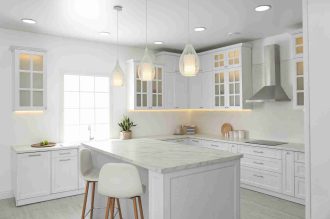
This is the Calacatta most often ordered for a complete kitchen, counters and island together, because its balance allows a large installation to remain elegant rather than feel overwhelming. The warm veins flatter white, cream, and wood cabinetry alike, and a well-laid island reads as a cohesive part of the design rather than the dominant feature. Despite its versatility, it remains a calcite marble on a working surface: cutting boards, trivets, and quick wipes are all part of living with it. The honed version discussed below is the more forgiving choice for heavy cooks.
Bathrooms show Calacatta Gold at its most luxurious, while exposing it to the least amount of wear and tear: no citrus, no knives, light traffic. Vanities, tub decks, and full-height shower walls all suit it. The warm veining keeps an all-white bathroom from feeling clinical and cold. Pair it with brushed brass or warm bronze and the gold in the stone seems to come alive. For safer shower floors we hone the surface so it grips when wet.
A fireplace surround or a run of built-in shelving topped in Calacatta Gold is a classic way of bringing the stone into living spaces. Vertical surfaces never come into close contact with acids or sharp blades, so the polish keeps its depth indefinitely. The firebox heat does not trouble the stone. A single slab often covers the surround, hearth, and mantel with material to spare for a matching coffee table top.
Honed Calacatta Gold has served as flooring in hotel lobbies and grand bathrooms for generations; the soft, matte surface takes foot traffic gracefully and hides the small marks that would show on a polished finish. At home the same logic applies to entry floors, powder rooms, and window sills. Floor work requires an additional conversation about thickness, pattern layout, and slip resistance; all of which deserves careful attention.
Whether you’re seeking a free estimate, a showroom visit, or an in-home evaluation, our team is ready to transform your space.
Calacatta Gold is quarried in the Apuan Alps above Carrara, the Tuscan mountains that produce the entire Calacatta family. The stone began as seafloor limestone before heat and pressure associated with the rise of the Apennines recrystallized it into marble; the Geology.com marble reference explains the process in more detail. Trace iron minerals carried into the fractures tinted the healing veins, and where that iron oxidized the veins warmed toward gold; the gray veins in the same slab carry carbon and finer minerals instead. One slab can hold both, which is the hallmark of the stone.
What separates a Calacatta from its neighbor White Carrara is selection, not geography: Calacatta blocks are the rarer ones with a whiter, brighter ground and fewer, bolder veins, where Carrara runs grayer and busier. Gold-veined Calacatta blocks are rarer still, which is why the name commands a premium across most suppliers.
In practical terms, it is calcite through and through: about a 3 on the Mohs hardness scale, cool to the touch, reactive to household acids, and softer than granite or quartzite. The gold color is part of the stone, not a treatment, and it runs through the full thickness of the slab.
Because the name covers a range of different looks, we try to keep more than one on the floor. For example, at the time of writing our Chantilly showroom holds three lots, twenty-three slabs in all: a 3cm extra-honed lot with a soft matte surface and fine pencil veining, the quietest of the three; a 2cm polished Calacatta Gold Extra lot with long, warm gold diagonals on a cream-white ground; and a 2cm polished jumbo-format lot in oversized 136 by 78 inch slabs, where gray clouds carry the warmth and a single slab can cover an island without a seam.
That variety is the point: one name, three temperaments, from reserved to statement-scale. It is also why we would rather walk you down each row than simply quote the name over the phone. Slabs within one lot are cut consecutively from the block and look harmonious on a full kitchen; the slabs you choose are tagged to your job the day you choose them.
With Calacatta Gold, the first fabrication decision is not the edge profile; it is the surface.
Polished or honed decides how the stone ages. A polish reveals the deepest white, the richest gold, and the famous mirror-like sheen. It is also where etch marks from acids show more obviously. A honed surface mutes the colors slightly, trading the shine for a soft glow. It also hides daily wear so well that many working kitchens choose it without seeing it in person first. We keep both finishes on the floor and show you an etched sample of each before you commit; refinishing later is possible but requires shop work; it is not a wipe-on product.
Layout makes the composition. We overlay your digital template on photographs of your actual slabs, place the strongest gold where you will see it, and plan seams along quiet gray passages where they disappear best. Our guide to vein matching shows how patterns carry across seams and waterfall edges.
Thickness follows the lot. 3cm stock carries standard overhangs and takes any edge profile directly; 2cm stock shines in vertical work and furniture, and builds up to a thicker look with a laminated or mitered edge when the design calls for it.
Sealing and lead time. Every piece gets a penetrating sealer before it leaves the shop and a second coat at installation. Fabrication and installation typically run 5 to 7 business days from template.


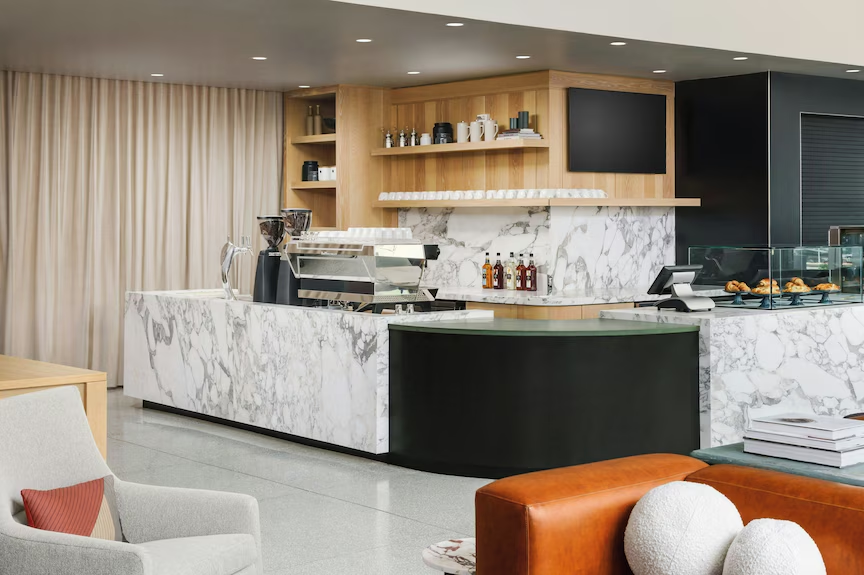
Calacatta Gold typically runs $110 to $230 per square foot installed, with quieter lots near the bottom and heavily gold, large-format lots toward the top.
What moves the number:
For comparison, White Carrara runs roughly $70 to $130 installed, and the rest of our Calacattas $110 to $240 depending on the name and the lot. Our countertop installation cost guide explains what an installed price includes. All figures are general ranges, confirmed at the free in-home estimate after we have measured.
Calacatta Gold asks for typical marble habits, and rewards them for decades.
Etching. Acids dull a polished calcite surface on contact; the Natural Stone Institute’s care guide names lemon, vinegar, and wine as the main offenders, and no sealer can prevent that from happening. On this stone’s white ground a fresh etch reads as a faint dull spot; a honed finish makes the same mark close to invisible, which is why hard-working kitchens often choose it.
Stains and sealing. Seal at installation and about once a year in a kitchen, less in a bathroom; reseal when water stops beading on the surface. Most spills that get through the seal will lift with a poultice, which we can supply or apply.
Cleaning. Warm water, a pH-neutral stone soap, and a microfiber cloth. No vinegar, citrus cleaners, or abrasive powders.
Choosing within the family. If you came in asking for Calacatta Gold, the most important question is how much gold do you actually want: Caldia for almost none, Gold for the balanced benchmark, Oro and Vagli for progressively louder veining. And if the maintenance requirements above are a dealbreaker, our guide to the types of natural stone countertops points to quartzites that have a similar look without the care rules.
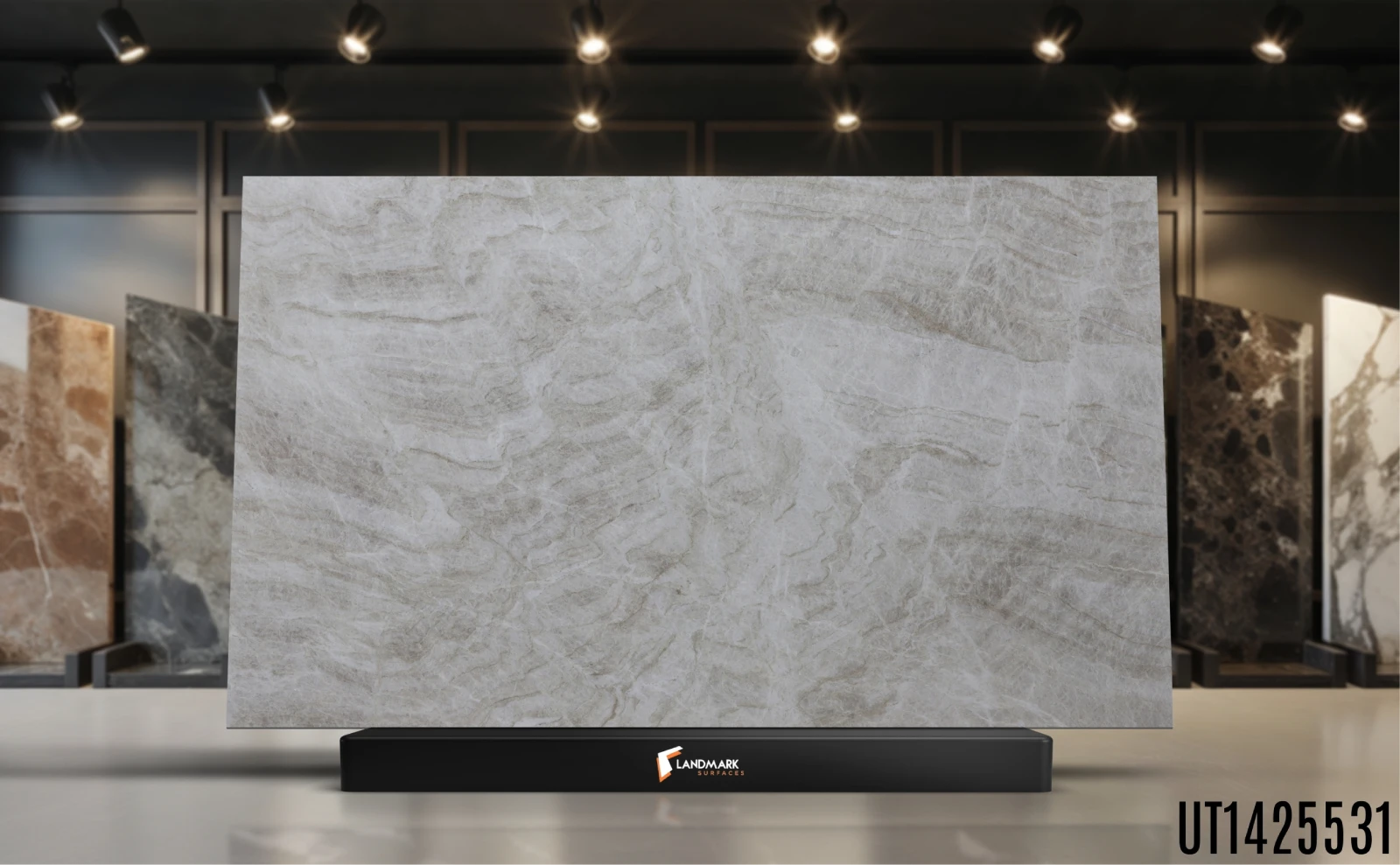


An Italian marble from the Apuan Alps above Carrara, and one of the best-known members of the Calacatta family: a bright white ground with bold veining that warms from gray into gold. It is a calcite marble, so it etches and scratches like every marble and asks for the same care habits.
The words mean the same thing, since oro is Italian for gold, but the trade uses them for different selections. Calacatta Gold is the balanced benchmark, where gold shares the slab with gray veining; Oro, and Vagli beyond it, offer stronger, more saturated gold. The slab, not the translation, tells you which you are looking at.
Yes; it is the Calacatta most often used for complete kitchens. It requires marble habits: cutting boards, trivets, and acids wiped away promptly. Many working kitchens choose a honed finish, which hides etching and daily wear far better than a polished one.
Polished gives the deepest color and the classic mirror sheen but shows etch marks more readily; honed mutes the colors slightly, glows instead of shines, and hides wear much better. Busy kitchens usually choose honed, bathrooms and vertical work tends to be polished. We show you etched samples of both to help you decide what works best for your home.
Yes. A penetrating sealer at installation and about once a year in a kitchen, less often in a bathroom. Sealing slows staining but cannot stop etching; no sealer does, on any calcite marble.
We stock it in full slabs, usually in more than one lot and finish so you can compare quieter and bolder faces of the name side by side. Availability changes weekly; check the live inventory page or visit the showroom to see our currently available slabs.
Calacatta Gold is the marble people envision when they say marble, and the fastest way to find the one for you is to look at several. Visit our Chantilly showroom, walk the lots, and ask to see the honed and polished faces side by side. Bring your project drawings, and we will lay your kitchen out in a template on the actual slabs before anything is cut.
Pricing and lead times on this page are general ranges for planning purposes. Actual cost depends on the slabs selected, measured square footage, edge profile, seams, cutouts, and finish, and is confirmed at your free in-home estimate. Slab availability, lots, and finishes change weekly. Natural stone varies from block to block, and future slabs of Calacatta Gold may differ in pattern from the slabs shown. Marble etches and scratches in normal use; this is a property of the stone, not a defect. Warranty terms vary by product, typically 6 to 10 years.
