


Years of Experience
0 +
Spotless Countertop Installation in Less Than a Week By 24+ years of experience and cutting-edge technology of Stone Fabrication & Installation there is no uncertanity


25391 Pleasant Valley Rd.
Chantilly, VA 20152
Phone: (703) 259-9027
5655 General Washington Dr
Suite G
Alexandria, VA 22312
Phone: (703) 259-9028
Calacatta Caldia marble is the more soft-spoken member of the Calacatta family: a clean white ground with light gray veining that drifts across the slab in clouds and feathers rather than bold lines. Where Borghini announces itself and Viola performs, Caldia takes a quieter approach. It reads as a bright, calm surface from across the room and only shows its drawing up close. This is exactly why designers choose it for whole-kitchen installations rather than just a feature island.
This page covers how that quiet pattern behaves in a room, where the stone works best, what it is and where it is quarried, what we typically stock, how we decide between 2cm and 3cm slabs, what it costs installed, and how it compares with the other white marbles on our floor. For today’s slab count, see live inventory.
Every Calacatta is a white marble with gray or gold veining, yet the pattern, scale, and intensity of that veining vary dramatically from one variety to another. Borghini draws a few thick, confident gray-gold lines across an open white field. Oro covers the slab in a fine golden network of veins. Caldia’s veining is lighter in both senses: pale gray, low in contrast, and arranged in soft, feathered drifts, with occasional stronger veins that keep the pattern visually engaging.
That restraint changes how the stone is used. A bold Calacatta draws attention wherever it is used, which is why covering multiple large surfaces in the same dramatic stone can sometimes overwhelm the room. Caldia works in reverse: the more of it you use, the more natural it tends to feel. Because no single vein demands attention, you can run it across perimeter counters, an island, and a full-height backsplash without the room feeling busy. It behaves less like a pattern and more like a tone, the way a honed White Carrara does, but on a whiter, brighter ground. In most projects, brightness is a feature rather than a side effect. Caldia keeps a white kitchen genuinely white. It flatters both warm and cool cabinet colors because the veining carries only a hint of warmth. It also pairs nicely with brass or nickel. For homeowners who want marble to unify the room rather than dominate it, Caldia is the correct choice.
 Excellent
4.9283 reviews
4.9Excellent283 reviewsPosted on Google
 onur gökçe8 November 2026So many choices for cop terrors and solid pricing and service. Highly recommended.Posted on Google
 Jim Greene1 October 2026Staff is amazing…especially Nesli. Installers did an excellent job. I would definitely use them again.Posted on Google
 Michelle Carey22 September 2026Working with Frank was fantastic! He is extremely knowledgeable about the various types of materials, carefully and thoroughly walked us through the process, was very patient in showing us different options throughout the store, and quickly and efficiently set us up with an appointment for the installers to come out and measure. We felt such relief after talking to Frank and making our selections. We know that Frank and his team will take excellent care of us!Posted on Google
 Danielle Liu14 September 2026Friendly, professional and very responsive. Highly recommend!Posted on Google
 Peg Nielsen10 September 2026This surfaces place is the best! Nesli guided me in choosing a beautiful quartzite for my kitchen. We only paid by the square foot. The measuring, fabricating, and installation was very timely and efficient. Such a great experience! Will definitely recommend and use Landmark again!


 Posted on Google
 Shannon Ross31 August 2026Frank has been very helpful working with us in the countertop selection process!Posted on Google
 Nate Myers24 August 2026Frank was very helpful! Good customer servicePosted on Google
 Brennan Roy15 August 2026Patient, knowledgeable, and helpful, Tina and crew made for an excellent first-time customer experience. My quartz nightstand topper was fabricated quickly and with precision. It looks great and is exactly what I specified. Recommended!

 Posted on Google
 Rebecca Perry10 July 2026Wonderful service, Frank was super helpfulPosted on Google
 R Chandra23 June 2026We are so happy with United Granite. From stone selection to install, the entire team was incredibly professional and helpful. Especially Nesli - she is a true gem. We had some stressful general contractor issues, and she really went beyond to help us keep our project on track. We can't thank her enough!! 100% recommend.Posted on Google
 John22 June 2026Been working with Frank here for a few weeks on a laundry room renovation. He’s been very helpful with providing multiple estimates. I know I’m a needy customer, but he’s been very pleasant to work with. Highly recommend him
 Posted on Google
 Ellen Soroka18 June 2026We looked for over 2 years (Yes, you read 2 years.) to find a counter to match our shower wall and floor tile. Nesli, at United Granite, found exactly what we were seeking. She is a consummate professional and we are thrilled that Ayla, from Happy Homes Remodeling (highly recommend) sent us there. Look no further to find exactly what you want both in remodelers (Happy Homes in Springfield and United Granite for counters and slabs.Posted on Google
 Lesley Grosso6 June 2026Frank was very helpful and the process was quick and efficient with a large selectionPosted on Google
 A M6 June 2026Frank was awesome in keeping me in my price range and problem solving!Posted on Google
 Thao Dang30 May 2026I like nice store , I Buy many time Stone Decorate my house !Posted on Google
 Beth23 May 2026Just shopping for now, but Frank was very helpful.Posted on Google
 L Odria22 May 2026Frank provided exceptional services; from selection of stone, design and updating me on the availability of my purchase for pick up. I will definitely come back for stone and marble purchases.Posted on Google
 SIDD. Jyothi9 April 2026We got the Countertop installed in remodeled kitchen and mudroom project from the Landmark Surfaces. They did an outstanding job for a very satisfying outcome, from the time we went through planning/pricing discussion (with Nesli) to their workforce performing the measurements, fabrication and installation. Well done!Posted on Google
 Jamie Holzer7 February 2026Nesli was wonderful to work with. Very helpful, knowledgeable and polite. Tons of different material and slabs to choose from and I would definitely recommend!Posted on Google
 Nan Miller4 February 2026I highly recommend Landmark Surfaces. Friendly and efficient sales and scheduling. Skilled, knowledgable technicians for measurement and installation. Very professional from start to finish. Great pricing, too. Most importantly, our countertops look great! We are very, very happy with their workmanship.Posted on Google
 Lauren Nadler2 January 2026Knowledgeable, courteous service made making kitchen update choices easy. Fast turn around at fabrication provided incredibly fast completion. The demolition and replacement of counters was completed in 4 hours!!!! My kitchen looks updated and great. I’m really enjoying the larger counter space now. The team in the office and in my home were wonderful. Completely satisfied!

 Posted on Google
 Shelli Mayer23 December 2025We have used Landmark Surfaces United Granite on three separate occasions for quartz installations, most recently for our kitchen and previously for two bathrooms. In my prior review, I noted that I would use them again, and they have once more exceeded expectations. Landmark Surfaces United Granite is an exceptional company in every respect. Their customer service is consistently accessible by phone or email and always responsive. My primary contact has been Nesli, who is highly knowledgeable, professional, responsive, and a pleasure to work with. When she is unavailable, another customer service representative is able to step in seamlessly, immediately accessing my information and understanding my order without delay. Their pricing is consistently more competitive than other companies. For each of our three projects, I obtained estimates from two additional vendors, and Landmark Surfaces United Granite was always the most reasonably priced while delivering superior quality. Their workmanship is excellent, with careful attention to proper installation, clean lines, and precise pattern alignment. Turnaround times for templating and installation are also impressively quick. The combination of attentive service, fair pricing, timely execution, high-quality craftsmanship, and expertise is exceptional. I highly recommend Landmark Surfaces United Granite.

 Posted on Google
 Marsha4 December 2025I had a great experience with Landmark Surfaces. They pay attention to detail and they are customer oriented. They did a fabulous job on my countertops! They delivered on-time and were very professional. I would definitely recommend them to my family and friends and my job satisfaction was a 10 out of 10!Posted on Google
 Carol Bruno11 November 2025Tina was very professional, helping me to narrow down my choice of Dekton countertop, then giving me the address to visit the slabs in person to make a final decision of design. The tech who did final measurements at my home was efficient, and the crew who did the final installation was respectful of the space. I am already getting rave reviews of the completed kitchen!
 Posted on Google
 S kim5 November 2025Tina was an absolute dream. I walked into the showroom, with a tight schedule and even tighter budget, and yet she treated me like a client with a limitless fund. She took the time to show me all of the various options fitting my design/pricing criteria and followed up with a detailed explanation of what to expect and how to prepare for the installation. And no issues were insurmountable for her. When I had to leave town unexpectedly (sick mother) which threatened to derail our schedule for installation, she took care of all the details necessary to complete the project. At all times, she kept me updated. With all the things that can and do go wrong in a kitchen makeover, my experience with Tina was a welcome exception. Indeed, i look forward to working with Tina in my next kitchen project.Posted on Google
 Jeremiah Walsh1 October 2025Landmark Surfaces is a first-rate professional business built on integrity, timely customer service, superior quality craftsmanship and installation, and product knowledge. I am a returning customer with three previous purchases. I worked with Nesli Kohen who is a superb account executive who optimizes integrity and customer service. It was a true pleasure to work with this professional for the fourth time! I enthusiastically recommend Landmark Surfaces for your next project!Posted on Google
 Albina Galieva30 September 2025The store has a very good selection of quartz. I found exactly what I was looking for. The team was very attentive and provided excellent services for a great price. Highly recommend them.Posted on Google
 Holly16 June 2025We have gotten multiple projects done here at Landmark services and have always been very happy with the fantastic customer service. Most notably I want to give a huge shout out of thanks and appreciation to Samantha Estacion for her help with our Hall bathroom upgrade. Samantha helped us with an 8 ft long super white marble shelf under our window, vanity top, threshold and toilet paper holder base. Everything was done to perfection! we love the results. Samantha was very kind and caring. She knows a lot about the different products and has great attention to detail, helping us finalize the designs. Thanks so much for your help Samantha!


 Posted on Google
 cindy luu6 May 2025My experience at Landmark was exceptional, from research to customer service and installation. Tina made the process very smooth; she was responsive to all my questions and provided follow-up. The installation went very smoothly, thanks to the team's promptness, meticulousness, and courteousness. I would go back to them for future projects.Posted on Google
 Lemony Lavender26 April 2025My husband and I went in to see about replacing our kitchen counters, and Robiya was such a huge help. She was very thorough, knowledgeable, and patient with us as she helped us find the perfect stone for our kitchen. When it came time to begin the process of removal of the old, measurements, and scheduling installation…the whole process was seamless and easy. The communication and follow up between Robiya and the service team was efficient and professional. If I had any questions or concerns, they were quick to respond with answers and advice. The overall turn around of the project from start to finish was very quick. We had a great experience working with Landmark surfaces and will definitely be returning for future projects.Posted on Google
 Joyce Schaefer23 April 2025Granite was beautiful. Tina was great to work with and the installation team did a great jobPosted on Google
 Lois Berlin21 April 2025Our experience at United Granite was excellent. From sales to measurement and drawings and installation, everyone was extremely professional and the installation was perfect. We are so pleased with how beautiful and how well fitted our counters are. I highly recommend them.Posted on Google
 Janice Mattheson15 April 2025Tina helped me with my selection, which was very easy. Girardo came out (twice) and took the measurements (my husband and I thought the process of installing cabinets was easy…It was not) he was very professional . Today the installers quickly installed the countertops and they’re beautiful…I love it❤️ Thank you!

 Posted on Google
 Jenna O’Brien15 April 2025Pleasant and Professional! I'm a decorator and I work with a LOT of contractors. I highly recommend Tina and the team at Landmark.They are easy to work with, very responsive, and come to the table with a wealth of knowledge. The process from quote to install was seamless.Posted on Google
 Mickey Mouse23 March 2025Tina was super helpful and a pleasure to work with! I needed options for my bathroom vanity. Even though it was a small project working with their remant section I found the perfect piece to complete my bathroom renovation. The installation crew did impecable work with solid eye on attention to detail. Definitely plan and using Tina and her crew for my last bathroom renovation.


 +2
Calacatta Caldia is one of the few marbles we recommend for large continuous installations as readily as for small ones. The rooms below are where it earns its keep.
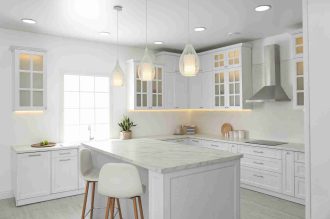
This is where Caldia makes its strongest case. The low-contrast veining scales well: even a large countertop in this stone reads as serene rather than repetitive, and seams are easy to hide within the soft pattern. A matching full-height backsplash turns the whole wall into one quiet surface. Households that cook a lot can still put a tougher stone on the work side; many of our clients run Caldia everywhere else because sometimes a quieter pattern is exactly what a room needs.
On an island, Caldia trades spectacle for light. A slab with one of the stronger wandering veins makes a subtle centerpiece. A waterfall edge in this stone looks tailored rather than theatrical. If you want the island to be the loudest thing in a room, a bolder Calacatta such as Borghini is the better choice. With Caldia, the island supports the room, rather than competes with it.
Vanity tops, tub decks, and shower walls are the natural home for a polished white marble: no acids, light traffic, and the polish keeps its gloss for years. Caldia’s pale veining makes a small bathroom feel larger and brighter, and two consecutive slabs bookmatched on a shower wall give a soft mirror effect instead of a loud one. For shower floors we hone the stone so it grips better when wet.
Caldia is equally at home on vertical surfaces, from fireplace surrounds and feature walls to console tops and shelving. Heat does not trouble marble, and acids rarely reach a vertical surface. It is also frequently used behind a range, where its calm pattern lets the hood and cabinetry take the lead.
Whether you’re seeking a free estimate, a showroom visit, or an in-home evaluation, our team is ready to transform your space.
Calacatta Caldia is a calcite marble from the Apuan Alps above Carrara in northern Tuscany. These are the mountains behind nearly every famous Italian white: Carrara, Statuario, and the Calacatta family. The CMP Solmar handbook of Apuan commercial names classifies the Calacattas as white marbles sorted by the color and character of their veining; “Caldia” is the trade’s name for the selection with the palest, most diffuse gray veining. The names are commercial rather than geological, which is why two suppliers’ “Calacatta” slabs can look so different, and why the specific name on the slab tag matters more than the family name.
Geologically it is the same stone as its louder cousins. The Geology.com marble reference explains that marble forms when limestone recrystallizes under heat and pressure, and that the veining comes from impurities folded into the original rock. In Caldia those impurities are sparse and finely dispersed, which is what produces the cloudy, low-contrast drawing. Chemically: calcite, about 3 on the Mohs scale, and reactive to acid; exactly like every other white marble on this site.
We keep Calacatta Caldia in stock in Chantilly as demand is consistent, usually in several lots at once and in both 2cm and 3cm thicknesses, with polished and honed finishes available to compare. For example, at the time of writing our floor holds multiple bundles of full-size slabs in the 118 to 129 inch range, from quiet, almost Carrara-soft faces to slabs with a single dramatic vein crossing the field.
The same caveat that applies to every natural stone applies here: lots sell out and new blocks arrive all the time, and each block leans slightly whiter, grayer, or bolder than the last. The photographs on this page show slabs from our current lots, not a permanent standard. When you choose Caldia for a project, we tag your specific slabs to your job that day, and for multi-slab kitchens we pull consecutive slabs from one block so the pattern matches across seams.
Because Caldia is commonly quarried and sold in both thicknesses, the 2cm-versus-3cm question comes up on almost every project, and the answer affects both the look and the construction of the installation.
3cm remains the standard thickness for kitchens: a solid edge with no lamination, more tolerance at long overhangs, and the proportions most American kitchens are designed around. The trade-off is weight: roughly half again as much as a 2cm slab, which matters on long waterfall panels and wall cladding.
2cm suits vertical work, furniture, and European-style flush installations. On counters it benefits from a laminated (built-up) edge or a plywood substrate. The lamination strip comes from the same slab and runs the vein through it, and on a stone this quiet the glue line is genuinely hard to find. Narrow strips at sinks and cooktops are rodded as standard practice on 2cm marble.
Finish. Polished keeps the ground at its whitest and maximizes the shine; honed gives a soft matte that hides etching in a working kitchen. We can hone any polished piece on request, priced per piece. We show you an etched sample of both finishes before you commit so there are no surprises. Our countertop finishes guide covers the trade-offs in more detail.
Sealing and lead time. Every piece gets a penetrating sealer before it leaves the shop and a second coat at installation. Fabrication and installation typically run 5 to 7 business days from template.


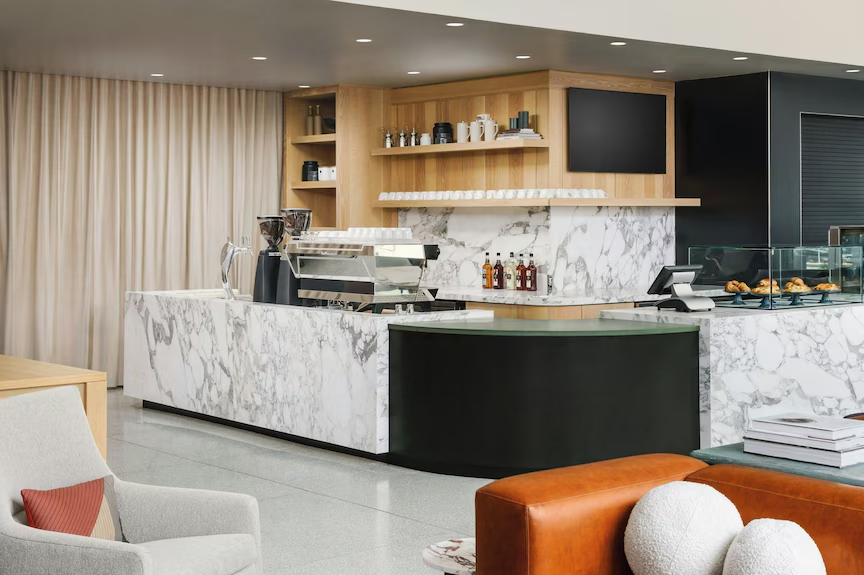
Calacatta Caldia typically runs $110 to $210 per square foot installed. That puts it in the middle of the Calacatta range: above White Carrara ($70 to $130 on our floor), in the same band as Calacatta Oro, and below the rarest Borghini Extra selections. The white ground makes up most of the price; fabrication costs the same as any marble of its thickness.
What moves the number:
Our countertop installation cost guide explains what an installed price includes. All figures are general ranges, confirmed at the free in-home estimate after we measure.
Most people considering Caldia are really choosing among three Apuan whites on our floor. Here is an honest comparison.
| Day to day | Calacatta Caldia | Calacatta Borghini | White Carrara |
|---|---|---|---|
| Ground | Bright white | Bright white | Light gray |
| Veining | Pale gray, soft, diffuse | Bold gray-gold lines | Soft gray, all-over |
| Reads from across the room | Calm white surface | Statement pattern | Gray-white texture |
| Best role | Whole kitchens, large runs | Islands, feature walls | Budget-friendly classic |
| Etching visibility | Moderate; white shows marks | Moderate; white shows marks | Lower on the gray ground |
| Installed cost per sq ft | $110 to $210 | $120 to $200; Extra higher | $70 to $130 |
Whichever white you choose, it remains a polished calcite marble, and it behaves like one.
Etching. Acids dull the polish on contact; the Natural Stone Institute’s care guide names lemon, vinegar, and wine as the usual culprits. No sealer prevents it from etching. On Caldia’s white ground an etch shows as a dull spot at a low angle; honing makes it far less visible, and a polished top can be re-polished on site.
Stains and sealing. Seal at installation and about once a year in a kitchen, less in a bathroom; reseal when water stops beading. A spot that gets through the seal usually lifts with a poultice, which we can supply or apply.
Cleaning. Warm water and a pH-neutral stone soap. No vinegar, citrus cleaners, or acidic sprays. Cutting boards for knives, coasters under wine, trivets under hot pans.
If you want zero habits. A quartzite or quartz is the better fit; our guide to the types of natural stone countertops lays out the differences. And polished marble belongs indoors; weather takes the shine off which ruins the effect of the pattern.
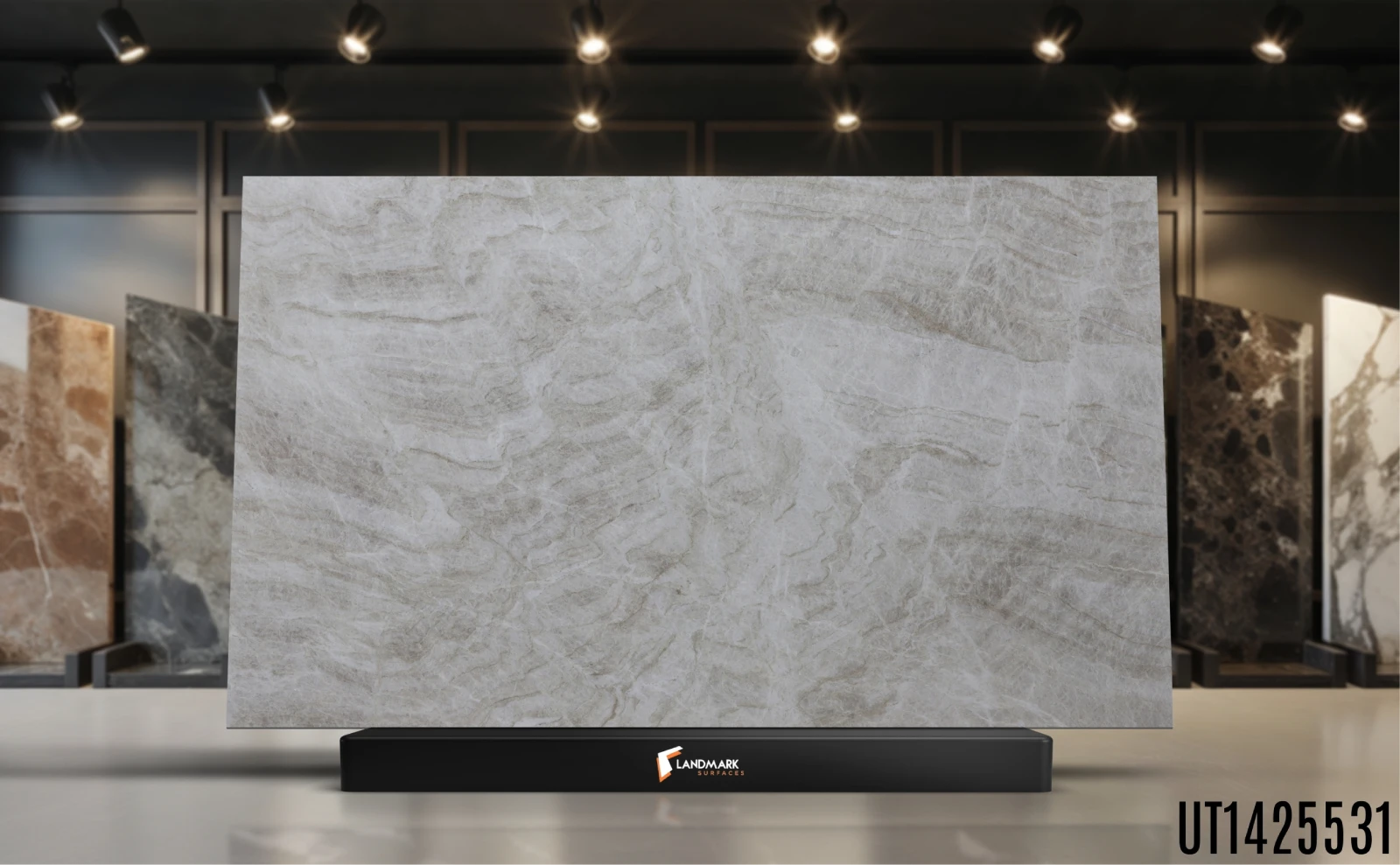


A white calcite marble from the Apuan Alps near Carrara, Italy, in the Calacatta family. “Caldia” is the trade name for the selection with the palest, softest gray veining. It has the same hardness and acid sensitivity as every white marble.
The simple, pale veining. Borghini draws bold gray-gold lines, Oro covers the slab in a golden network of veining, and Caldia is more subdued: pale gray clouds and feathers with little contrast in colors. It is the Calacatta most often chosen for whole kitchens rather than single statement pieces.
Yes; that is its specialty. The low-contrast pattern covers long runs without feeling busy, and seams hide easily. It still etches and scratches like any marble, so cutting boards and prompt wiping of acids remain part of maintaining it.
3cm is the simpler choice for kitchen counters: solid edge, no lamination. 2cm suits walls, furniture, and flush looks. It does, however, require a built-up edge on counters. We often stock both, which means the project can drive the choice rather than stock availability.
Yes. A penetrating sealer at installation and about once a year in a kitchen, less in a bathroom. Sealing slows stains; it does not stop etching.
Usually, yes, often in several lots across 2cm and 3cm slabs. Natural stone inventory changes weekly, so check the live inventory page or contact us before visiting.
Calacatta Caldia is a must see stone if you want a white marble kitchen that whispers instead of shouts its presence in a room. Visit our Chantilly showroom, stand a Caldia slab next to a Borghini and a Carrara, and bring a cabinet door to see how the stones interact with cabinetry. Most people find the right white for them will make itself apparent when they see it in person.
Pricing and lead times on this page are general ranges for planning purposes. Actual cost depends on the slabs selected, measured square footage, edge profile, seams, cutouts, and finish, and is confirmed at your free in-home estimate. Slab availability changes weekly. Natural stone varies from block to block, and future lots of Calacatta Caldia may differ in tone and veining from the slabs shown. Marble etches and scratches in normal use; this is a property of the stone, not a defect. Warranty terms vary by product, typically 6 to 10 years.
