


Years of Experience
0 +
Spotless Countertop Installation in Less Than a Week By 24+ years of experience and cutting-edge technology of Stone Fabrication & Installation there is no uncertanity


25391 Pleasant Valley Rd.
Chantilly, VA 20152
Phone: (703) 259-9027
5655 General Washington Dr
Suite G
Alexandria, VA 22312
Phone: (703) 259-9028
Arabescato Corchia marble is a white Italian marble marked by a dense, broken web of gray veins. The pattern the Italian stone trade calls arabescato is named after the arabesque. Where a Calacatta draws a few bold lines across a white field, Arabescato Corchia fills the slab with movement: veins that split, rejoin, and outline small islands of white. The stone reads as one continuous drawing from edge to edge.
We currently carry two bundles, both 2cm polished slabs at about 117 by 65 inches, and the veining is noticeably different. This page starts with how to tell the two apart and which rooms each one suits. The guide then covers where the stone is quarried, how it compares with Calacatta and Carrara, what it costs installed, how we fabricate it, and how a polished or honed finish changes how you live with it day to day. For today’s slab count, see live inventory.
Both bundles share the same ground: a cool, bright white with a faint gray cast in the denser areas, never a cream or ivory color. The difference between the slabs is in how the veining is organized, and the distinction is large enough that we treat them as two separate choices.
The first bundle: a flowing band. These slabs carry a wide river of gray that runs lengthwise through the middle, with soft, cloudy veining feathering out above and below it. The band is the focal point, and the rest of the slab supports it. Because it follows the 117 inch length, it reads best on a long island or a waterfall edge, where the eye can follow it from end to end.
The second bundle: an open crackle. These slabs are whiter overall, with thin, sharp gray veins crossing the face at angles and outlining irregular white panels, which looks a little like crazed glass. There is no single dominant band, so the slab works in any direction and seams are easier to place.
Within each bundle the slabs were cut in sequence, so neighboring slabs mirror each other and can be bookmatched or slip-matched. We do not recommend mixing the two bundles in one kitchen, because the patterns will not continue to flow naturally across a seam.

 4.9287 reviews

 Trustindex verifies that the original source of the review is Google.
 Trustindex verifies that the original source of the review is Google.
 Trustindex verifies that the original source of the review is Google.
 Trustindex verifies that the original source of the review is Google.
 Trustindex verifies that the original source of the review is Google.
 Trustindex verifies that the original source of the review is Google.
 Trustindex verifies that the original source of the review is Google.
 Trustindex verifies that the original source of the review is Google.


 Trustindex verifies that the original source of the review is Google.
 Trustindex verifies that the original source of the review is Google.
 Trustindex verifies that the original source of the review is Google.


 Trustindex verifies that the original source of the review is Google.
 Trustindex verifies that the original source of the review is Google.
 Trustindex verifies that the original source of the review is Google.

 Trustindex verifies that the original source of the review is Google.
 Trustindex verifies that the original source of the review is Google.
 Trustindex verifies that the original source of the review is Google.
 Trustindex verifies that the original source of the review is Google.
 Trustindex verifies that the original source of the review is Google.
 Trustindex verifies that the original source of the review is Google.
 Trustindex verifies that the original source of the review is Google.
 Trustindex verifies that the original source of the review is Google.
 Trustindex verifies that the original source of the review is Google.
 Trustindex verifies that the original source of the review is Google.


 Trustindex verifies that the original source of the review is Google.


 Trustindex verifies that the original source of the review is Google.
 Trustindex verifies that the original source of the review is Google.

 Trustindex verifies that the original source of the review is Google.
 Trustindex verifies that the original source of the review is Google.
 Trustindex verifies that the original source of the review is Google.
 Trustindex verifies that the original source of the review is Google.


 Trustindex verifies that the original source of the review is Google.
 Trustindex verifies that the original source of the review is Google.
 Trustindex verifies that the original source of the review is Google.
 Trustindex verifies that the original source of the review is Google.
Arabescato Corchia is a busy stone, and that drama is its strength. It hides crumbs and water spots better than a plain white, and it has enough character of its own so the rest of the kitchen can stay simple and understated. Here is how we usually pair each bundle with a project.
The first bundle is the one best suited for an island. The central band gives the top a clear direction. For a waterfall edge we cut the end panel from the same slab so that the band turns the corner without a break in the pattern. One 117 by 65 inch slab covers most islands in a single piece. If the household cooks every day, consider a harder quartzite or quartz on the perimeter and let the island carry the drama of an Arabescato Corchia marble.
The second bundle is the most conventional choice for a full kitchen. With no dominant band, perimeter runs can be cut from any part of the slab, and the crackle pattern hides seams well. A full-height backsplash from the same bundle continues the pattern up the wall, and because the slabs are open and bright, they do not overwhelm a smaller kitchen.
Either bundle works on vanity tops, tub decks, and shower walls, where acids and knives rarely make contact and the polish holds up longer. Two consecutive slabs bookmatched on a shower wall create a mirror pattern, and with the first bundle’s band the effect is especially mesmerizing. For shower floors, we recommend a honed finish because it provides better traction when wet.
A full slab on a fireplace surround or a range hood wall shows the whole pattern at once, with nothing cut away. Fireplace heat does not harm marble, and acidic spills rarely come into contact with a vertical surface. For a wall with more texture, the same stone can be cut into fluted panels that catch side light along the veins.
Whether you’re seeking a free estimate, a showroom visit, or an in-home evaluation, our team is ready to transform your space.
Arabescato Corchia is quarried on Monte Corchia, in the Versilia area of the Apuan Alps in northern Tuscany. This is the same mountain range that produces Carrara marble. According to the Stone-Ideas profile of the stone, the quarries are managed by the Cooperativa Condomini Levigliani, named for the village below the mountain. The stone is extracted in an underground quarry at about 1,300 meters (roughly 4,300 feet) above sea level. The detailed profile of this marble places it in the Italian group of brecciated marbles. The original limestone was fractured during mountain building, and the cracks filled with darker material before the rock recrystallized into marble; that is where the broken, outlined look comes from.
Monte Corchia is a hollow mountain. Inside it is the Antro del Corchia, which Visit Tuscany describes as the most extensive karst cave system in Italy, entered through a tunnel cut from an old marble quarry. Water carved that cave by slowly dissolving the marble, which is a useful comparison of what acid does to the stone on a kitchen counter.
Chemically it is ordinary marble: calcite, about 3 on the Mohs scale, and reacts with acid. The Geology.com marble reference explains that marble forms when limestone recrystallizes under heat and pressure, and that impurities in the original rock produce the veining. The gray in Arabescato Corchia is that impurity; the white is nearly pure calcite.
All three come from the Apuan Alps and are the same mineral, so the only difference is found in the pattern and the price.
On its own, “Arabescato” describes a pattern, not a quarry, and it is worth noting that several Apuan quarries sell their own Arabescato. “Corchia” is the quarry name and the one to take note of on a slab tag. If you like the broken, outlined look but want more color, Breccia Capraia takes the same brecciated structure further, with larger fragments and warmer tones.
Arabescato Corchia typically runs $110 to $200 per square foot installed. That places it alongside the Calacattas, above White Carrara and below the rarest selections of marble. The unique pattern and the Italian origin are what you pay for; fabrication costs the same as any 2cm marble.
What moves the number:
For comparison, White Carrara on our floor runs $70 to $130 per square foot installed and Calacatta Oro $120 to $220. Our countertop installation cost guide explains what an installed price includes. All figures are general ranges, confirmed at the free in-home estimate after we measure.


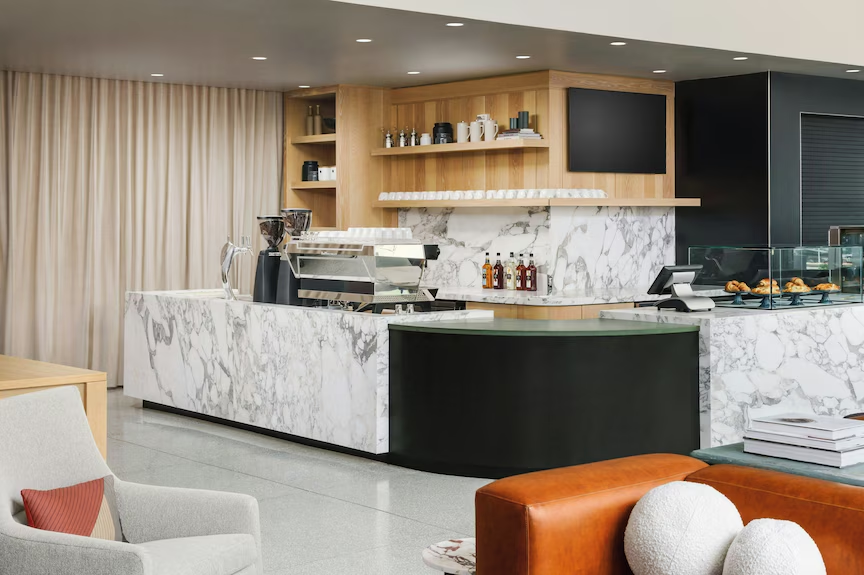
A 2cm Arabescato fabricates like other Italian white marbles. What sets it apart is how much the veining dictates the layout.
Layout first. We place the digital template over the slab photo before cutting anything, so you see where the band or the crackle lands on each piece. On the first bundle we center the band on the island and keep cutouts away from it; on the second we match the vein density on both sides of each seam.
Edges on 2cm. A 2cm slab needs a laminated (built-up) edge to look like a thicker countertop, or a plywood substrate under a simple edge. We cut the lamination strip from the same slab and follow the veins through it, which on a stone this busy makes the joint very hard to find.
Reinforcement. The darker veins in a brecciated marble can be natural lines of weakness, so we rod narrow strips at sinks and cooktops. We also give longer pieces extra support when we move them. Undermount sink reveals are polished to match the face.
Sealing. Every piece gets a penetrating sealer before it leaves the shop and a second coat at installation.
Weight and lead time. A 2cm slab at 117 by 65 inches weighs roughly 600 to 650 pounds. Fabrication and installation typically take 5 to 7 business days from template.
Both of our bundles arrived polished. That finish keeps the gray veins crisp and makes the white bright; this is what you see in the photos. Honing gives a soft, matte surface that slightly lowers the contrast in colors and changes how etching shows. Here is how the two finishes compare in daily use.
| Day to day | Polished Arabescato Corchia | Honed Arabescato Corchia |
|---|---|---|
| Look | Crisp veins, bright white, reflective | Softer contrast, matte, relaxed |
| Lemon, wine, vinegar, tomato | Etches; dull spot visible at a low angle | Etches; blends into the matte surface |
| Stains | Resists a little better | Absorbs a little faster; seal more often |
| Scratches | Show in raking light | Less visible |
| Water spots and crumbs | Hidden by the veining | Hidden by the veining |
| Repair | Re-polished in place | Re-honed in place |
| Best for | Bathrooms, walls, fireplaces, islands used with care | Busy kitchens and bars |
Etching. Calcite reacts with acid, and the Natural Stone Institute’s care guide names lemon, vinegar, and other acids as what dulls calcareous stone. There is no sealer that prevents etching. The busy veining of Arabescato hides an etch better than a plain white does, but it does not stop it.
Sealing and stains. Seal at installation and about once a year in a kitchen, less in a bathroom; reseal when water stops beading on the surface. A stain that gets through can usually be lifted with a poultice, which we can supply or apply for you.
Cleaning. Warm water and a pH-neutral stone soap. No vinegar, citrus cleaners, or acidic bathroom sprays. Use cutting boards for knives, coasters under glasses, trivets under hot pans to keep it looking its best.
When we suggest something else. If you want a counter that is more forgiving, a quartzite or quartz is the better fit; our guide to the types of natural stone countertops explains the differences. Polished marble also loses its shine outdoors, so we suggest you keep it inside. For more on how finishes change a stone, see our countertop finishes guide.
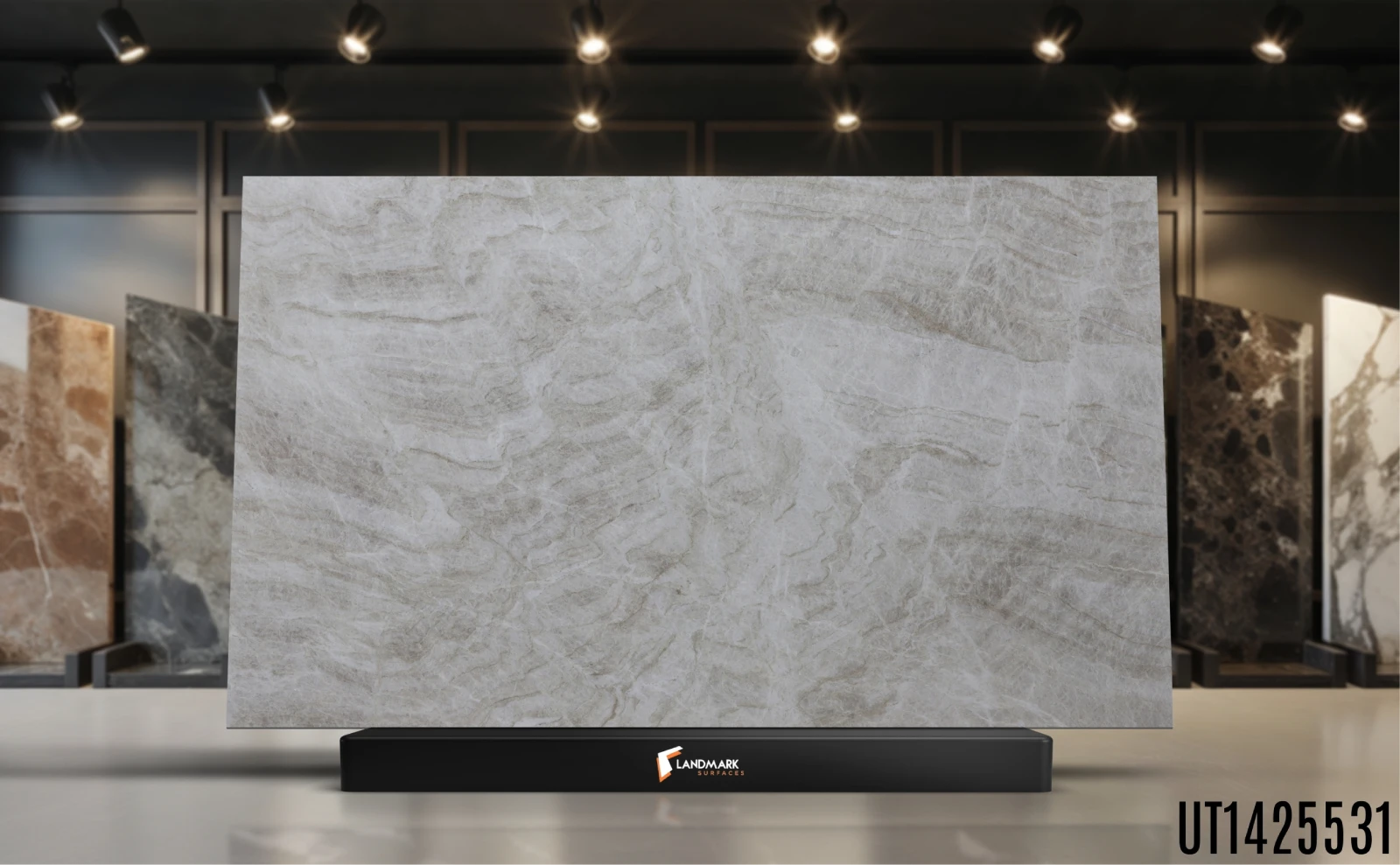


A white Italian marble from Monte Corchia in the Apuan Alps of Tuscany, with a dense, broken network of gray veins. “Arabescato” is the trade name for this arabesque-like pattern, and “Corchia” is the quarry it came from. It is a calcite marble, with the same hardness and acid sensitivity as any white marble.
Both have a white ground. Calacatta has fewer, bolder veins with large open areas of white; Arabescato has far more veining, broken into a network that covers the whole slab. They are priced in a similar range, so the choice comes down to how much movement you want in your room.
Yes, for a household that uses cutting boards and wipes up acids promptly. It etches and scratches like every marble, but its busy veining hides marks better than a plain white stone. A honed finish makes etching even less noticeable.
Each bundle was cut from a different block, and the veining in a brecciated marble can change a lot across the quarry. One bundle has a central flowing band; the other has an open crackle pattern. We recommend choosing one bundle for a whole project.
Yes. A penetrating sealer at installation and about once a year in a kitchen, less in a bathroom. Sealing slows stains; it does not stop etching.
Usually, yes, in 2cm polished slabs, currently from two bundles. Natural stone inventory changes weekly, so check the live inventory page or contact us before visiting.
Arabescato Corchia is the stone to choose if you want a white marble with more movement than a Calacatta. Visit our Chantilly showroom, compare a slab from each bundle side by side, and bring a cabinet door to see how the two work together. Most people know within a few minutes which bundle fits their kitchen needs best.
Pricing and lead times on this page are general ranges for planning purposes. Actual cost depends on the slabs selected, measured square footage, edge profile, seams, cutouts, and finish, and is confirmed at your free in-home estimate. Slab availability changes weekly. Natural stone varies from block to block, and future bundles of Arabescato Corchia may differ in tone and veining from the slabs shown. Marble etches and scratches in normal use; this is a property of the stone, not a defect. Warranty terms vary by product, typically 6 to 10 years.
