




Years of Experience
0 +
Spotless Countertop Installation in Less Than a Week By 24+ years of experience and cutting-edge technology of Stone Fabrication & Installation there is no uncertanity


25391 Pleasant Valley Rd.
Chantilly, VA 20152
Phone: (703) 259-9027
5655 General Washington Dr
Suite G
Alexandria, VA 22312
Phone: (703) 259-9028
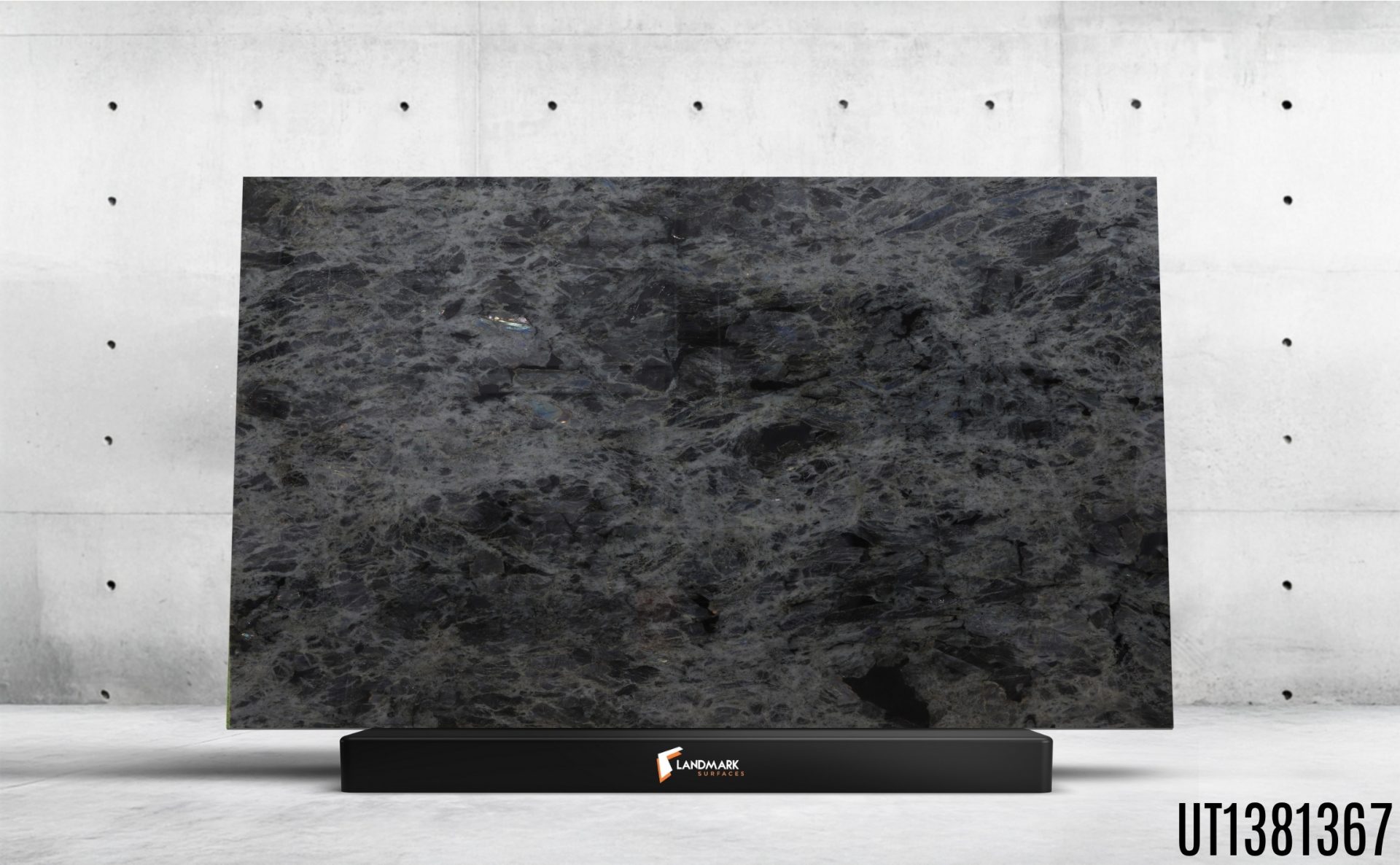
Lemurian Blue granite is a stone that photographs as black yet installs as blue. It is a labradorite from southern Madagascar, and the color lives in the crystal structure rather than on the surface, so it only shows when light hits the slab at the right angle. Every photo on this page undersells it, including ours.
We stock it at Chantilly in 3cm polished slabs because it solves a problem Blue Bahia cannot: it gives a kitchen real blue flair, but with the hardness and low maintenance of an ordinary granite. This page explains what the stone is, how to see the color before you buy, how it holds up in daily use, and what it tends to cost. If you only need to know what is on the floor today, go to live inventory.
Lemurian Blue is a labradorite rock, not a granite, and it is quarried by R.E.D. Graniti in southern Madagascar, who hold the Lemurian Blue name as a registered trademark. The quarry produces about 250 tons of block a month, which is small by granite standards, and the company describes the site as difficult to work in. That is the first reason the stone is so scarce.
Labradorite is a calcium-rich plagioclase feldspar with a Mohs hardness of 6 to 6.5, according to the Geology.com labradorite reference. It also notes that labradorite-rich anorthosite is cut for countertops and sold under names like “blue granite” or “labradorite granite”. Rocks made almost entirely of it are called anorthosites, and that is what you are looking at in a Lemurian Blue slab: a mass of interlocking feldspar crystals, dark gray to black at rest, with no quartz veins and no soft minerals mixed in. The trade calls it granite because it cuts, polishes, and performs like one, and in this case the label is closer to the truth than it is for Blue Bahia.
The blue is a structural effect called labradorescence. During slow cooling the feldspar separated into microscopic layers, and when light enters at the right angle those layers reflect a single color back, usually blue, sometimes green or gold. With every movement of your head the blue shifts with the light. That is why the stone cannot be photographed properly and why a sample chip tells you less than a slab does.
The name refers to Lemuria, an old nickname for Madagascar and the lands around it, and nothing more. You will also see the stone sold as Labradorite Blue, Lemurian Blue Extra, or Lemurian Blue Superior; the last two are grading terms some distributors use for slabs with a stronger flash, not different stones. This page is about dimension-stone slabs for countertops and walls; the labradorite sold as tumbled stones and beads is the same mineral in a different market, and we do not deal with those specific products.

 4.9287 reviews

 Trustindex verifies that the original source of the review is Google.
 Trustindex verifies that the original source of the review is Google.
 Trustindex verifies that the original source of the review is Google.
 Trustindex verifies that the original source of the review is Google.
 Trustindex verifies that the original source of the review is Google.
 Trustindex verifies that the original source of the review is Google.
 Trustindex verifies that the original source of the review is Google.
 Trustindex verifies that the original source of the review is Google.


 Trustindex verifies that the original source of the review is Google.
 Trustindex verifies that the original source of the review is Google.
 Trustindex verifies that the original source of the review is Google.


 Trustindex verifies that the original source of the review is Google.
 Trustindex verifies that the original source of the review is Google.
 Trustindex verifies that the original source of the review is Google.

 Trustindex verifies that the original source of the review is Google.
 Trustindex verifies that the original source of the review is Google.
 Trustindex verifies that the original source of the review is Google.
 Trustindex verifies that the original source of the review is Google.
 Trustindex verifies that the original source of the review is Google.
 Trustindex verifies that the original source of the review is Google.
 Trustindex verifies that the original source of the review is Google.
 Trustindex verifies that the original source of the review is Google.
 Trustindex verifies that the original source of the review is Google.
 Trustindex verifies that the original source of the review is Google.


 Trustindex verifies that the original source of the review is Google.


 Trustindex verifies that the original source of the review is Google.
 Trustindex verifies that the original source of the review is Google.

 Trustindex verifies that the original source of the review is Google.
 Trustindex verifies that the original source of the review is Google.
 Trustindex verifies that the original source of the review is Google.
 Trustindex verifies that the original source of the review is Google.


 Trustindex verifies that the original source of the review is Google.
 Trustindex verifies that the original source of the review is Google.
 Trustindex verifies that the original source of the review is Google.
 Trustindex verifies that the original source of the review is Google.
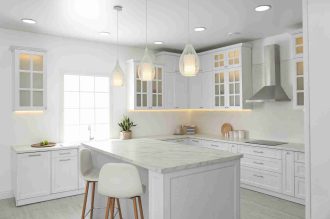
Lemurian Blue is a working-kitchen stone, and that is the main difference from other blues on our floor. It works beautifully throughout the entire kitchen, perimeter included, without requiring extra care.
Where we would slow you down. Outdoor kitchens and exterior cladding: the quarry describes Lemurian Blue as suited to interior applications, and we follow that recommendation; sun and weather are hard on polished dark feldspar and the unique flash is the first thing to go. A kitchen with only overhead can lights and no side light: the stone will still be a handsome dark granite, but you will see the blue best at night with the under-cabinet lights on. If blue in daylight is the goal, look at the quartzites listed below instead. A design that requires a flowing vein: unfortunately there is none. Lemurian Blue offers texture, not movement. For a vein that travels, see Blue Bahia or Ijen Blue.
Hard enough for prep zones, dark enough to forgive daily use. Put the strongest flash on the run under a window or an island under pendants, and the quietest slab section where the light is weakest.
Under low, warm, off-axis lighting the blue comes alive. A wet bar or a basement bar is where this stone tends to get the most compliments.
Vertical and side-lit by a window or a sconce, the surface shimmers as people walk through the room. The quarry itself recommends this stone be used for interior walls and architectural features.
A vanity-size piece can be cut from the best-flashing part of a slab, and better yet, it will experience no etching from toiletries. In lobbies and hospitality, the lot consistency of this stone is what makes a 40-piece job possible without visible color stepping.
Whether you’re seeking a free estimate, a showroom visit, or an in-home evaluation, our team is ready to transform your space.
In a flat, front-lit warehouse photo, Lemurian Blue reads as charcoal gray with silver mottling. In front of the slab, with light coming across it, sections of the surface light up as a steely blue, and the patches continually change as you move. Both are true since the surface is constantly shifting. Which one you get in your kitchen depends on where the windows and fixtures are.
Three things to do before you decide:
The flash is not evenly distributed across a slab, and that is normal. A fabricator who knows the stone uses that unevenness on purpose, which is what the fabrication notes below are about.
The Lemurian Blue slabs in our Chantilly warehouse are 3cm polished, roughly 124 by 78 inches, and they come from one consistent lot. The ground is near-black, the mottling is silver-gray with blue-gray crystal faces scattered across the whole surface, and there is no directional vein to chase. Several slabs are on the floor as of this writing; check live inventory for today’s count.
This is natural stone, and a future block may run bluer, grayer, or coarser than what is on the floor now. The photos on this page are the current lot, taken under flat light, which is the least flattering way to see this material. Come and take a look for yourself.
Lemurian Blue granite behaves like a dense, dark granite, because in every way that matters to a kitchen it is one. Feldspar at Mohs 6 to 6.5 resists ordinary knife contact, the stone has no calcite and no soft veins to etch, and the near-black ground hides crumbs and water spots that a white stone would show. The care routine is the same one you would give Black Pearl or Steel Gray.
| Property | Lemurian Blue | Blue Bahia (for comparison) |
|---|---|---|
| Main mineral hardness (Mohs) | 6 to 6.5 (labradorite feldspar) | 5.5 to 6 (sodalite) |
| Acid sensitivity | Low; wipe spills, avoid harsh acids | Sensitive; treat like marble |
| Sealing | Yes, at install, then every 1 to 3 years | Yes, yearly |
| Heat | Tolerates hot pans; trivets recommended | Same |
| Scratching | Resists most daily use | Shows knife marks |
| Slab prep | Usually none; some lots mesh-backed | Resin-filled and mesh-backed |
Scratches and chips. Feldspar has two good cleavage directions, which is a mineralogist’s way of saying individual crystals can chip along a flat face if struck hard on an edge. On the polished top that never happens. On a sharp outside corner it can, which is why we ease the corners on this stone and keep edge profiles simple.
Stains and sealing. The stone is dense and takes a tight polish, so it does not drink in oil the way a lighter granite can. We still seal at installation because a sealer is cheap insurance and because the water-bead test is the easiest way for you to know when the surface needs attention again. Expect one to three years between coats, depending on use.
Fingerprints and dust. A dark polished surface shows handprints and dust more than a busy light stone does. Daily life with Lemurian Blue involves using a microfiber cloth to wipe off any prints or mess. That is the main trade-off for the color.
Finish. We stock polished only. A honed or leathered finish kills most of the labradorescence, because the flash depends on a flat, reflective surface. If you want a matte dark counter, there are better stones for it: Belvedere granite, which we stock leathered, is the preferred alternative, and our finishes guide covers the general case.
On most stones the layout question is where the vein goes. On Lemurian Blue the layout question is where the light goes, and it changes how we work from template to install.
Mapping the flash. Before we cut, we stand the slab under a raking light and mark on the digital template which areas light up and from which direction. Then we put the strongest-flashing areas where the room’s main light will hit them: an island top under pendants, or a run below a window. The dullest areas go into the dishwasher run or the pantry counter. Done well, a kitchen reads as if every square foot flashes. Without careful layout planning, the best part of the slab ends up under the microwave.
Orientation. Because the flash depends on the angle between crystal faces and the viewer, rotating a piece 180 degrees can turn a blue area gray. We keep each cut piece in the same orientation it had on the slab relative to the room, and we do not flip pieces end for end to save material for this stone.
Seams. Mottled texture means seams are easy to hide visually, but the flash can change sides at a seam if the two pieces came from areas that light up differently. We pick seam locations after the flash map, not before.
Edges and corners. Feldspar cleaves along flat faces, so a sharp 90-degree outside corner can chip a crystal if it takes a hit. We ease every exposed corner by default and recommend simple profiles: eased, small bevel, half bullnose, or a mitered waterfall. Heavy ogee edges expose more crystal faces at steep angles and show more variation in flash than the top does.
Cutouts and strips. Standard granite practice. Narrow strips at the sink are rodded as a precaution, the same as on any 3cm natural stone, but the material is not fragile and the yield is normal.
Weight and lead time. A 124 by 78 inch slab at 3cm weighs roughly 1,100 to 1,200 pounds. Fabrication and installation typically run 5 to 7 business days from template.


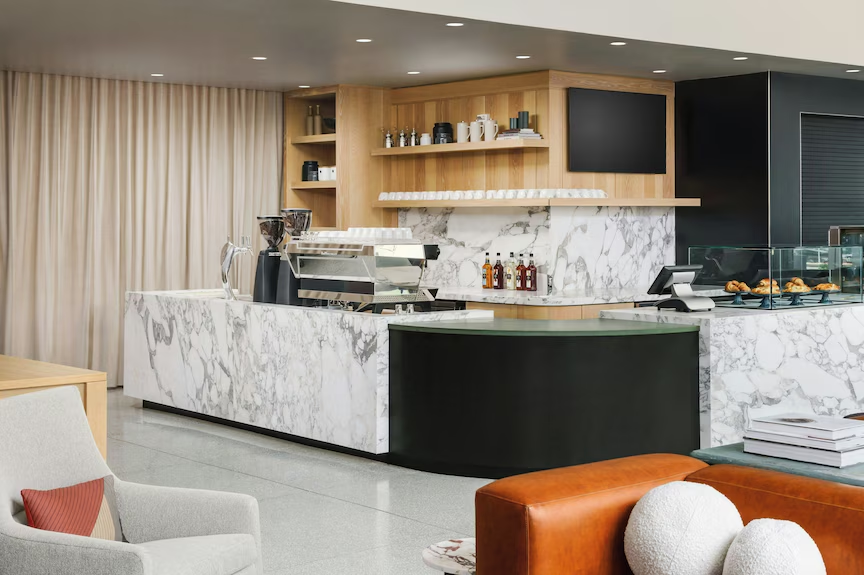
Lemurian Blue granite typically runs $120 to $250 per square foot installed, which puts it well above a standard granite, but below Blue Bahia. The slab is the bulk of the cost; fabrication is priced like any other 3cm granite because the stone cuts normally and yields normally.
What moves the number:
For comparison, premium granites in our granite collection usually land between $50 and $130 per square foot installed, and Blue Bahia typically runs $150 to $300.
All figures are general ranges. The real number depends on the slab grade, the square footage, the number of seams and cutouts, the edge profile, and it is all set at the free in-home estimate after we have measured.
People who want blue usually end up choosing between these two, and they are very much opposites. Blue Bahia is blue in the photo and is demanding to care for in a kitchen. Lemurian Blue is dark in photos and is easy to care for in a kitchen.
| Lemurian Blue | Blue Bahia | |
|---|---|---|
| Where the blue comes from | Light reflecting inside feldspar crystals | Sodalite, a blue mineral |
| Reads blue in a photo | No, reads charcoal | Yes |
| Reads blue in the room | Yes, in flashes, depends on light | Yes, always |
| Pattern | Mottled texture, no vein | Flowing diagonal bands |
| Full-kitchen use | Yes | Island or bar is safer |
| Acid and scratches | Granite-like | Marble-like |
| Bookmatch potential | Not needed | Strong |
| Installed cost | $120 to $250 per sq ft | $150 to $300 per sq ft |
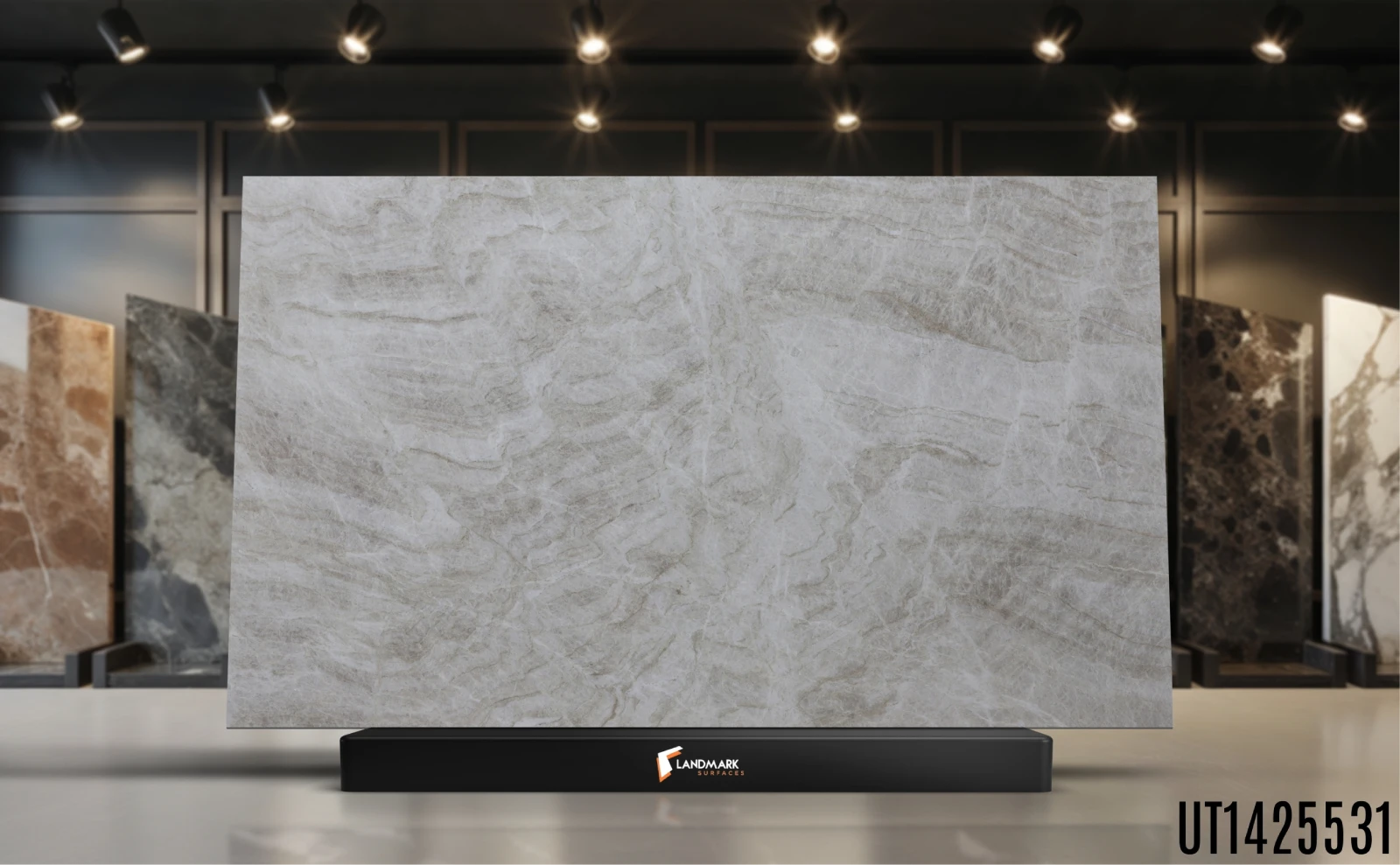
Other blues on our floor: Blue Dream, Ijen Blue, Sky Blue, Mustang Blue, and Blue Noir quartzites give a lighter, veined blue-gray with quartzite hardness; Blue de Savoie marble exudes a soft gray-blue perfect for bathrooms and fireplaces. The Blue Bahia page compares them in detail, and our blue quartz countertops guide covers the engineered options. For where Lemurian Blue sits among the most popular colors people actually install, see the most popular granite colors.


No. Lemurian Blue is a labradorite rock from Madagascar, made of feldspar crystals rather than the quartz and feldspar mix of true granite. It is sold as granite because it cuts, polishes, and holds up like one, with a Mohs hardness of 6 to 6.5.
The blue is labradorescence, a reflection from inside the feldspar crystals that only appears when light hits the surface at the right angle. Flat, front-lit photos don’t show its true nature. In a room with side light the slab flashes blue as you move around it.
Yes. It resists scratches and heat like a conventional granite, has no acid-sensitive minerals, and can be used on the full kitchen including prep areas. Seal it at installation and re-seal every one to three years.
Yes, even though it is dense and does not stain easily. Seal at installation and re-seal when water no longer beads on the surface, typically every one to three years.
We do not recommend it. The quarry describes the stone as best-suited to interior applications, since sun and the weather dull the polish that the blue flash depends on.
Usually, yes, in 3cm polished slabs, but natural stone inventory changes weekly. Check the live inventory page or contact us before visiting, and we will tell you what is on the floor that day.
Lemurian Blue is the stone we most often hear “I almost scrolled past it” about. Photos do it no favors; the slab has to speak for itself. It is currently in our Chantilly warehouse. See it in natural light, bring a cabinet sample, and take a few minutes to view the full slab before making your decision.
Pricing and lead times on this page are general ranges for planning purposes. Actual cost depends on the slab grade selected, measured square footage, seams, cutouts, and edge profile, and is confirmed at your free in-home estimate. Slab availability changes weekly. Natural stone varies from block to block, and future lots of Lemurian Blue may differ in color and flash from those shown. Warranty terms vary by product, typically 6 to 10 years.
