


Years of Experience
0 +
Spotless Countertop Installation in Less Than a Week By 24+ years of experience and cutting-edge technology of Stone Fabrication & Installation there is no uncertanity


25391 Pleasant Valley Rd.
Chantilly, VA 20152
Phone: (703) 259-9027
5655 General Washington Dr
Suite G
Alexandria, VA 22312
Phone: (703) 259-9028
Belvedere granite is an elegant black stone highlighted by white quartz streaks and small gold pockets. It is one of only a few exotics we keep on the floor in two finishes: 3cm polished and 3cm leathered. Same block, two different countertops. Polished, the white veins flash and the black reflects like a mirror. Leathered, the veins soften to pewter and the surface minimizes the visibility of fingerprints. Selecting which finish you want on this stone comes down to which one you want to share your space with long-term.
You will also see this stone sold as Belvedere quartzite, and the similarity in naming is worth noting because it changes how you care for it. This page covers the finish choice, what the rock actually is, how the directional veins affect layout, how it performs in a working kitchen, and what it tends to cost. For today’s slab count, go to live inventory.
We stock both because clients’ preference split almost evenly, and because the two finishes make the same slab look like two different stones. Decide this before anything else since it affects the edge profile, the seam plan, and how much time you spend cleaning it with a microfiber cloth.
Polished. The black base reads as a deep, inky tone, while the white quartz streaks are bright and sharp, with a smattering of gold sparkling pockets throughout. Under pendant lights or a window the whole top of the slab comes alive with subtle movement. Like other polished slabs, there are typical trade-offs for any dark polished stone. Handprints, water spots and dust show quite easily. A pan slid across the surface can leave a faint scuff you only notice in raking light. Choose polished for an island people look at more than they cook on, for a bar, or for a fireplace surround.
Leathered. The finish is brushed into the surface after polishing, which leaves a low sheen and a fine texture you can feel. On Belvedere granite the effect of leathering is strong: the black comes out as charcoal, while the white veins are muted to a pewter gray, but the delicate gold stays the same. Fingerprints and water spots are mostly concealed by the leathering effect. The texture also hides small scuffs that a polished black surface showcases. The leathered effect is for a working kitchen, perimeter runs around a sink and range, and basically anyone who already knows they do not want to wipe down a black counter twice a day.
Two things people get wrong.
If you are undecided, stand both slabs next to each other on our floor in Chantilly; they are usually racked close together. Our finishes guide covers the general case for honed, leathered, and polished stone.
 Excellent
4.9283 reviews
4.9Excellent283 reviewsPosted on Google
 onur gökçe8 November 2026So many choices for cop terrors and solid pricing and service. Highly recommended.Posted on Google
 Jim Greene1 October 2026Staff is amazing…especially Nesli. Installers did an excellent job. I would definitely use them again.Posted on Google
 Michelle Carey22 September 2026Working with Frank was fantastic! He is extremely knowledgeable about the various types of materials, carefully and thoroughly walked us through the process, was very patient in showing us different options throughout the store, and quickly and efficiently set us up with an appointment for the installers to come out and measure. We felt such relief after talking to Frank and making our selections. We know that Frank and his team will take excellent care of us!Posted on Google
 Danielle Liu14 September 2026Friendly, professional and very responsive. Highly recommend!Posted on Google
 Peg Nielsen10 September 2026This surfaces place is the best! Nesli guided me in choosing a beautiful quartzite for my kitchen. We only paid by the square foot. The measuring, fabricating, and installation was very timely and efficient. Such a great experience! Will definitely recommend and use Landmark again!


 Posted on Google
 Shannon Ross31 August 2026Frank has been very helpful working with us in the countertop selection process!Posted on Google
 Nate Myers24 August 2026Frank was very helpful! Good customer servicePosted on Google
 Brennan Roy15 August 2026Patient, knowledgeable, and helpful, Tina and crew made for an excellent first-time customer experience. My quartz nightstand topper was fabricated quickly and with precision. It looks great and is exactly what I specified. Recommended!

 Posted on Google
 Rebecca Perry10 July 2026Wonderful service, Frank was super helpfulPosted on Google
 R Chandra23 June 2026We are so happy with United Granite. From stone selection to install, the entire team was incredibly professional and helpful. Especially Nesli - she is a true gem. We had some stressful general contractor issues, and she really went beyond to help us keep our project on track. We can't thank her enough!! 100% recommend.Posted on Google
 John22 June 2026Been working with Frank here for a few weeks on a laundry room renovation. He’s been very helpful with providing multiple estimates. I know I’m a needy customer, but he’s been very pleasant to work with. Highly recommend him
 Posted on Google
 Ellen Soroka18 June 2026We looked for over 2 years (Yes, you read 2 years.) to find a counter to match our shower wall and floor tile. Nesli, at United Granite, found exactly what we were seeking. She is a consummate professional and we are thrilled that Ayla, from Happy Homes Remodeling (highly recommend) sent us there. Look no further to find exactly what you want both in remodelers (Happy Homes in Springfield and United Granite for counters and slabs.Posted on Google
 Lesley Grosso6 June 2026Frank was very helpful and the process was quick and efficient with a large selectionPosted on Google
 A M6 June 2026Frank was awesome in keeping me in my price range and problem solving!Posted on Google
 Thao Dang30 May 2026I like nice store , I Buy many time Stone Decorate my house !Posted on Google
 Beth23 May 2026Just shopping for now, but Frank was very helpful.Posted on Google
 L Odria22 May 2026Frank provided exceptional services; from selection of stone, design and updating me on the availability of my purchase for pick up. I will definitely come back for stone and marble purchases.Posted on Google
 SIDD. Jyothi9 April 2026We got the Countertop installed in remodeled kitchen and mudroom project from the Landmark Surfaces. They did an outstanding job for a very satisfying outcome, from the time we went through planning/pricing discussion (with Nesli) to their workforce performing the measurements, fabrication and installation. Well done!Posted on Google
 Jamie Holzer7 February 2026Nesli was wonderful to work with. Very helpful, knowledgeable and polite. Tons of different material and slabs to choose from and I would definitely recommend!Posted on Google
 Nan Miller4 February 2026I highly recommend Landmark Surfaces. Friendly and efficient sales and scheduling. Skilled, knowledgable technicians for measurement and installation. Very professional from start to finish. Great pricing, too. Most importantly, our countertops look great! We are very, very happy with their workmanship.Posted on Google
 Lauren Nadler2 January 2026Knowledgeable, courteous service made making kitchen update choices easy. Fast turn around at fabrication provided incredibly fast completion. The demolition and replacement of counters was completed in 4 hours!!!! My kitchen looks updated and great. I’m really enjoying the larger counter space now. The team in the office and in my home were wonderful. Completely satisfied!

 Posted on Google
 Shelli Mayer23 December 2025We have used Landmark Surfaces United Granite on three separate occasions for quartz installations, most recently for our kitchen and previously for two bathrooms. In my prior review, I noted that I would use them again, and they have once more exceeded expectations. Landmark Surfaces United Granite is an exceptional company in every respect. Their customer service is consistently accessible by phone or email and always responsive. My primary contact has been Nesli, who is highly knowledgeable, professional, responsive, and a pleasure to work with. When she is unavailable, another customer service representative is able to step in seamlessly, immediately accessing my information and understanding my order without delay. Their pricing is consistently more competitive than other companies. For each of our three projects, I obtained estimates from two additional vendors, and Landmark Surfaces United Granite was always the most reasonably priced while delivering superior quality. Their workmanship is excellent, with careful attention to proper installation, clean lines, and precise pattern alignment. Turnaround times for templating and installation are also impressively quick. The combination of attentive service, fair pricing, timely execution, high-quality craftsmanship, and expertise is exceptional. I highly recommend Landmark Surfaces United Granite.

 Posted on Google
 Marsha4 December 2025I had a great experience with Landmark Surfaces. They pay attention to detail and they are customer oriented. They did a fabulous job on my countertops! They delivered on-time and were very professional. I would definitely recommend them to my family and friends and my job satisfaction was a 10 out of 10!Posted on Google
 Carol Bruno11 November 2025Tina was very professional, helping me to narrow down my choice of Dekton countertop, then giving me the address to visit the slabs in person to make a final decision of design. The tech who did final measurements at my home was efficient, and the crew who did the final installation was respectful of the space. I am already getting rave reviews of the completed kitchen!
 Posted on Google
 S kim5 November 2025Tina was an absolute dream. I walked into the showroom, with a tight schedule and even tighter budget, and yet she treated me like a client with a limitless fund. She took the time to show me all of the various options fitting my design/pricing criteria and followed up with a detailed explanation of what to expect and how to prepare for the installation. And no issues were insurmountable for her. When I had to leave town unexpectedly (sick mother) which threatened to derail our schedule for installation, she took care of all the details necessary to complete the project. At all times, she kept me updated. With all the things that can and do go wrong in a kitchen makeover, my experience with Tina was a welcome exception. Indeed, i look forward to working with Tina in my next kitchen project.Posted on Google
 Jeremiah Walsh1 October 2025Landmark Surfaces is a first-rate professional business built on integrity, timely customer service, superior quality craftsmanship and installation, and product knowledge. I am a returning customer with three previous purchases. I worked with Nesli Kohen who is a superb account executive who optimizes integrity and customer service. It was a true pleasure to work with this professional for the fourth time! I enthusiastically recommend Landmark Surfaces for your next project!Posted on Google
 Albina Galieva30 September 2025The store has a very good selection of quartz. I found exactly what I was looking for. The team was very attentive and provided excellent services for a great price. Highly recommend them.Posted on Google
 Holly16 June 2025We have gotten multiple projects done here at Landmark services and have always been very happy with the fantastic customer service. Most notably I want to give a huge shout out of thanks and appreciation to Samantha Estacion for her help with our Hall bathroom upgrade. Samantha helped us with an 8 ft long super white marble shelf under our window, vanity top, threshold and toilet paper holder base. Everything was done to perfection! we love the results. Samantha was very kind and caring. She knows a lot about the different products and has great attention to detail, helping us finalize the designs. Thanks so much for your help Samantha!


 Posted on Google
 cindy luu6 May 2025My experience at Landmark was exceptional, from research to customer service and installation. Tina made the process very smooth; she was responsive to all my questions and provided follow-up. The installation went very smoothly, thanks to the team's promptness, meticulousness, and courteousness. I would go back to them for future projects.Posted on Google
 Lemony Lavender26 April 2025My husband and I went in to see about replacing our kitchen counters, and Robiya was such a huge help. She was very thorough, knowledgeable, and patient with us as she helped us find the perfect stone for our kitchen. When it came time to begin the process of removal of the old, measurements, and scheduling installation…the whole process was seamless and easy. The communication and follow up between Robiya and the service team was efficient and professional. If I had any questions or concerns, they were quick to respond with answers and advice. The overall turn around of the project from start to finish was very quick. We had a great experience working with Landmark surfaces and will definitely be returning for future projects.Posted on Google
 Joyce Schaefer23 April 2025Granite was beautiful. Tina was great to work with and the installation team did a great jobPosted on Google
 Lois Berlin21 April 2025Our experience at United Granite was excellent. From sales to measurement and drawings and installation, everyone was extremely professional and the installation was perfect. We are so pleased with how beautiful and how well fitted our counters are. I highly recommend them.Posted on Google
 Janice Mattheson15 April 2025Tina helped me with my selection, which was very easy. Girardo came out (twice) and took the measurements (my husband and I thought the process of installing cabinets was easy…It was not) he was very professional . Today the installers quickly installed the countertops and they’re beautiful…I love it❤️ Thank you!

 Posted on Google
 Jenna O’Brien15 April 2025Pleasant and Professional! I'm a decorator and I work with a LOT of contractors. I highly recommend Tina and the team at Landmark.They are easy to work with, very responsive, and come to the table with a wealth of knowledge. The process from quote to install was seamless.Posted on Google
 Mickey Mouse23 March 2025Tina was super helpful and a pleasure to work with! I needed options for my bathroom vanity. Even though it was a small project working with their remant section I found the perfect piece to complete my bathroom renovation. The installation crew did impecable work with solid eye on attention to detail. Definitely plan and using Tina and her crew for my last bathroom renovation.


 +2
This is a stone for people who want drama without a maintenance contract. It goes almost anywhere a dark granite goes, and the finish choice decides the rest. The places it does not belong are further down the page, after the cost section.
Hard, acid-proof, and dark enough to forgive a busy household. Leathered on the perimeter and polished on the island is the most popular combination we install, since the island gets most of the light and the perimeter gets the majority of the work.
Resistant to etching from toiletries, and a leathered vanity top does not show water spots. Shower walls in bookmatched polished slabs are the single most popular thing we do with this stone.
Vertical and side-lit, the diagonal streaks read as a single sweep across the wall. A pair of mirrored slabs can be used to make a chevron pattern. This is where the polished finish earns its keep.
Gneiss handles weather, and the stone’s material library rates it as suitable for outdoors. We specify leathered outside because a polished dark surface loses its glossy shine in the sun, and a leathered one has no gloss to lose.
Whether you’re seeking a free estimate, a showroom visit, or an in-home evaluation, our team is ready to transform your space.
Distributors cannot agree on this stone. Arizona Tile and GenRose sell it as granite; Marble Systems, Aria, and most European importers sell it as quartzite. You will also see it named Cosmic Black, Black Cosmic, Fortemoro, or Tropical Storm, which the Belgian importer BMB lists as trade aliases for the same material. None of the three labels are quite correct, and the right classification tells you how to maintain it as a countertop.
Petrographically, Belvedere is a gneiss: a banded metamorphic rock. The German stone library at Draenert classifies it as a paragneiss. That is a gneiss that started life as sandy, clay-rich sediment on an ancient sea floor roughly 570 million years ago. It was buried, heated, and squeezed during the building of mountains, then recrystallized into the dramatic rock you see on the slab. Their mineral breakdown matches what you can see with your eyes. The black ground is fine-grained quartz, feldspar, and black biotite mica. The bright lenses are coarse, glassy quartz with white feldspar. The yellow to tan pockets are limonite, an iron oxide. The streaks are not veins that fill cracks, as in marble. They are bands of minerals that separated under pressure, which is why they run one direction across a whole slab.
The Geology.com gneiss reference explains the naming problem in one line: in the countertop trade, any rock with visible interlocking feldspar grains gets called granite. Gneiss qualifies, and it usually does not split along its banding the way slate or schist does, which is why it has a long history as a countertop and paving stone. The “quartzite” label comes from the quartz-rich streaks, as well as its hardness. It is not wrong in essence, since the stone performs like a hard quartzite, but a true quartzite is a totally different rock.
What the label means at your counter: there is no calcite in Belvedere granite, so lemon juice and vinegar do not etch it. The quartz streaks sit at Mohs 7 and the feldspar ground at about 6, so ordinary knife contact does not scratch it. Treat it like a typical dark granite for best results.
One note on origin. European importers list the quarry in Angola; Draenert lists Brazil. Blocks under this name have come from both, and the slabs on our floor come from one lot. If the country matters to your project, ask and we will check the lot paperwork.
Belvedere granite has a grain the way wood does. On every slab in our current lot the white streaks run in one direction, roughly diagonal, with gold flecks that stretch along the same line. That is the metamorphic banding described above, and it gives you three things to decide at the template stage that a mottled stone like Black Pearl doesn’t require.
Which way the grain runs in the room. A grain that runs across an island leads the eye from the sink to the seating; along it, it stretches the island visually. Picture the slab in your head and tell us which orientation suits you best, because once the first piece is cut the rest have to follow suit.
Whether the pieces agree. An L-shaped kitchen cut from one slab will have the grain running one way on the long leg and across on the short leg. That is standard unless the short leg is cut from a second slab turned to match. That second slab is sometimes the difference between a $90 and a $130 per square foot job, and it is the first thing we discuss when a layout has corners.
Bookmatch or not. Consecutive slabs from one block mirror each other, and on Belvedere granite the effect is dramatic: the diagonal streaks meet at the seam like an open book. It suits a long island with a center seam, a waterfall edge, or a fireplace wall surround. It also doubles the slab count. Our vein-matching guide shows how we plan it on the digital template before the cutting begins.
The Belvedere granite slabs in Chantilly are 3cm, from one block, in two finishes: polished is approximately 124 by 78 inches and leathered is about 117 by 74 inches. The majority of the slab is black, streaks are white to a silver color and run corner to corner, and gold pockets are small and scattered rather than concentrated in one band. Several of each finish are on the floor as of this writing; check live inventory for today’s count.
Because the lot is consistent, a job that needs three or four slabs can be cut without the color differing between pieces. What does change from slab to slab is where the brightest streaks sit, and that is what we map before cutting. The photos on this page are the current lot under flat warehouse light; the polished slabs in particular show far more depth in person. Natural stone changes block to block, and a future lot may carry more gold, less white, or a different grain angle than these.
Belvedere granite cuts and polishes like a hard granite, with three unique characteristics of its own.
Edges on a two-hardness stone. The quartz streaks are harder than the feldspar around them. When we polish an edge, the feldspar polishes faster than the streak of quartz, and a hurried edge ends up with a faint ridge where each white band crosses it. We run the edge through an extra pass with a finer grit to level it. The flatter the profile, the less this matters: eased, small bevel, and mitered edges look cleanest; a heavy ogee exposes a lot of streak at steep angles.
Edges on leathered slabs. A cut edge is bare stone, not leathered. We either polish the edge for a deliberate contrast or re-texture it by hand with brushes to match the top. Matching takes longer and is better looking on a waterfall; polished edges on a leathered top suit a perimeter where the edge is mostly hidden by the counter overhang. Tell us which you prefer at the template appointment.
Seams follow the grain. A seam that runs with the streaks disappears; one that cuts across them shows as a break in the pattern. We put seams along the grain wherever the layout allows. When it does not, we cut two pieces from adjacent areas of the slab so the bands line up across the joint. On a bookmatched island the seam is the centerline by design.
Gold pockets. The limonite flecks are small and sit flush in the current lot. On some blocks they can be slightly softer than the surrounding stone. We check each slab under light before cutting and avoid placing a large pocket at an edge or a cutout corner.
Cutouts and rodding. Standard dark-granite practice. Narrow strips at the sink are rodded as a precaution, the same as on any 3cm natural stone. The stone is not fragile and yields normally.
Weight and lead time. A 124 by 78 inch slab at 3cm weighs roughly 1,100 to 1,200 pounds. Fabrication and installation typically run 5 to 7 business days from template.


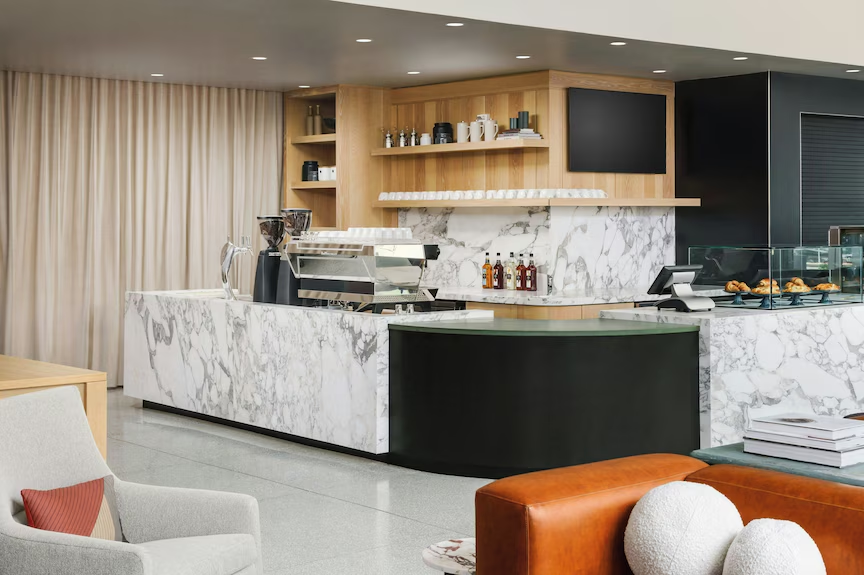
Belvedere granite typically runs $90 to $160 per square foot installed, which puts it at the top of the mainstream granite range, but well below the blue exotics. Polished and leathered slabs from the same lot are priced the same at the slab; the finish does not change the material cost, only the edge work.
What moves the number:
For comparison, premium granites in our granite collection usually land between $50 and $130 per square foot installed. Lemurian Blue typically runs $120 to $250 and Blue Bahia $150 to $300. Belvedere granite is the best way to get an exotic-looking black counter at something close to a standard granite price.
All figures are general ranges. The real number depends on the finish, the square footage, the number of seams and cutouts, the edge profile, and whether the layout needs a second slab for grain or bookmatch. All this is set at the free in-home estimate after we have measured.
In use, Belvedere granite is one of the easier exotics we sell. It has no calcite to etch, no soft veins to chip, and a hardness that matches the dark granites most people already trust. Here it is against two other dark stones from our floor.
| Property | Belvedere | Black Pearl | Lemurian Blue |
|---|---|---|---|
| Rock | Gneiss (sold as granite or quartzite) | Granite | Labradorite (sold as granite) |
| Look | Black with white streaks and gold pockets | Black with silver fleck | Charcoal with blue flash |
| Hardness of main minerals (Mohs) | Quartz 7, feldspar 6 | Feldspar 6 | Feldspar 6 to 6.5 |
| Acid sensitivity | None in practice | None in practice | Low |
| Finishes we stock | Polished and leathered | Polished | Polished |
| Pattern | Directional, bookmatches | Uniform, no layout decisions | Mottled, no layout decisions |
| Sealing | At install, then every 1 to 3 years | Same | Same |
| Shows fingerprints | Polished yes, leathered barely | Yes | Yes |
Scratches. The white streaks are quartz, the hardest common mineral on a countertop. A knife will not mark them. The black background is a little softer and a little more forgiving to polish, which is why edges on this stone take an extra pass when cutting; see the fabrication notes above.
Stains and sealing. The stone is dense. We seal every Belvedere granite at installation because the leathered finish opens the surface slightly, and because the water-bead test is the simplest way for you to know when to re-seal. Expect one to three years between coats depending on the finish and how hard the kitchen is being used.
Heat. Hot pans do not harm it, and gneiss is used as paving stone in climates far harsher than a kitchen. We still recommend a trivet under cast iron on any polished dark stone, because the problem is not the heat; it is the potential of scraping the surface after it’s placed down.
Cleaning. Warm water and a drop of dish soap, or a pH-neutral stone cleaner. Skip the vinegar not because it etches this stone but because it strips the sealer quicker. Polished Belvedere needs a microfiber cloth for upkeep; leathered does not need a special cloth and is more low maintenance.
Where we would slow you down
For where Belvedere granite sits among the colors people actually install, see the most popular granite colors.


Neither, strictly. Belvedere is a gneiss, a banded metamorphic rock made of quartz, feldspar, and biotite mica. The trade sells it as granite and as quartzite, and it performs like a hard granite: no acid etching, no soft veins, and a hardness that resists everyday knife contact.
Polished shows the white streaks and gold pockets at full contrast and suits islands, bars, and fireplaces. Leathered mutes the veins to pewter, hides fingerprints and water spots, and suits working kitchens and perimeter runs. We stock both in 3cm.
Yes. It resists scratches, heat, and acidic spills, and it can be used in the entire kitchen including prep areas. Seal it at installation and re-seal every one to three years.
Yes. The stone is dense, but a penetrating sealer protects against oil and makes maintenance predictable and easy, especially on the leathered finish. Re-seal when water no longer beads on the surface.
Yes. Gneiss handles weather, and the stone is rated for exterior use by its material library. We recommend the leathered finish outdoors, since a polished dark surface loses its gloss to the sun and grit over time.
Usually, yes, in 3cm polished and 3cm leathered slabs, but natural stone inventory changes weekly. Check the live inventory page or contact us before visiting, and we will tell you what is on the floor that day.
Belvedere granite is the slab that stops people in their tracks since it is commanding and captivating. The two finishes are usually racked a few feet apart in our Chantilly warehouse, and standing between them settles any questions faster than any photo will. Bring a cabinet door, decide which way you want the grain to run, and we will plan the rest on our template.
Pricing and lead times on this page are general ranges for planning purposes. Actual cost depends on the finish and slab selected, measured square footage, seams, cutouts, edge profile, and layout, and is confirmed at your free in-home estimate. Slab availability changes weekly. Natural stone varies from block to block, and future lots of Belvedere granite may differ in color, grain direction, and the amount of white and gold from those shown. Warranty terms vary by product, typically 6 to 10 years.
