



Semi-Precious Stone Countertops: From Slab to Backlit Bar

Semi-precious stone countertops start as hundreds of hand-cut gemstone pieces, so the key choices happen long before installation day. This guide follows a typical project from the slab rack to the first night the lights come on. Along the way, it explains what these slabs are made of, where they hold up, where they struggle, and what pushes the price up or down.
The Brief: A Backlit Bar Top for a Lower-Level Lounge
Most gemstone requests that reach us are not for a whole kitchen. Instead, they arrive as a single feature: a basement bar, a powder room vanity, or a lobby reception desk.
So picture a common version of that brief. A homeowner wants an 8-foot bar top in blue agate, lit from below, with a thick mitered front edge. The bar will see drinks and conversation, not chopping boards or hot pans, and that detail matters more than the color.
Matching the stone to the use comes first, because the resin that holds a gemstone slab together sets the limits on heat and scratching. A bar, a vanity, or a wall panel suits the material well. In contrast, a main prep counter beside the range asks it to do work it handles poorly.
Choosing Semi-Precious Stone Countertops at the Slab Rack
A semi-precious slab is a composite of real minerals and a man-made binder. Manufacturers slice agate, quartz crystal, amethyst, and similar stones into thin pieces. Workers then lay the pieces by hand on a flat bed and fill the gaps with clear or tinted resin. Once the resin cures, they grind and polish the face, and many add a fiberglass mesh or backing layer for strength.
That construction explains the question we hear most often at the gemstone racks: is this real stone or plastic? The honest answer is both. The crystals are genuine minerals, most rating between about 6 and 7 on the Mohs scale, while the resin between them is far softer and more sensitive to heat.
Our Gem Stone Collection shares the yard with more than 2,000 slabs, and new shipments arrive weekly. Many granite and quartz yards carry few gemstone slabs or none. As a result, clients often see the material in person for the first time on our racks.
Translucent Stones: Agate, Quartz Crystal, and Amethyst
Agate is the stone most people picture. Its concentric bands occur naturally in grays, whites, and browns. However, producers often dye agate blue, green, or pink, so ask whether the color is natural. Thin agate slices pass light well, which is why agate leads most backlit projects.
Clear quartz crystal glows evenly and looks almost icy under light. Amethyst carries deep purple clusters, but its denser pieces pass less light, so the glow tends to look patchy instead of even.
Opaque Stones: Petrified Wood, Tiger Eye, Labradorite, and Jasper
Petrified wood shows growth rings and bark lines turned to stone, usually in warm browns and rust tones. Tiger eye shimmers in gold bands as you walk past it, and labradorite flashes blue and green depending on the angle. Jasper, meanwhile, brings earthy reds and creams.
These four look their richest under ordinary room lighting. Because they block most light, a light box behind them adds cost without adding much glow.
Ask to see the whole slab, not a sample chip. Gemstone slabs often measure close to 4 by 8 feet. Across that span, the pattern can shift a lot from one end to the other. Our live inventory shows what sits on the racks this week, although nothing replaces holding a flashlight against the back of the actual slab you plan to buy.
Templating and Layout: Where the Seams Can Hide
After the client approves a slab, our templater measures the bar. The template records the cabinet line, the wall, and any posts or overhang supports. For a backlit top, it also marks where the light box and a service panel will go.
Layout is where a gemstone top succeeds or fails. On a marble or quartzite job, we follow a vein so it carries across a seam, and our guide to vein matching countertops covers that process. A gemstone slab has no vein to follow, so the goal changes: we look for the resin channels between stones and place any seam inside one of them.
A seam that cuts straight through a crystal looks like a crack. By comparison, a seam that follows a resin line nearly disappears, since the eye already expects a line there. An 8-foot bar cut from one slab may need no seam at all. An L-shaped bar or a long island, however, usually needs one, and sometimes a second slab.
Two slabs from the same production batch tend to match in tone, yet they never match stone for stone. For that reason, we lay digital images of both slabs side by side before cutting, so the client can approve where the pattern changes.
Cutting a Slab That Is Part Crystal, Part Resin
Gemstone slabs cut differently from granite. The crystals are hard and brittle, while the resin around them is soft. A blade moving at granite speed can chip a crystal edge or smear the resin with friction heat. Our fabricators slow the feed rate and keep plenty of water on the blade.
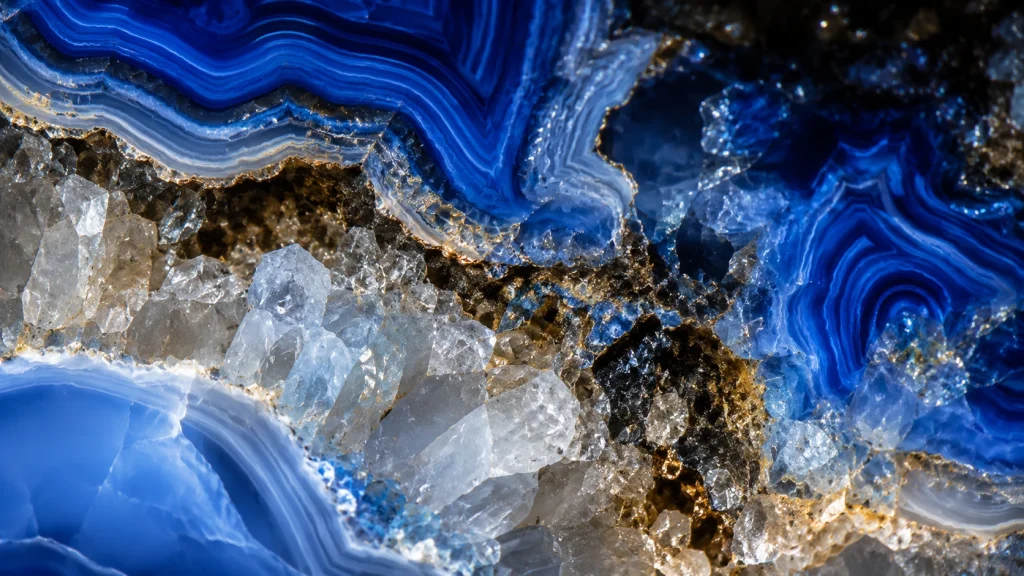
Water serves a second purpose as well. Agate, quartz crystal, and amethyst are all forms of silica, and dry cutting them releases respirable crystalline silica dust. OSHA’s silica standard sets exposure limits for that dust, which is one reason this work belongs in a shop with wet cutting and proper ventilation, not in a garage.
Edge choices also shift with this material. A mitered edge folds a second strip down to form a thick front. It works well here because the pattern shows on the face and the edge alike. Ornate profiles such as an ogee tend to chip crystals and expose resin, so most clients settle on a square, eased, or mitered edge. Our post on countertop edge profiles compares those options in more depth.
Cutouts need care, too. An undermount bar sink is possible in many cases, but the corners of the opening concentrate stress, so we round them and add support underneath. Overhangs typically need more bracing than in quartz, because gemstone slabs are often thinner and less uniform.
Building the Light Box
Backlighting is what most people want from a translucent gemstone, and it takes more planning than the stone itself. The setup usually includes LED panels or strips on a reflective backer, a diffuser layer, and an air gap between the lights and the stone.

That gap matters. If the LEDs sit too close, each diode shows as a hot spot and the bar looks dotted. Most installers aim for a few inches of depth and test the light with the slab in place.
Heat matters as well. Modern LEDs stay fairly cool, yet a closed box with a driver inside can still warm the resin over years of use. For that reason, a good design leaves room for airflow and places the driver where an electrician can reach it. A removable panel under the bar keeps future service simple.
Color temperature changes the look of the stone. Warm white light flatters petrified wood and amber agate, whereas a cooler white keeps clear quartz looking crisp. If you are weighing a lit surface, our onyx countertops guide shows how a translucent natural stone handles the same setup.
Living With a Gemstone Surface
The real trade-off with semi-precious stone countertops is the resin. The crystals resist scratches and most household acids, but the binder between them can scratch, dull, or discolor if you treat the top like a work counter.
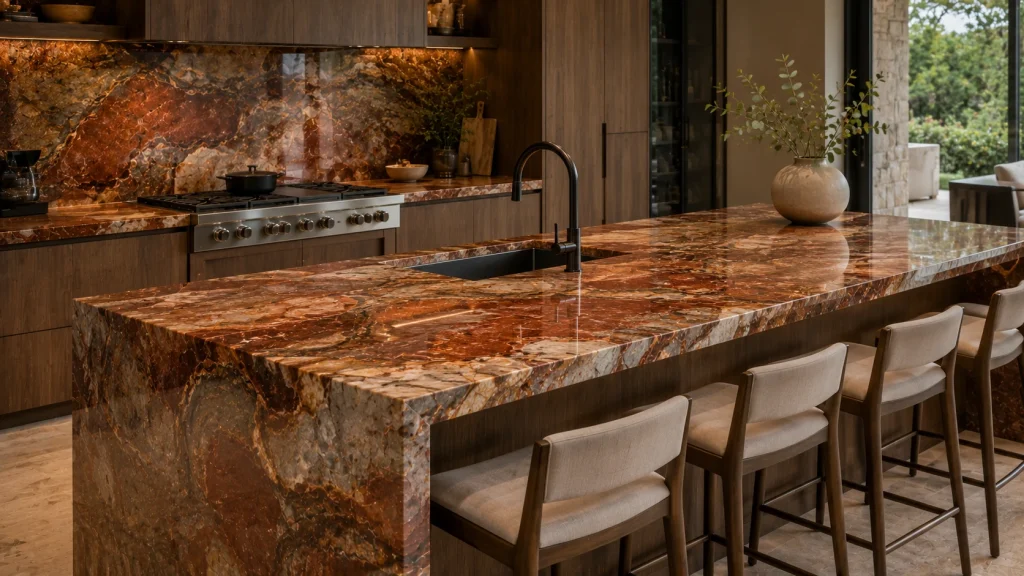
Heat is the biggest risk. Resin can soften or scorch under a hot pan, so trivets are essential, and the material does not belong beside a range. Strong solvents such as nail polish remover and oven cleaner can haze the resin. In addition, long exposure to direct sun may yellow some resins, which is why these slabs stay indoors.
Daily care is simple. A soft cloth with warm water and a pH-neutral stone cleaner handles most spills. Since the slab is largely nonporous, it usually does not need routine sealing, although the manufacturer’s care sheet has the final word. Our stone countertop care guide lists cleaners to avoid across every stone type.
If a crystal chips at an edge, a fabricator can often fill it with tinted resin. A deep scorch mark in the resin, on the other hand, is much harder to hide, so prevention beats repair.
Where the Money Goes
Gemstone tops cost far more than quartz or granite. For context, installed quartz and granite usually ranges from $50 to $130 per square foot. A gemstone surface commonly lands somewhere between about $250 and $1,000 per square foot installed, and slabs with large, clear crystals can go higher.
Several factors decide where a project falls in that range:
- The gemstone. Agate and jasper sit toward the lower end, while amethyst, tiger eye, and large-crystal quartz sit higher.
- Slab count. A bar that fits within one slab costs far less than an island that needs two.
- Edge and thickness. A mitered front adds material and shop hours.
- Backlighting. The light box, diffuser, driver, and electrical work form a separate line item.
- Cutouts and supports. Sinks, faucet holes, and extra bracing all add fabrication time.
Most of the cost sits in the slab itself, so a smaller footprint is the usual lever. Many clients put gemstone on a bar or a bathroom vanity top, then use quartz or quartzite elsewhere. Our breakdown of countertop installation cost explains how the other parts of an estimate add up. For the surrounding surfaces, our overview of types of natural stone countertops covers other rare options.
The table below sums up how the common gemstones compare once they leave the rack.
| Gemstone | Light transmission | Look | Typical use |
|---|---|---|---|
| Agate | High in thin slices | Concentric bands, natural or dyed | Bar tops, backlit walls |
| Quartz crystal | High and even | Clear to milky, icy | Backlit bars, vanities |
| Amethyst | Moderate, patchy | Deep purple clusters | Vanities, accent panels |
| Petrified wood | Low | Wood grain in browns and rust | Island accents, tables |
| Tiger eye | Low | Gold bands that shift with angle | Small bars, furniture |
| Labradorite | Low | Blue and green flashes | Vanities, wall panels |
Before You Commit: Common Questions
Are semi-precious stone countertops real stone?
Yes. The gemstone pieces are real minerals such as agate, quartz crystal, and amethyst. The manufacturer bonds them with resin, so each slab is a composite of natural stone and a man-made binder.
Can you put a hot pan on a gemstone countertop?
No. The crystals tolerate heat, but the resin between them can soften or scorch. Always use a trivet, and keep gemstone tops away from the range.
Do semi-precious stone countertops need sealing?
No, in most cases. The resin-filled slab is largely nonporous, so routine sealing is not typical. Follow the manufacturer’s care sheet, since some slabs ship with a factory topcoat that has its own guidance.
Which gemstones glow when backlit?
Agate and clear quartz crystal transmit light most evenly. Amethyst glows in patches, while petrified wood, tiger eye, labradorite, and jasper block most light and look richer under normal room lighting.
How much do semi-precious stone countertops cost?
Installed cost commonly falls between about $250 and $1,000 per square foot, depending on the gemstone, the number of slabs, the edge, and whether the piece is backlit. Rare large-crystal slabs can cost more.
A photo of an agate slab tells you about color, but it cannot show how the stone behaves with light behind it. At our Chantilly and Alexandria showrooms, you can press a light against the back of the exact gemstone slab you want. For a wider look at how fabricators judge stone quality, the Natural Stone Institute publishes useful consumer resources.
When a space is ready, we can come to you at no charge and measure the bar or vanity. On that visit, we talk through where a seam and a light box would go before any number goes on paper. Our templaters and install crews cover homes and businesses throughout Virginia, Maryland, and the District of Columbia.
Prices and timelines in this article are general guidance, not a quote. Your real cost depends on the gemstone, the size of the piece, the edge detail, and the lighting. A free in-home estimate turns those choices into a firm figure. Standard tops usually install within about five to seven days of templating, though lit pieces can take longer because of the electrical work. Product warranties range from six to ten years depending on the slab.
Editorial Note: Some illustrative images in this article were created using AI to help visualize design concepts, countertop materials, and interior applications. Product availability, natural stone patterns, and slab characteristics may vary. We recommend viewing actual slabs in person before making a final selection.
